NCERT Solutions for Class 3 Maths Chapter 2: Toy Joy by PW
 Mishika Gupta25 Sept, 2026

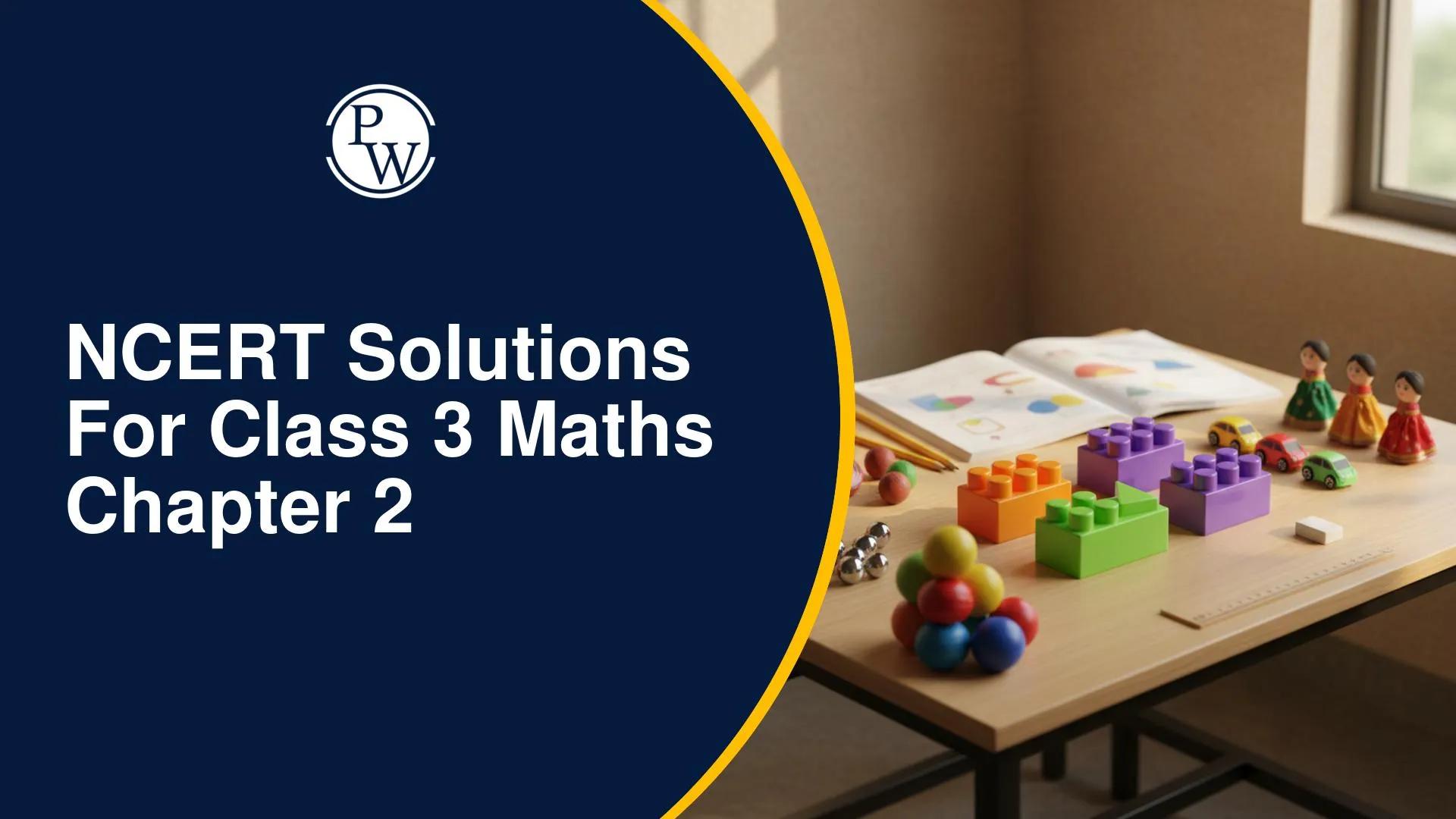
Understanding 3D shapes can sometimes be confusing when children have to identify them from different objects or remember their faces, edges, and corners. Questions based on cubes, cuboids, cones, cylinders, and spheres may also require careful observation, especially when the chapter includes activities with toys, blocks, dice, and other familiar objects.
The Class 3 Maths Chapter 2 Solutions provide answers to the exercises and activities from Toy Joy. They help children check their responses, understand the properties of different shapes, and work through questions involving shape identification, comparisons, arrangements, and practical activities.
Class 3 Maths Chapter 2 Solutions: Toy Joy
The following solutions cover the questions and activities from both lectures of Toy Joy. Try the questions before checking the answers.
Lecture 01 – Toy Joy
A. Warm-Up Questions
Q1. If I give you a football, what shape is it?
A. Cube
B. Sphere
C. Cone
D. Cuboid
Answer: B. Sphere
A football is approximately spherical in shape.
Q2. Which object can roll easily?
A. Book
B. Dice
C. Ball
D. Eraser
Answer: C. Ball
A ball has a curved surface that allows it to roll easily.
Q3. Which one is NOT a 3D shape?
A. Cube
B. Cylinder
C. Circle
D. Cone
Answer: C. Circle
A circle is a 2D shape, while a cube, cylinder, and cone are 3D shapes.
Q4. If you could build anything using blocks, what would children choose?
A. Castle
B. Rocket
C. Robot
D. House
Answer: This is an open-ended question. Any option can be chosen.
B. Jaya's Rocket Activity
Q5. What shapes has Jaya used to build the rocket, and how many of each shape are there?
Answer: Jaya has used:
-
2 cubes
-
4 cuboids
-
1 cone
-
1 cylinder
Q6. What shape is on the top of the orange cylinder?
Answer: Cone
Q7. What shape is under the pink cone?
Answer: Cube
Q8. What shape is between the red cuboid and yellow cuboid?
Answer: The answer depends on the illustrated rocket arrangement. The written source does not provide enough information to identify the shape independently.
C. Devika's Toy Engine
Q9. How many red cylinders, yellow cones, grey cuboids and blue cubes are there in Devika's toy engine?
Answer:
-
1 red cylinder
-
2 yellow cones
-
1 grey cuboid
-
1 blue cube
D. Shapes Used in Toys and Houses
Q10. Which 3D shapes are used to make the toys shown in the activity?
Answer: The shapes include cylinder, cone, sphere, cube, and cuboid.
Q11. Which shapes can be used to build houses and other structures?
Answer: Cone, cylinder, cube, and cuboid can be used to create different structures.
Q12. What is special about a cube when compared with a cuboid?
Answer: A cube is a special type of cuboid because all its faces are equal squares.
E. Find Shapes Around You
Q13. Find a cylinder, sphere, cube, cuboid and cone in your classroom.
Answer: This is an activity-based question. Students should identify objects in their classroom that resemble these shapes.
Q14. Which shape do you find the most and which do you find the least?
Answer: The answer depends on the objects found in the classroom.
Q15. Name an object that is made up of more than one shape.
Answer: The answer may vary. Students can identify any object made using two or more 3D shapes.
F. Shape Properties
Q16. Which shape has only curved faces?
A. Cube
B. Cuboid
C. Sphere
D. Cone
Answer: C. Sphere
Q17. Which shapes have both flat and curved faces?
A. Sphere
B. Cube
C. Cylinder
D. Cone
Answer: Cylinder and Cone
Q18. Which shape has no edges and no corners?
A. Cube
B. Cuboid
C. Sphere
D. Cone
Answer: C. Sphere
Q19. Which shape can roll and also stand on its flat face?
A. Sphere
B. Cube
C. Cylinder
D. Cuboid
Answer: C. Cylinder
Lecture 02 – Toy Joy
A. Classroom Shape Activity
Q20. Identify the cubes, cones, cylinders and cuboids shown in the activity.
Answer: Circle the cubes, tick the cones, cross the cylinders, and put a box around the cuboids shown in the activity.
Q21. Which shapes have only flat faces?
Answer: Cube and cuboid
Q22. Which shapes have both straight and curved edges?
Answer: Cone and cylinder
B. Building Shapes
Q23. Which shapes can children build using clay and sticks?
Answer: Examples include a square-based pyramid and a cube.
Q24. How can you make the given shapes using cubes?
Answer: Arrange small cubes together to match the shapes shown in the activity. More than one arrangement may be possible for some shapes.
Q25. How can different 3D shapes be compared?
Answer: They can be compared by looking at their faces, edges, corners, and curved or flat surfaces.
C. Dice Activity
Q26. Which numbers are on the faces opposite 1, 2 and 3 on a die?
Answer:
-
Opposite 1 → 6
-
Opposite 2 → 5
-
Opposite 3 → 4
Q27. What pattern do you notice on the opposite faces of a die?
Answer: The numbers on opposite faces always add up to 7.
D. Joining Cubes
Q28. What can you make by joining 3 cubes?
Answer: Three cubes can be joined in different arrangements. Students should draw the arrangements shown or made during the activity.
Q29. What can you make using six cubes?
Answer: Six cubes can be arranged to make a cuboid, a tower, or another shape of children's choice.
E. Multiple Choice Questions
Q30. Which object looks like a cube?
A. Football
B. Dice
C. Pencil
D. Spoon
Answer: B. Dice
Q31. Which shape has one circular flat face and one curved face?
A. Cone
B. Cylinder
C. Sphere
D. Cube
Answer: A. Cone
Q32. Which shape has 6 equal square faces?
A. Cube
B. Sphere
C. Cone
D. Cylinder
Answer: A. Cube
Q33. Which object is most likely to be a cuboid?
A. Pencil box
B. Orange
C. Ice cream cone
D. Marble
Answer: A. Pencil box
Class 3 Maths Chapter 2 Solutions PDF
Use the Class 3 Maths Chapter 2 Solutions PDF while revising the questions and activities from Toy Joy. The resources can help children revisit shape identification, properties of 3D shapes, and activity-based questions.
Class 3 Maths Chapter 2 NCERT Solutions PDF
Class 3 Maths Chapter 2 NCERT Solutions PDF – Additional Resource
Study without using the internet
Why Choose NCERT Class 3 Maths Chapter 2 Solutions by PW?
NCERT Class 3 Maths Solutions by Physics Wallah supports children's practice of the shape-based questions and activities covered in Toy Joy.
-
Identify 3D Shapes: Recognise cubes, cuboids, cones, cylinders, and spheres in familiar objects.
-
Understand Shape Properties: Learn about faces, edges, corners, and curved or flat surfaces.
-
Compare Shapes: Identify similarities and differences between different 3D shapes.
-
Observe Objects: Connect geometric shapes with toys, classroom objects, and everyday items.
-
Practise Shape Activities: Work through activities involving blocks, clay, sticks, and cubes.
-
Explore Dice Patterns: Understand the relationship between numbers on opposite faces of a die.
-
Build Different Forms: Experiment with cubes to create cuboids, towers, and other shapes.
-
Check Children's Answers: Compare children's textbook responses with the solutions after completing the questions themselves.
Exploring Toy Joy helps children understand 3D shapes through everyday objects and hands-on activities. The exercises encourage children to identify shapes, examine their features, and experiment with different arrangements. Class 3 Maths Chapter 2 Solutions can be used to review children's answers, clarify concepts, and complete activity-based questions with greater confidence.
Class 3 Maths Chapter 2 NCERT Solutions FAQs
What is covered in Class 3 Maths Chapter 2?
Which shapes are introduced in Toy Joy?
What is the pattern on opposite faces of a standard die?


Have questions about your prep?
Our experts can answer all your questions