



Karnataka 1st PUC Physics Notes PDF 2026-27: Chapter-wise Notes


Karnataka 1st PUC Physics Notes help Karnataka Board Class 11 students understand fundamental concepts, revise important formulas and prepare for examinations. The syllabus covers topics such as units and measurement, motion, Newton's laws, work and energy, rotational dynamics, gravitation and thermodynamics.
Students can use these notes along with their prescribed textbooks to revise important concepts and practise numerical problems. Chapter-wise notes make it easier to study individual topics and revisit important formulas during examination preparation.
The Karnataka 1st PUC Physics Notes PDF provides chapter-wise study material for all 14 Physics chapters. you can also refer to the Karnataka 1st PUC syllabus to understand the topics included in the academic year.
Karnataka 1st PUC Physics Notes PDF Download
Students can refer to chapter-wise 1st PUC notes to revise the topics covered in the Class 11 syllabus. These notes include important definitions, formulas, dimensional analysis, equations of motion, laws of motion, and other concepts covered in the respective chapters.
Below are the available chapter-wise Physics notes PDF links for Karnataka 1st PUC 2026-27.
Units and Measurement Notes PDF
Download Here
|
Chapter Name |
Notes PDF |
|
Motion in a Straight Line |
|
|
Motion in a Plane |
|
|
Newton's Laws of Motion |
|
|
Work, Energy and Power |
|
|
Rotational Dynamics |
|
|
Gravitation |
|
|
Mechanical Properties of Solids |
|
|
Mechanical Properties of Fluids |
|
|
Thermal Properties of Matter |
|
|
Thermodynamics |
|
|
Kinetic Theory of Gases |
|
|
Oscillations |
|
|
Waves |
Students can open the respective links to access the chapter notes. They can refer to these PDFs while studying individual topics and revising the concepts covered in their textbooks.
Topics Covered in 1st PUC Physics Notes for Class 11
The Karnataka 1st PUC Physics syllabus introduces students to fundamental and derived physical quantities, motion, forces, energy and rotational motion. The first six chapters cover the following concepts:
|
Chapter |
Important Topics Covered |
|
Units and Measurement |
Fundamental and derived quantities, systems of units, dimensional analysis, significant figures and rounding off |
|
Motion in a Straight Line |
Displacement, average velocity, acceleration, equations of motion, motion graphs and motion under gravity |
|
Motion in a Plane |
Projectile motion, horizontal and vertical motion, time of flight, horizontal range and maximum height |
|
Newton's Laws of Motion |
Newton's three laws, linear momentum, impulse, conservation of momentum, friction and circular motion |
|
Work, Energy and Power |
Work done by constant and variable forces, kinetic energy, potential energy, work-energy theorem, power and collisions |
|
Rotational Dynamics |
Centre of mass, moment of inertia, radius of gyration, torque, angular momentum and conservation of angular momentum |
These topics form the basis for understanding different physical phenomena and solving numerical problems. Students can refer to the respective PDFs to revise the definitions, equations and concepts covered in each chapter.
You can also refer to the Karnataka 1st PUC exam pattern to understand the examination structure while planning your preparation.
Chapter-wise Physics Notes and Important Formulas
Physics involves mathematical relationships between different physical quantities. Understanding these relationships and remembering the relevant formulas are important parts of preparation.
The chapter-wise notes cover several important formulas and concepts.
1. Units and Measurement
This chapter explains fundamental and derived quantities, different systems of units and dimensional formulas. It also covers the principle of homogeneity and the applications and limitations of dimensional analysis.
Important topics include:
-
Fundamental and derived quantities.
-
FPS, CGS, MKS and SI systems of units.
-
Dimensional formula of physical quantities.
-
Principle of homogeneity.
-
Applications and limitations of dimensional analysis.
-
Significant figures and rounding-off rules.
2. Motion in a Straight Line
This chapter covers the motion of objects along a straight line. Students learn about displacement, distance, average velocity, average speed and acceleration.
Important equations of motion include:
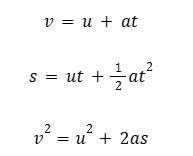
The chapter also covers displacement-time, velocity-time and acceleration-time graphs. Motion under gravity is explained using equations involving gravitational acceleration.
3. Motion in a Plane
This chapter introduces projectile motion and the horizontal and vertical components of motion.
Important formulas include:
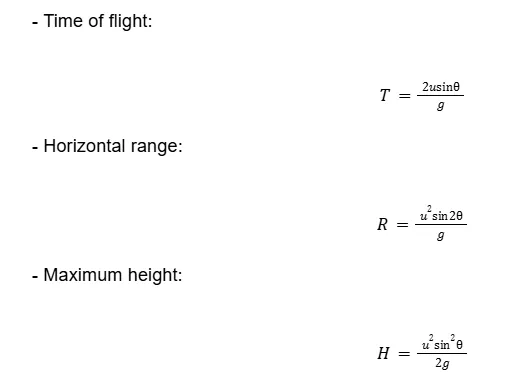
Students can also revise the equation of trajectory, horizontal projection from a height and velocity at different points during projectile motion.
4. Newton's Laws of Motion
This chapter explains the relationship between force and motion through Newton's three laws. It also covers linear momentum, impulse, conservation of momentum and different types of forces.
Important topics include normal reaction, tension, spring force, connected bodies, inertial and non-inertial frames, pseudo force, friction and centripetal force.
5. Work, Energy and Power
This chapter covers work done by constant and variable forces, potential energy, kinetic energy and the conservation of mechanical energy.
Important concepts include:
-
Work-energy theorem.
-
Conservative and non-conservative forces.
-
Stable, unstable and neutral equilibrium.
-
Power delivered by an agent.
-
Circular motion in a vertical plane.
-
Elastic and inelastic collisions.
-
Coefficient of restitution.
6. Rotational Dynamics
This chapter explains the rotational motion of rigid bodies and the motion of the centre of mass.
Important topics include centre of mass, conservation of linear momentum, coefficient of restitution, moment of inertia, perpendicular axis theorem, parallel axis theorem, radius of gyration, torque and angular momentum.
Revise the 1st PUC Physics Formulas regularly and practise questions after completing each chapter. You can also use the Karnataka 1st PUC mid-term question papers to become familiar with the question format and practise applying the concepts you have studied.
How to Use Karnataka 1st PUC Physics Textbook Solutions and Question Bank?
Textbook questions help you check whether you have understood the concepts covered in a chapter. After studying a topic, solve the related textbook exercises and review the steps used in numerical problems.
The 1st PUC Physics Study Material can be used along with textbook exercises for concept revision and formula practice. You can organise your preparation in the following way:
-
Read the textbook explanation before referring to the notes.
-
Make a separate list of formulas and definitions for each chapter.
-
Practise derivations by writing each step.
-
Solve textbook questions after completing a topic.
-
Revisit numerical problems where you make calculation or unit-conversion errors.
-
Use question papers to practise answering within the examination time.
Students studying through different language options can refer to the 1st PUC Physics Notes English Medium and 1st PUC Physics Notes Kannada Medium according to their preferred medium of study.
Also Check,
| Subject | Study Material |
| Mathematics | Karnataka 1st PUC Maths Notes PDF 2026-27 |
| Chemistry | Karnataka 1st PUC Chemistry Notes PDF 2026-27 |
| Botany | Karnataka 1st PUC Botany Notes PDF 2026-27 |
| Zoology | Karnataka 1st PUC Zoology Notes PDF 2026-27 |
For preparation across subjects, you can also refer to the Karnataka 1st PUC Maths previous-year question paper when practising the mathematics skills used in Physics calculations.