KCET 2027 Preparation Roadmap with PW: 5-Month Study Plan
KCET 2027 preparation roadmap with PW combines 2nd PUC board studies with entrance exam practice. Complete the syllabus by December, revise and test in January, prioritise board exams in February and March, then focus on KCET revision, MCQs and mock tests.

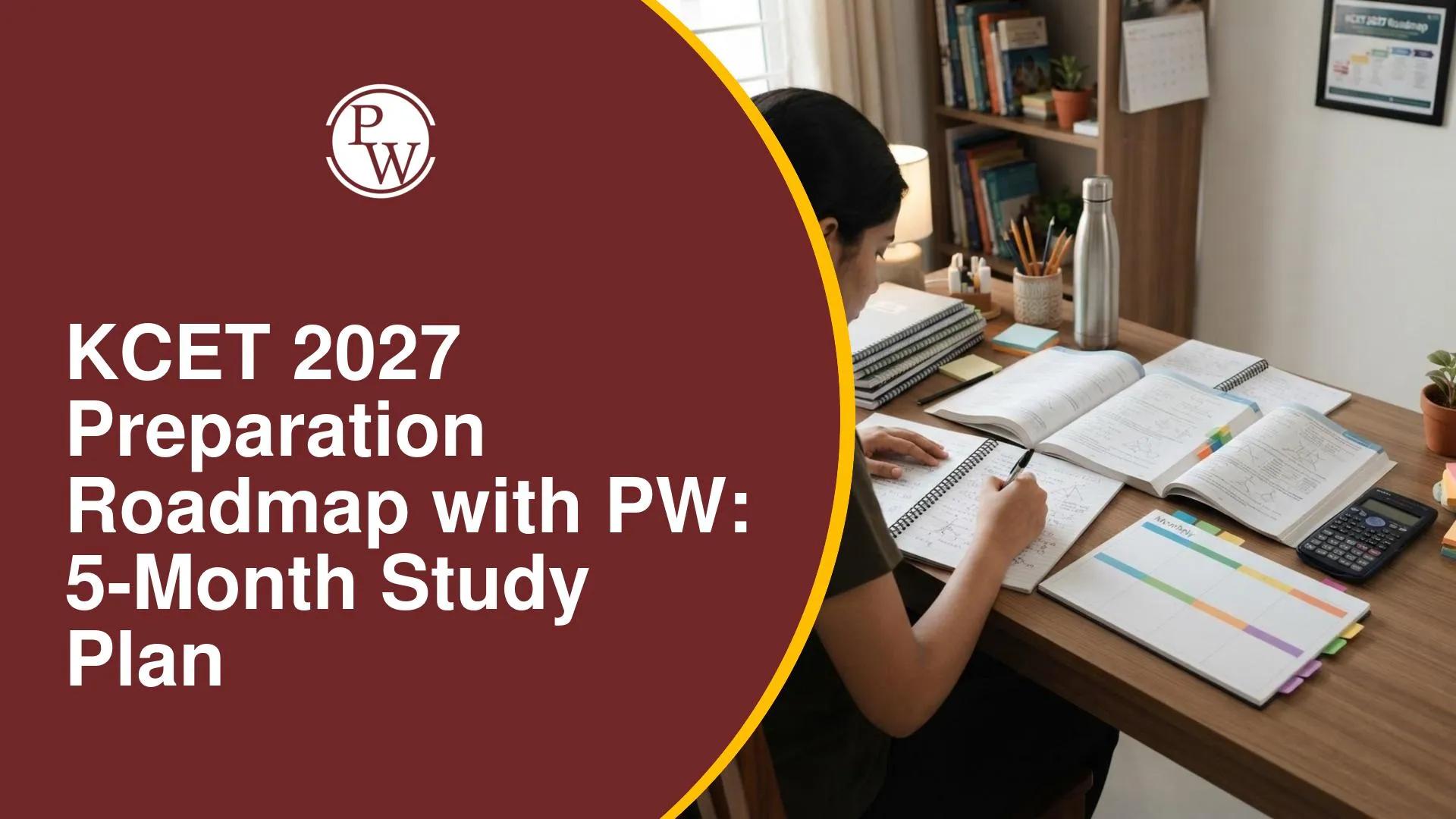
Preparing for KCET 2027 while studying for the Karnataka 2nd PUC board examination can feel like handling two different study plans at the same time. Students have to complete their PUC syllabus, prepare for preparatory examinations, revise board-level theory questions and practise KCET multiple-choice questions.
The good news is that these preparations do not always need separate study hours. Many concepts covered in 2nd PUC are also useful for KCET. The difference is mainly in how students practise and answer questions. Board preparation requires attention to descriptive answers and written presentation, while KCET preparation demands regular MCQ practice, speed and accuracy.
To help students manage both, PW has shared a five-month KCET 2027 preparation roadmap covering November 2026 to March 2027. It divides preparation into syllabus completion, revision, testing, board examination practice and full-time KCET preparation after the board exams.
Here is how students can follow this roadmap with PW.
KCET 2027 Preparation Roadmap: Month-Wise Study Plan
The PW strategy follows five main preparation stages. Students should complete the major syllabus targets before the board examination period so that they can use the final weeks for revision and examination practice.
| Month | Preparation phase | Main target |
| November 2026 | Learn and practise | Begin major chapters, understand concepts and practise daily KCET MCQs |
| December 2026 | Complete the syllabus | Finish remaining chapters and attempt chapter-wise tests |
| January 2027 | Revise and test | Revise completed chapters, solve PYQs and identify weak areas |
| February 2027 | Board exam preparation | Practise board papers, revise theory and continue short KCET practice |
| February 27–March 18, 2027 | Board examination period | Prioritise scheduled 2nd PUC papers and maintain light revision where possible |
| After the final board paper | Full KCET preparation | Revise all chapters, solve previous-year questions and attempt timed mock tests |
This is a practical framework rather than a fixed timetable for every student. Adjust the targets according to your stream, subject combination, syllabus progress and board examination schedule.
November 2026: Start Major Chapters and Build Your Concepts
November is the time to strengthen your understanding of important chapters. Instead of trying to memorise questions immediately, begin with the basics and understand how each concept works.
Students should focus on completing major chapters from the prescribed 2nd PUC syllabus while also revisiting relevant concepts from 1st PUC.
The Chemistry study plan shown in the PW session suggests the following targets for November:
-
Start major Chemistry chapters from the basics.
-
Understand concepts using NCERT and prescribed study material.
-
Solve at least 10 KCET Chemistry MCQs daily.
-
Prepare short notes for important concepts.
-
Maintain a separate formula and reaction sheet.
The same learning approach can be used for other KCET subjects. Understand a chapter first, then practise questions based on it.
How to use PW: Follow the relevant chapter classes and make notes while learning. After completing a topic, attempt MCQs instead of waiting until the entire syllabus is finished.
December 2026: Complete the Remaining Syllabus
December is an important month in the PW roadmap because the target is to finish the remaining chapters by the end of the month.
Students appearing for 2nd PUC should try to complete their major syllabus portions before preparatory examinations begin in January. This will reduce the pressure of learning new chapters during the board examination period.
For Chemistry, the December targets shown in the study plan include:
-
Complete the remaining chapters.
-
Focus on important reactions, formulas and concepts.
-
Practise chapter-wise KCET MCQs.
-
Attempt short chapter tests containing around 50–60 questions.
Students should not rush through chapters just to mark them as complete. A chapter should be considered covered only after understanding its concepts and attempting relevant questions.
How to use PW: Complete the chapter classes, revise the related notes and attempt the question bank. Keep a record of questions that you answered incorrectly so that you can revisit them during January.
January 2027: Revise Chapters and Take Regular Tests
January is the revision and testing phase of the KCET 2027 preparation roadmap. By this stage, students should have covered most of their 2nd PUC syllabus and should focus on remembering concepts and improving question-solving ability.
The month is also important because preparatory examinations may begin during this period. Students should use their preparation time to strengthen both board-level understanding and entrance examination practice.
The PW Chemistry roadmap suggests these activities:
-
Revise all completed chapters.
-
Solve previous-year KCET questions.
-
Take one full Chemistry test every week.
-
Identify weak topics and revise them.
-
Strengthen important formulas and chemical reactions.
After every test, spend time analysing your performance. Do not simply check the score and move to the next paper.
Find out whether you lost marks because of:
-
An incorrect concept.
-
A forgotten formula or reaction.
-
A calculation error.
-
Misreading the question.
-
Spending too much time on one MCQ.
This analysis will help you decide what to revise during the next week.
How to use PW: Use the previous-year question solutions, chapter-wise practice resources and tests available in your batch. Discuss difficult questions during the available doubt-clearing sessions.
February 2027: Shift the Main Focus to 2nd PUC Board Exams
February is the month to give greater importance to the 2nd PUC board examination. Students should practise descriptive questions, revise important theory and solve board model question papers.
However, completely abandoning KCET practice is not necessary. The PW roadmap suggests continuing a small amount of daily MCQ practice alongside board examination preparation.
For Chemistry, the February targets include:
-
Practise board question papers and model papers.
-
Revise important theory, reactions and numerical problems.
-
Continue solving around 10–15 KCET MCQs daily, whenever the schedule allows.
-
Keep short notes handy for quick revision.
-
Focus more on board examination preparation.
This approach helps students remain familiar with the KCET question format without taking time away from their immediate board examination targets.
How to use PW: Complete the board-oriented revision classes and practise model questions. Use the formula sheets and short notes for quick revision instead of repeatedly reading lengthy material.
March 2027: Manage Board Exams and KCET Preparation Together
The March phase needs a practical adjustment based on the final Karnataka 2nd PUC Exam 1 timetable.
The screenshots show March 1–16 as the board examination period, followed by full KCET preparation from March 17. However, KSEAB's final timetable schedules 2nd PUC Exam 1 from February 27 to March 18, 2027.
Students should therefore prioritise their respective board papers and move to full-time KCET preparation after their final 2nd PUC examination.
During the Board Examination Period
From February 27 to March 18, follow your subject-wise board timetable.
-
Revise the subject scheduled for the next examination.
-
Keep important formulas and reactions ready for quick revision.
-
Practise board-style questions and review important concepts.
-
Avoid starting entirely new KCET topics during this period.
-
Continue a short KCET MCQ session only when your board preparation permits.
Do not sacrifice preparation for an upcoming board paper to complete an arbitrary KCET target.
After Your Last Board Examination: Begin Full KCET Preparation
Once your final board paper is over, shift your main attention to KCET.
The PW roadmap recommends:
-
Revise all Chemistry chapters again.
-
Solve previous-year KCET questions.
-
Attempt regular timed mock tests.
-
Focus on speed and accuracy.
-
Review mistakes and revise weak areas.
-
Revisit formulas, reactions and important concepts.
The exact KCET 2027 examination date should be checked through the Karnataka Examinations Authority (KEA) notification. Adjust your revision and mock-test frequency once the official schedule is announced.
KCET and 2nd PUC Board Preparation: How to Manage Both Together?
One of the central messages in the PW session is that students should not treat board examination preparation and KCET preparation as two completely separate activities.
The concepts are connected, so students can study a chapter once and practise it in two different formats.
| Preparation area | 2nd PUC board exam | KCET |
| Concept learning | Understand the topic and prepare descriptive answers | Understand the concept and apply it to MCQs |
| Question practice | Textbook exercises and board-style questions | Chapter-wise and topic-wise MCQs |
| Numerical problems | Show steps, calculations and units | Solve accurately within limited time |
| Revision | Theory, derivations, reactions and diagrams | Formulas, concepts and quick application |
| Testing | Board model question papers | Timed KCET mock tests |
| Performance review | Check answer presentation and missed points | Analyse incorrect answers and time spent |
For example, after completing a Chemistry chapter, revise its theory and reactions for the board examination. Then solve KCET MCQs from the same chapter to practise applying those concepts.
This method reduces duplication and helps students use their study time more effectively.
KCET 2027 Chemistry Preparation Plan: What Should You Focus On?
The visual study plan shared by PW is specifically titled KCET 2027 Chemistry – 5-Month Study Plan. Students preparing for Chemistry can follow its monthly targets closely.
| Month | Chemistry preparation target |
| November 2026 | Begin major chapters, understand concepts and solve 10 MCQs daily |
| December 2026 | Finish remaining chapters, revise reactions and formulas, and take chapter tests |
| January 2027 | Revise all chapters, solve KCET PYQs and take one full Chemistry test every week |
| February 2027 | Focus on board theory, reactions and numericals while continuing 10–15 KCET MCQs when possible |
| Board exam period | Prioritise 2nd PUC papers and revise Chemistry formulas and reactions briefly |
| After the final board paper | Revise all Chemistry chapters, solve PYQs and attempt timed mock tests |
How to Prepare Chemistry for KCET 2027
Chemistry preparation should include concept understanding, reaction revision and regular MCQ practice.
Physical Chemistry: Understand the concepts and formulas behind numerical problems. Practise calculations and maintain a formula sheet for quick revision.
Inorganic Chemistry: Revise important concepts and chemical properties regularly. Use short notes to recall the information covered in each chapter.
Organic Chemistry: Focus on understanding reactions and the concepts behind them. Maintain a reaction notebook and revise it frequently.
Do not study these areas only by memorising question lists. Understanding the underlying concepts will help you handle questions that are framed differently.
How to Practice KCET MCQs and Previous-Year Questions?
MCQ practice should begin alongside chapter learning instead of being postponed until the syllabus is complete.
Follow this sequence:
-
Complete the chapter concept or lecture.
-
Read the relevant textbook content.
-
Attempt basic chapter-wise MCQs.
-
Solve KCET previous-year questions from the same topic.
-
Review incorrect answers and identify the reason for each mistake.
-
Reattempt difficult questions after revision.
During the initial learning stage, focus on understanding the correct method. As the examination approaches, pay more attention to speed and accuracy.
Previous-year questions are useful for understanding how concepts have appeared in earlier KCET examinations. However, they should be used along with the prescribed syllabus and other practice questions rather than as a prediction of the exact paper.
How to Use PW Batches for KCET 2027 Preparation?
The PW session mentions different batch options to support students at different stages of KCET preparation.
The batches referred to in the video include:
-
Lakshya KCET Fast Track: Mentioned as an option for focused preparation and revision.
-
Lakshya KCET: Presented as another KCET preparation option.
-
Arjuna KCET 2027: Mentioned for students, including 1st PUC learners, who want to begin their preparation earlier.
Students should check the current course page for the exact batch name, subjects, class schedule, syllabus coverage, study materials and pricing before enrolment. Offers and prices mentioned in the video may have changed.
A batch can provide a planned study route, but students still need to attend or watch classes regularly, solve questions independently and revise consistently.
Common Mistakes to Avoid During KCET 2027 Preparation
Students can lose valuable preparation time by following an unplanned routine. Avoid these mistakes while preparing for KCET and 2nd PUC together:
-
Keeping board and KCET preparation separate: Study the same concepts for both examinations, then practise the required question formats.
-
Postponing syllabus completion: Set chapter deadlines and try to finish the major syllabus portions by December as suggested in the roadmap.
-
Skipping MCQ practice: Solve a small number of questions daily instead of waiting until the final revision phase.
-
Ignoring previous-year questions: Use PYQs to understand question styles and identify concepts that need more practice.
-
Taking tests without analysis: Review incorrect answers and revise weak topics after every test.
-
Starting new topics during board exams: Give priority to the next scheduled board examination and avoid unnecessary syllabus expansion.
-
Neglecting timed mock tests: Practise under time limits during the dedicated KCET revision phase.
-
Changing study resources repeatedly: Follow a consistent set of textbooks, class notes, question banks and revision material.
KCET 2027 Preparation Roadmap FAQs
How should I prepare for KCET 2027 along with 2nd PUC board exams?
What is the five-month KCET 2027 study plan by PW?
When should I complete the 2nd PUC syllabus for KCET 2027?
How many KCET Chemistry MCQs should I practise daily?