







How PW Legal Drafting Certification Program Helps Build Practical Legal Skills
 Aarti .20 Jul, 2026
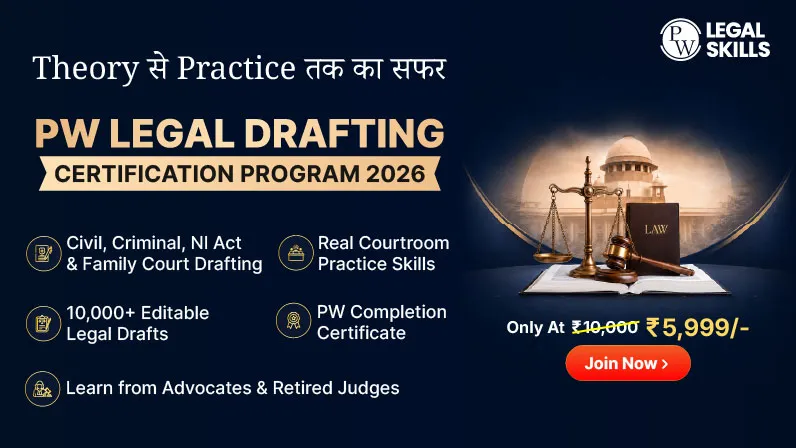
Many law students and aspiring legal professionals find it challenging to apply theoretical knowledge in real legal drafting and courtroom work. The PW Legal Drafting Certification Program helps bridge this gap by providing practical training through live drafting sessions, court procedure understanding, client management, judgment analysis, and case-based learning.
The four-month online course also includes over 10,000 editable legal drafts in English and Hindi, helping law students, judiciary aspirants, interns, fresh advocates, and young legal practitioners develop practical legal drafting skills for professional practice.
PW Legal Drafting Certification Program Highlights
The PW Legal Drafting Certification Program provides flexible online learning with practical training over four months. The table below highlights the course duration, schedule, learning mode, study resources, and certification details.
|
Particular |
Details |
|
Course Duration |
4 Months |
|
Course Dates |
20 June 2026 – 30 October 2026 |
|
Validity |
Till 30 July 2027 |
|
Classes |
Weekend Live Classes (Saturday & Sunday) |
|
Learning Mode |
Online |
|
Study Material |
10,000+ Editable Legal Drafts in English & Hindi |
|
Who Can Join? |
Law students, judiciary aspirants, fresh advocates, interns, and anyone looking to build practical legal drafting skills |
|
Teaching Methodology |
Live classes, recorded lectures, drafting notes, templates, assignments, practice exercises, and case-based learning. Recorded lectures are available for students who miss live sessions. |
|
Course Language |
Classes are conducted in Hinglish, while lower court drafts are covered in English and Hindi. |
|
Certificate |
PW Completion Certificate upon successful completion of the course |
|
Refund Policy |
No refund policy. Fees paid are non-refundable. |
Course Structure and Practical Learning Modules
The PW Legal Drafting Certification Program includes eight practice-oriented modules that cover legal drafting, court procedures, AI-assisted legal practice, judgment analysis, and client counselling. The table below provides an overview of the topics covered in each module.
|
Module |
Key Topics Covered |
|
Module 1: Introduction to Court Craft |
Legal terminology, principles of legal drafting, structure of legal documents, formatting, annexures, verification, affidavits, common drafting mistakes, court etiquette in filings |
|
Module 2: Criminal Legal Drafting (Basic) |
Criminal court hierarchy and proceedings, FIR, E-FIR, legal notices, bail, criminal complaints, cheque bounce matters, quashing petitions, appeals, and related criminal drafting |
|
Module 3: Civil Legal Drafting (Basic) |
Civil court proceedings, civil notices, affidavits, plaint, written statement, set-off, counterclaim, amendment of pleadings, injunctions, caveat applications, court fees, jurisdiction, and limitation |
|
Module 4: Matrimonial Cases & Family Court Procedure |
Maintenance, restitution of conjugal rights, mutual consent divorce, judicial separation, talaq, adoption, domestic violence matters, child custody, transfer petitions, and settlement agreements |
|
Module 5: Land and Property Matters & Other Civil Documents |
Sale deed, lease deed, rent agreement, gift deed, mortgage deed, family settlement agreement, partnership deed, power of attorney, employment agreement, NDA, wills, testamentary agreements, RTI applications, and contract clauses |
|
Module 6: AI-Powered Legal Drafting & Modern Legal Practice |
E-Courts portal, e-filing, virtual hearings, AI-assisted legal research, prompt engineering, draft improvement, judgment summarisation, client consultation notes, confidentiality, and responsible AI usage |
|
Module 7: Judgment Reading & Analysis |
Landmark judgments, IRAC method, legal research, case law analysis, legal databases, citations, keyword mapping, and judgment briefing |
|
Module 8: Court Procedure & Practice |
Filing procedures, certified copies, court fees, jurisdiction, applications, vakalatnama, note-taking, case briefs, assisting senior counsel, court etiquette, and client counselling |
How the Course Structure Builds Practical Legal Skills?
The Legal Skills program includes eight comprehensive practice-oriented modules covering important aspects of legal drafting and litigation practice.
-
Legal Drafting Sessions
Students learn professional drafting formats through live legal drafting sessions covering different legal documents.
-
Court Procedure and Filing
The course explains court procedures and filing processes to help learners understand practical litigation workflows.
-
Judgment Reading and Analysis
Students learn how to read and analyse judgments to improve legal understanding and drafting quality.
-
Client Management
The curriculum includes client management concepts that support professional legal practice.
-
AI-Powered Legal Drafting and Modern Legal Practice
The course also introduces AI-powered legal drafting and modern legal practice tools as part of its curriculum.
-
Internship Toolkit
An internship toolkit is included to support students during internships and early legal practice.
Practical Drafting Resources Included in the Course
One of the key features of the course is access to 10,000+ editable legal drafts in English and Hindi. The drafting resources cover documents such as:
|
Category |
Legal Drafting Documents Covered |
|
Criminal Law |
Legal Notices, FIR, Bail Applications, Criminal Complaints, Cheque Bounce (Section 138 NI Act), Quashing Petitions, Appeals |
|
Civil Law |
Plaint, Written Statement, Set-off and Counter Claim, Injunction, Caveat |
|
Family Law |
Maintenance Matters, Restitution of Conjugal Rights, Divorce/Talaq |
|
Property & Commercial Law |
Sale Deed, Lease Deed, Gift Deed, Mortgage Documents, Partnership Deed, Family Settlement Agreement, Power of Attorney |
|
Succession Law |
Wills, Testamentary Agreements |
The course also includes SCC/Live Law training and client counselling.
Benefits of the PW Legal Drafting Certification Program
The programme is designed to help learners apply legal knowledge in practical situations. By combining drafting resources, procedural understanding, and professional learning, it supports learners during internships and early legal practice.
Learners can:
-
Understand professional drafting formats
-
Prepare commonly used legal documents
-
Improve confidence during internships
-
Assist senior advocates and legal professionals more effectively
-
Understand court documentation and filing requirements
-
Explore opportunities in freelance drafting and legal startups
These benefits help learners build a stronger foundation for professional legal work.
How PW Legal Drafting Certification Program FAQs
Who should join the PW Legal Drafting Certification Program?
What study resources are provided in the course?
Will recorded lectures be available?
Does the course include legal drafting templates?
What is the language of instruction?




Get Free Counselling Today
and Clear up all your Doubts
 Live & recorded classes available at easeDashboard for progress trackingLakhs of practice questions

