







Legal Drafting for USLLS Students: Contracts, Petitions, Notices & Key Drafts



Studying at the University School of Law and Legal Studies (USLLS) gives students a strong academic foundation through programmes such as B.A. LL.B, B.B.A. LL.B, and LL.M. However, understanding case law, legal provisions, and legal principles is only one part of building practical legal skills. Students also need to learn how to apply this knowledge while preparing notices, pleadings, petitions, agreements, and other legal documents.
This is where practical legal drafting skills become important. A student may understand the concept of an injunction or a cheque bounce notice but may still find it difficult to prepare a draft based on a specific set of facts. Alongside their university studies, students can use structured learning resources such as PW’s Legal Drafting Certification Program to practise different drafting formats, understand court procedures, and gain exposure to practical legal workflows.
Why Legal Drafting Skills Matter for USLLS Students
Legal employers generally look for more than academic knowledge. Legal research, drafting, communication, attention to detail and the ability to work within deadlines are important skills for internships and early legal careers.
This is where many students experience a practical gap. A student may understand the meaning of an injunction or a cheque bounce notice but still struggle when asked to prepare one based on a specific set of facts.
Building drafting skills during law school can help bridge this gap. Familiarity with legal language, bare acts, document structures and practical drafting formats can make the transition from classroom learning to internships smoother.
Legal Drafts Every USLLS Student Should Know
Students interested in litigation, corporate law, internships or general legal practice should gradually become comfortable with different types of legal documents.
-
Contracts and Agreements
Important documents include:
-
Sale deeds
-
Lease deeds
-
Partnership deeds
-
Family settlement agreements
-
Other basic commercial and property agreements
-
Petitions and Pleadings
Students should understand the structure and purpose of:
-
Plaint
-
Written statement
-
Injunction applications
-
Caveats
-
Other common petitions and pleadings
-
Legal Notices and Applications
Common drafting exercises include:
-
Legal notices
-
Cheque bounce notices under Section 138 of the Negotiable Instruments Act
-
Bail applications
-
Criminal complaints
-
Other procedural applications
-
Family and Civil Law Drafts
Students can also benefit from practising drafts related to:
-
Maintenance
-
Restitution of conjugal rights
-
Divorce matters
-
Property disputes
-
Family settlements
-
Client-Facing Legal Documents
Drafting is not limited to court documents. Students may also need to prepare:
-
Case briefs
-
Case summaries
-
Legal correspondence
-
Client communications
-
Matter-related notes
Knowing the definition of a legal document is different from being able to draft it accurately from a set of facts. Regular practice is what helps students develop that ability.
Bridging the Gap Between Legal Theory and Practical Drafting
Drafting, court procedure and legal research are common areas where students may feel less confident despite having a strong theoretical foundation.
For example, a student might know what a plaint is but not know how to structure one for a particular dispute. Similarly, understanding an injunction in theory does not automatically translate into preparing an application based on actual facts.
Research also requires practice. Students need to learn how to identify the relevant provision, locate useful case law, connect legal principles with facts and present the findings clearly.
These skills become easier with repeated, guided practice rather than relying only on textbook learning.
How to Build Legal Drafting Skills During Law School
Students do not need to wait until their final year to start practising drafting. A simple, consistent approach can help build confidence over time.
-
Study sample drafts and understand their structure.
-
Compare different formats for notices, petitions and agreements.
-
Practise drafting from hypothetical case facts.
-
Refer to the relevant bare acts while drafting.
-
Read judgments to understand how legal issues and facts are presented.
-
Seek feedback on clarity, structure and legal reasoning.
-
Gradually practise drafting without depending entirely on templates.
The goal should not be to memorise formats. Students should understand why each document is structured in a particular way and how its contents change according to the facts and applicable law.
PW Legal Drafting Certification Program: A Practical Learning Option
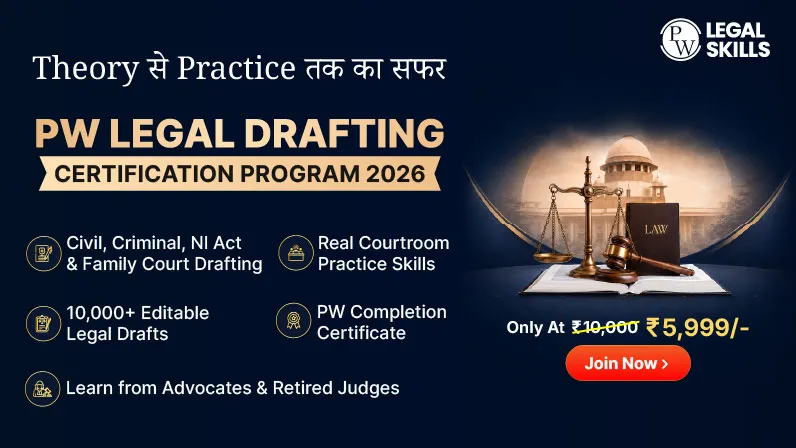
For students looking for structured practice alongside their regular law studies, PW offers the Legal Drafting Certification Program 2026.
The 4-month online programme is designed for law students, judiciary aspirants, young legal practitioners and interns who want to strengthen practical drafting skills. Instead of limiting learning to theoretical explanations, the programme focuses on drafting formats, court procedures, client communication and other practical aspects of legal work.
What the PW Legal Drafting Program Covers
Based on the 2026 batch details, the programme includes:
-
10,000+ editable legal drafts in English and Hindi
-
Drafts covering FIRs, bail applications, cheque bounce notices, plaints, wills, partnership deeds and more
-
8 learning modules covering drafting and related practical skills
-
Live sessions on legal drafting and court procedures
-
Court filing and procedural guidance
-
Client management and communication
-
Judgment reading
-
AI-assisted legal drafting
-
Internship-focused learning resources
-
Weekend live classes with recording access
The programme is positioned for beginners as well as learners who already have some exposure to legal drafting. For a USLLS student, this kind of structured practice can complement university coursework by providing additional exposure to practical formats and legal workflows.
PW Legal Drafting Certification Batch Details
The supplied PW Legal Drafting Certification 2026 programme details include:
-
Course duration: 4 months
-
Class format: Online weekend live classes
-
Content access: Available beyond the live course period
What Should a USLLS Student Do Next?
If you are pursuing a B.A. LL.B, B.B.A. LL.B or LL.M at USLLS, assess your current drafting ability honestly.
Ask yourself:
-
Can you prepare a basic legal notice without relying completely on a template?
-
Can you distinguish between a plaint and a written statement in practical use?
-
Can you apply a legal provision to a given set of facts and turn that analysis into a properly structured draft?
If not, there is no reason to worry. Drafting is a skill that improves with practice.
Start by studying real-world formats, understanding their structure and practising with hypothetical facts. If you want more structured guidance, a programme such as PW's Legal Drafting Certification Program can provide a dedicated environment for practising different types of drafts while learning about court procedure, client communication and other practical aspects of legal work.
For USLLS students, developing these skills during law school can make internships more manageable and provide a stronger foundation for early legal practice.





Get Free Counselling Today
and Clear up all your Doubts
 Live & recorded classes available at easeDashboard for progress trackingLakhs of practice questions

