Development of Genito-Urinary System: Factors and Development of Different Parts
 Priyanka Yadav31 Mar, 2026
For NEET PG, the development of the genito-urinary system is a must-know topic because it directly connects basic embryology with clinical questions asked in the exam and helps in fetching 1-2 direct questions.
The intermediate mesoderm is the primary germ layer for the genito-urinary system. External genitalia fully differentiate around 12 weeks. Female differentiation is completed by 11 weeks, while male differentiation finishes by 14 weeks.
What is Development of Genito-Urinary System?
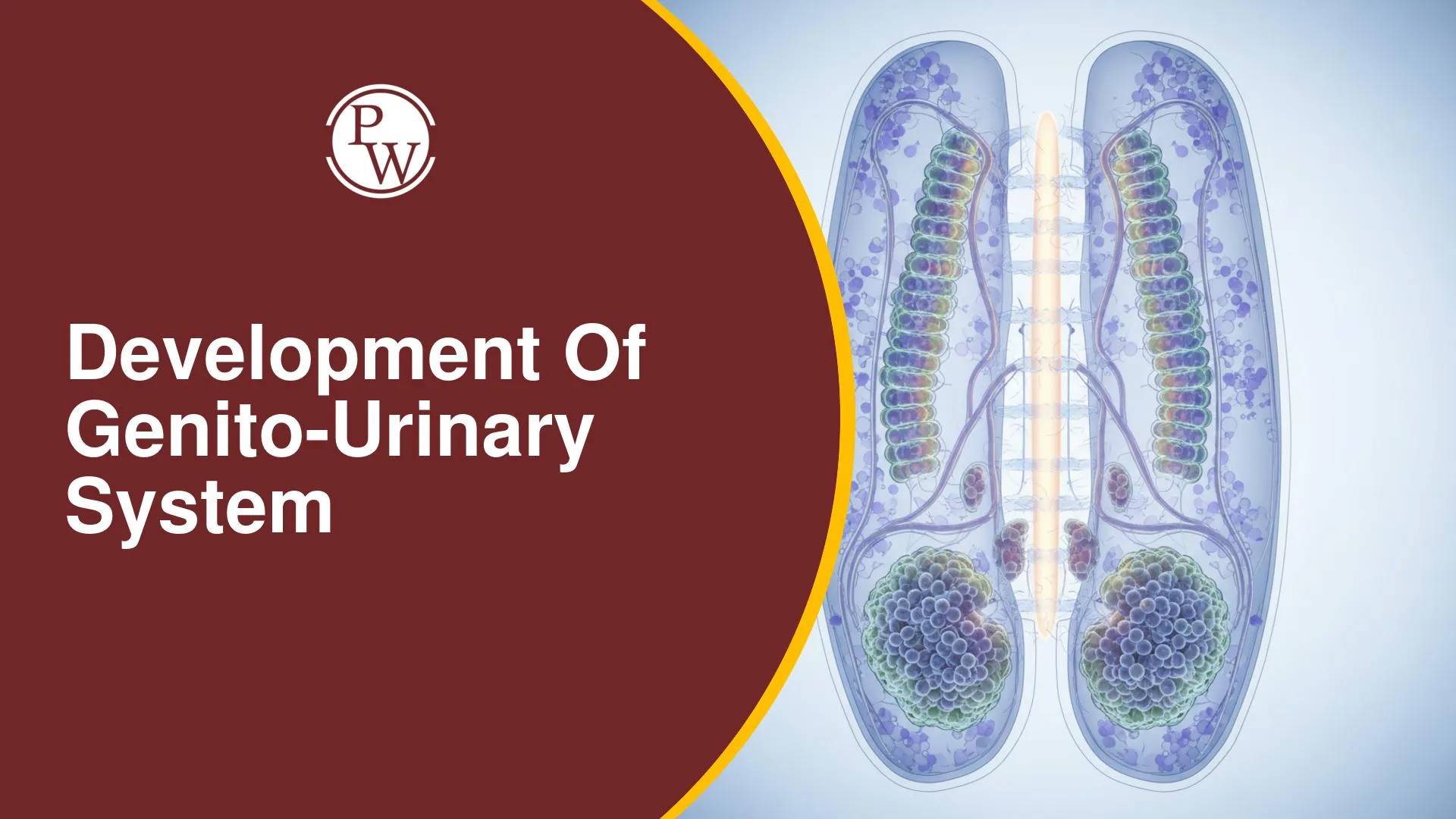
The development of the genito-urinary system refers to the process by which the urinary and reproductive organs form and mature during embryonic growth.
It involves the formation of structures such as the kidneys, ureters, urinary bladder, and urethra (urinary system), along with the gonads (testes or ovaries) and reproductive ducts (genital system). These systems develop closely together because they originate from a common embryonic tissue called the intermediate mesoderm.
This development occurs in stages and includes the formation of three kidney systems—pronephros, mesonephros, and metanephros—out of which the metanephros develops into the permanent kidneys. At the same time, the reproductive organs differentiate based on genetic and hormonal factors.
Development of Genital System
Male development begins earlier than female development in terms of gonad formation, with testes forming before ovaries. However, female external genitalia reach terminal differentiation sooner. The genital ridge forms at week 5 from the intermediate mesoderm. This ridge can become either testes or ovaries.
Factors for Sex Differentiation
The SRY gene, located on the Y chromosome, guides sex differentiation. It codes for the testis-determining factor (TDF). TDF triggers testis formation.
-
Males possess the SRY gene, leading to TDF production.
-
Leydig cells produce testosterone, vital for male development.
-
Sertoli cells make Müllerian Inhibiting Factor (MIF), which prevents female duct development.
-
These factors promote testis formation.
-
Their absence leads to ovary formation.
Transverse Section of Embryo Showing Notochord
The notochord, or axial mesoderm, lies centrally. The paraxial mesoderm is lateral to it, followed by the lateral plate mesoderm. The intermediate mesoderm forms the bulk of the genito-urinary system, creating ridges (testis, ovary, kidney) and ducts (Mullerian and Wolffian).
Development of the Renal System
Three kidney systems develop sequentially in the urogenital ridge:
-
Pronephros: This earliest system degenerates.
-
Mesonephros: This degenerates, leaving the mesonephric (Wolffian) duct. Ureteric buds arise from these ducts.
-
Metanephros: This develops into the definitive kidney, stimulated by the ureteric bud. The definitive kidney becomes functional and excretes urine by 12 weeks.
The urogenital sinus forms the bladder, urethra, and lower vagina.
Development of the Female Genito-Urinary System
The Mullerian (paramesonephric) ducts fuse centrally to form the uterus. Their unfused parts become the uterine tubes.
-
Mullerian Duct Derivatives: Uterus, uterine tubes, and the upper one-third of the vagina.
-
Urogenital Sinus Derivatives: Urinary bladder, urethra, and the lower two-thirds of the vagina.
The mesonephric ducts largely regress in females, leaving vestigial remnants like the epoophoron, paroophoron, and Gartner’s duct.
Development of Trigone
The trigone of the urinary bladder is mesodermal. It forms when the tip of the mesonephric duct is absorbed into the posterior wall of the urogenital sinus. The bladder itself is endodermal.
Development of Nephron
The ureteric bud stimulates the metanephros to form the nephron's excretory part, which includes the glomerulus, proximal convoluted tubule, loop of Henle, and distal convoluted tubule.
-
Metanephric Blastema Derivatives: Excretory portion of the kidney (nephrons).
-
Ureteric Bud Derivatives: Collecting system (ureter, renal pelvis, major/minor calyces, collecting ducts).
|
Embryo Part |
Adult Derivative |
|---|---|
|
Metanephric Mesoderm |
Glomerulus, Bowman’s Capsule, Proximal/Distal Convoluted Tubules, Loop of Henle, Collecting Tubule |
|
Ureteric Bud |
Ureter, Renal Pelvis, Major Calyces, Minor Calyces, Collecting Ducts |
Mullerian and Wolffian Derivatives
At week 6, the embryo has indifferent gonads and both Mullerian and Wolffian ducts.
-
Female Development: Ovaries develop from the genital ridge. Mullerian ducts form the uterus, uterine tubes, and upper vagina. Wolffian ducts regress, leaving vestigial structures.
-
Male Development: Testes develop from the genital ridge. Mullerian ducts regress due to MIF. Wolffian ducts develop into the epididymis, ductus deferens, seminal vesicles, and ejaculatory ducts.
Mullerian Agenesis
Mullerian agenesis is the absence of the uterus, uterine tubes, and the upper one-third of the vagina. A shallow vagina (lower two-thirds) and ovaries are present. This condition is also known as Mayer-Rokitansky-Küster-Hauser syndrome.
Wolffian Duct: Vestigial Remnants
In females, after the trigone formation, the Wolffian (mesonephric) duct largely regresses. Its remnants include the epoophoron, paroophoron, and Gartner’s duct. In males, the Wolffian duct forms the reproductive tubes.
External Genitalia
External genitalia develop from the dorsal somatic portion of the lateral plate mesoderm.
-
Genital Tubercle: Clitoris (female), glans penis (male).
-
Genital/Urethral Fold: Labia minora (female), penile-scrotal raphe (male).
-
Genital Swelling: Labia majora (female), scrotum (male).
Common Congenital Anomalies of the Genito-Urinary System
Understanding congenital anomalies is crucial because NEET PG frequently asks clinical and image-based questions from these conditions. These anomalies arise due to errors in development, migration, fusion, or differentiation.
-
Renal Agenesis
Absence of one or both kidneys due to failure of ureteric bud development. Bilateral agenesis is associated with the Potter sequence. -
Horseshoe Kidney
Fusion of the lower poles of the kidneys; it gets trapped under the inferior mesenteric artery during ascent. Very commonly asked in exams. -
Ectopic Kidney
Kidney fails to ascend and remains in the pelvis or crosses to the opposite side (crossed ectopia). -
Polycystic Kidney Disease
A genetic disorder causing multiple cysts in the kidneys; it can be autosomal dominant or recessive. -
Hypospadias
Urethral opening on the ventral surface of the penis due to incomplete fusion of the urethral folds. -
Epispadias
Urethral opening on the dorsal surface; often associated with bladder exstrophy. -
Cryptorchidism
Failure of the testis to descend into the scrotum increases the risk of infertility and malignancy. -
Müllerian Duct Anomalies
Includes bicornuate uterus, septate uterus, or uterus didelphys due to improper fusion of paramesonephric ducts. - Patent Urachus
Persistence of the urachus leading to urine discharge from the umbilicus.
Development of Genito-Urinary System FAQs
Which germ layer primarily contributes to the genito-urinary system?
What is the main role of the SRY gene in development?
From which embryonic structure does the definitive kidney develop?
What structures are derived from the Mullerian duct in females?
What is the origin of the trigone of the urinary bladder?