






Goitre Surgery Lecture: Causes, Indications, and Surgical Management
 Ekta Rakesh Singh24 Jul, 2026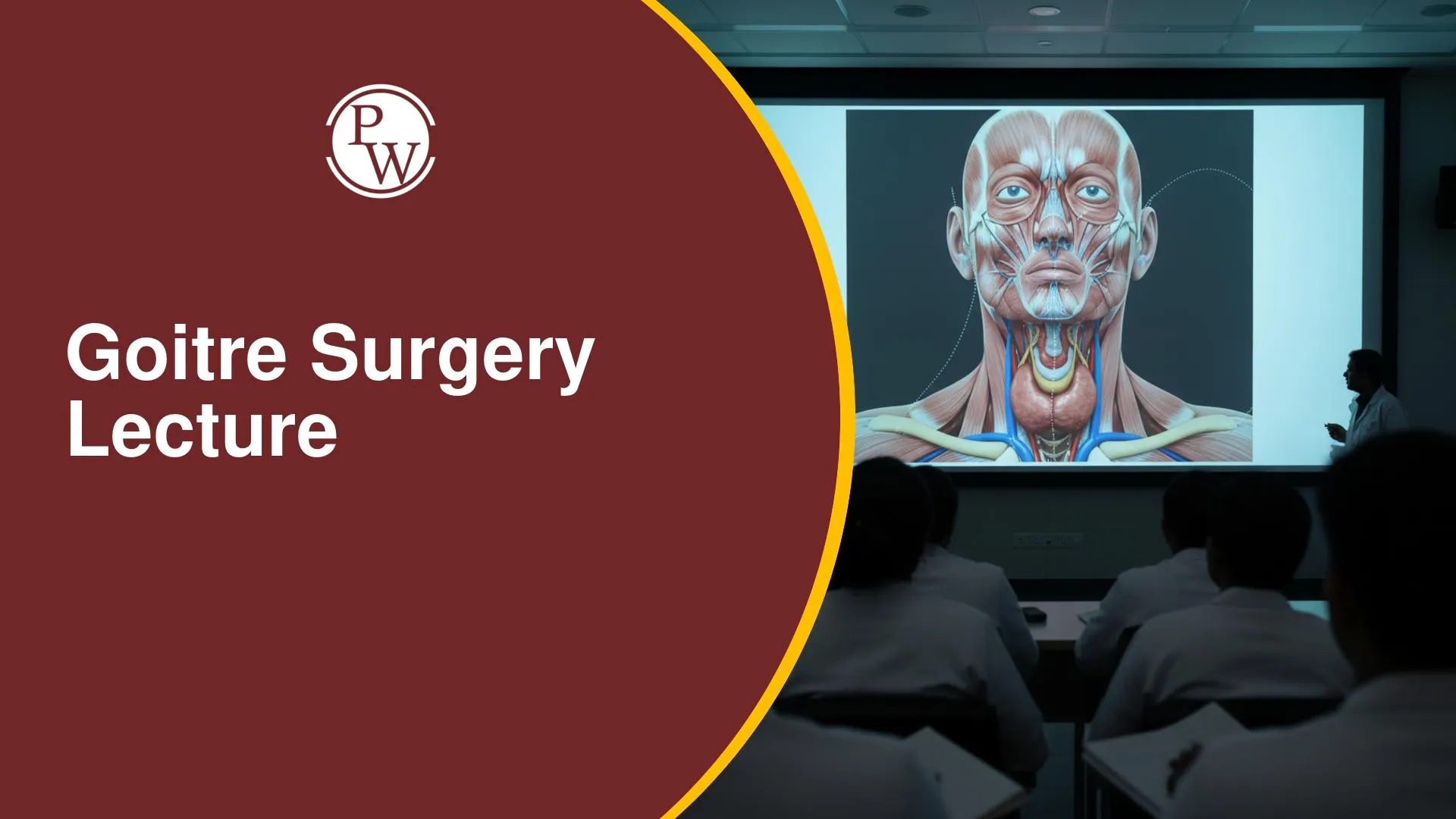
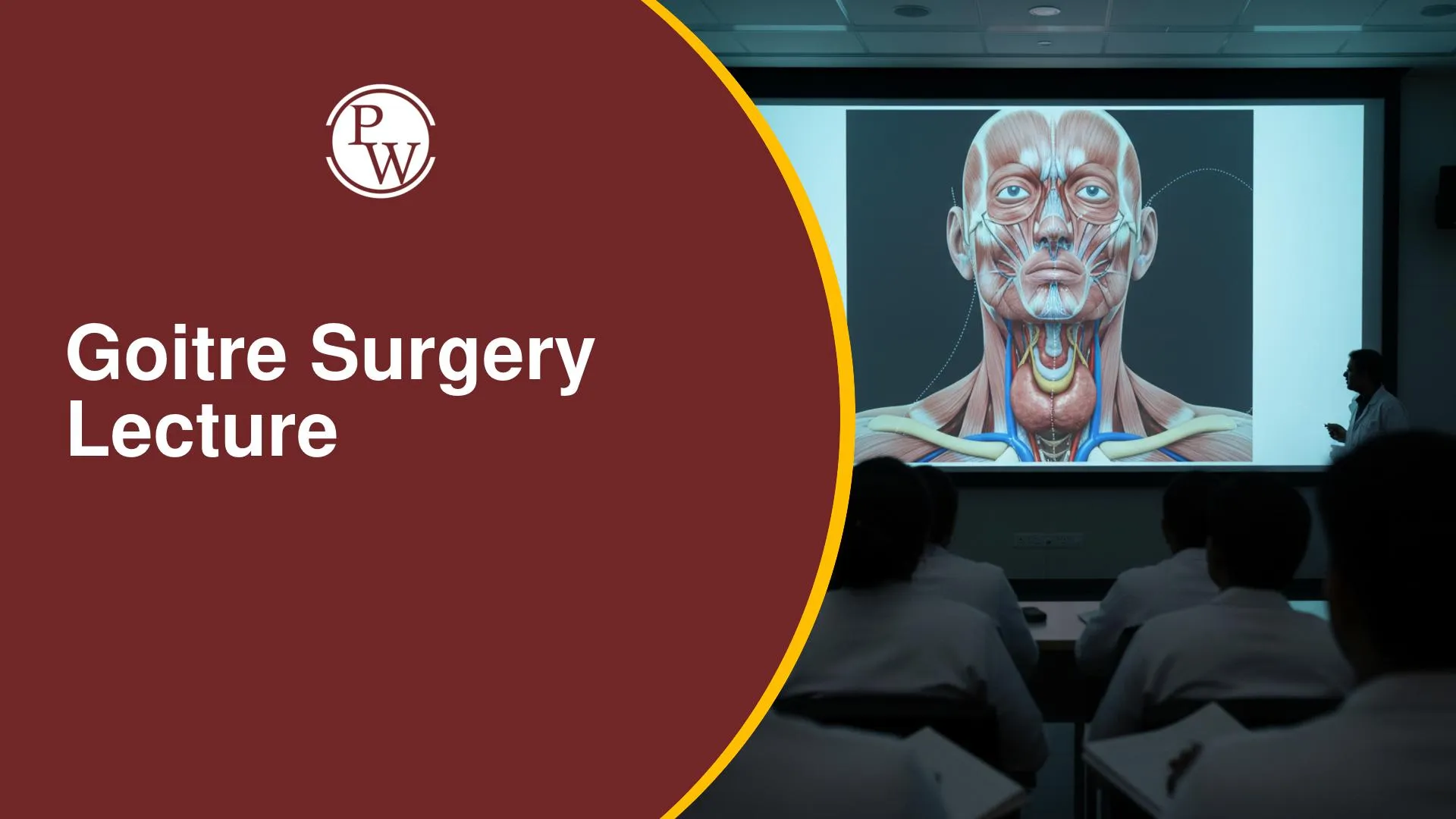
A goiter is defined as a generalized enlargement of the thyroid gland, characterized by a uniform affection of the entire organ. This condition arises from various physiological and non-physiological factors, often linked to imbalances in thyroid hormone production and iodine availability.
Understanding its causes, development, clinical signs, and potential complications is crucial for effective diagnosis and management.
Causes of Goiter
Goiter can be categorized into two main types based on its underlying causes: Physiological Goiter and Non-physiological Goiter.
Physiological Goiter
This type occurs when there is an increased demand for thyroid hormone, and the existing supply is inadequate. The gland enlarges to compensate and produce more hormone. Examples include periods of increased metabolic demand like puberty and pregnancy. This is a physiological enlargement that is reversible, with the gland returning to normal size once the increased demand subsides.
Non-physiological Goiter
Non-physiological goiters are classified based on iodine deficiency or impaired utilization.
Primary Iodine Deficiency
To maintain euthyroid status, the daily iodine requirement is 0.1 to 0.15 mg/day. When iodine intake is reduced, failing to meet this daily requirement, a goitrous state develops. This is the primary cause of endemic goiter, common in populations consuming food from iodine-deficient soil or water, such as in hilly regions.
Secondary Iodine Deficiency
In this condition, iodine intake is normal, but the iodine uptake or utilization by the thyroid follicles is reduced.
- Goitrogens: These are food substances that interfere with iodine absorption. Examples include members of the Brassicaceae family like cabbage and turnip. Goitrogens produce thiocyanate, which blocks the sodium-iodine symporter (NIS) on thyroid follicular cells, preventing iodine uptake.
-
Dishormonogenesis: This condition involves a deficiency of the thyroperoxidase (TPO) enzyme, which is essential for organification of iodine and its incorporation into thyroid hormones. Without sufficient TPO, iodine cannot be processed to synthesize T3 and T4.
-
Drugs: Certain medications, such as Amiodarone, can interfere with iodine absorption and utilization, leading to goiter.
Pathophysiology of Goiter
The pathophysiology of goiter formation, especially in iodine deficiency, involves a disruption of the Hypothalamic-Pituitary-Thyroid (HPT) axis.
Normal HPT Axis Review
The Hypothalamus releases Thyrotropin-Releasing Hormone (TRH), which stimulates the Pituitary Gland to release Thyroid-Stimulating Hormone (TSH). TSH then stimulates the Thyroid Gland to produce T3 and T4. Adequate T3 and T4 levels exert negative feedback on the hypothalamus and pituitary, inhibiting further TRH and TSH release. This entire cycle relies on a normal supply of iodine to the thyroid gland.
Goiter Formation Pathway (Diffuse Hyperplastic Goiter)
-
Decreased Iodine Supply: This occurs due to primary or secondary iodine deficiency.
-
Decreased T3/T4 Production: Inadequate iodine means the thyroid cannot synthesize sufficient T3 and T4.
-
Loss of Negative Feedback: Low T3/T4 levels fail to inhibit the hypothalamus and pituitary.
-
Increased TSH Secretion: The pituitary releases more TSH to stimulate thyroid hormone production.
-
TSH-Induced Thyroid Growth: TSH not only stimulates thyroid follicles but also promotes growth. Excess TSH causes proliferation of thyroid follicles through both hypertrophy (increase in cell size) and hyperplasia (increase in cell number) of follicular cells.
-
Gland Enlargement: This excessive proliferation and growth throughout the gland lead to a uniform enlargement of the entire thyroid gland.
-
Resulting Condition: This initial stage is known as Diffuse Hyperplastic Goiter. It is diffuse because it affects the entire gland uniformly, and hyperplastic due to the increased number of follicular cells.
-
Memory Tip: Think of iodine as the "raw material" (like sugarcane for juice). Even if the "machine" (HPT axis, TSH) is running, without raw material (iodine), the "product" (T3/T4) cannot be made.
Progression to Multi-Nodular Goiter (MNG)
Diffuse Hyperplastic Goiter is a reversible condition; if treated with iodine or hormonal supplementation, the gland can regress. However, if untreated and chronic, it can transform into an irreversible condition: Multi-Nodular Goiter (MNG).
Mechanisms of MNG formation:
Differential TSH Stimulus
In a diffusely enlarged gland, not all follicles respond equally to TSH. Some follicles become more active and proliferate extensively, forming nodules, while others become dormant or less active. This leads to differential growth and a nodular appearance.
Hemorrhage and Fibrosis
Hyperplasia in Diffuse Hyperplastic Goiter increases vascularity. Newly formed blood vessels can be fragile. Spontaneous rupture or minor trauma can cause hemorrhage within the gland, leading to sudden pain and increased gland size. The expanding hemorrhage pushes active follicular cells to the periphery, eventually transforming into a necrotic core that undergoes fibrosis. Fibrosis is an irreversible process. The active peripheral follicular cells continue to proliferate, leading to nodularity.
[MANDATORY CAUTION]: Long-standing, untreated Multi-Nodular Goiter is a risk factor for the development of follicular thyroid cancer. Unlike Diffuse Hyperplastic Goiter, MNG is often managed surgically due to its irreversible nature and malignant potential.
Clinical Presentation of Simple Goiter
This section focuses on Simple Goiter, where the patient is euthyroid or hypothyroid (not hyperthyroid).
Epidemiology
-
Age: Commonly observed in the third decade of life (30-40 years).
-
Sex: More common in females due to estrogen receptors on thyroid follicular cells, which respond to fluctuating estrogen levels. In endemic goiter areas, the incidence can be equal between sexes.
Classical Complaint
Patients typically present with a midline neck swelling that is usually painless and develops gradually over time.
Examination
Examination Position
The patient should be examined in a sitting position with adequate exposure of the neck.
-
Memory Tip: General rules for swelling examination: Above xiphisternum: Sitting position (e.g., breast, axilla, head, neck). Abdomen: Supine position. Inguino-scrotal: Standing position.
|
Examination |
|||
|---|---|---|---|
|
Method Name |
Patient Position & Action |
Examiner Position & Technique |
Specific Use/Indication |
|
1. Lahey's Method |
Sits with neck extended, hands by side. |
Stands behind the patient, uses all fingers to palpate the gland. |
General palpation. |
|
2. Pilos Method |
Sits, clasps hands behind head, pushes head backward (against examiner's hand) for maximum neck extension. |
Stands behind the patient, palpates the gland. |
For patients with short, stout, or obese necks to maximize neck exposure. |
|
3. Crile's Method |
Sits with hands across (normal sitting). |
Stands in front of the patient, anchors with one hand, and uses the thumb of the other hand to palpate. |
To assess nodularity of the gland. Palpate while the patient swallows to feel the gland move against the thumb. |
|
4. Koecher's Method |
Patient swallows as instructed. |
Places thumb on one side of the trachea, lateral to the thyroid gland. |
To feel gland movement and assess for nodularity against the thumb. |
Clinical Findings
-
Size Increase: Usually gradually increasing in size. A sudden increase in size with pain or tenderness indicates hemorrhage within the gland.
-
Pain/Tenderness: Typically painless and non-tender. Pain and tenderness are present with hemorrhage.
-
Movement with Deglutition: A key diagnostic feature is that the swelling moves upwards with deglutition (swallowing). This is due to the attachment of Berry's ligament to the pre-tracheal fascia, which moves with the larynx.
-
Surface on Palpation: A nodular surface confirms a Multi-Nodular Goiter. A smooth surface does NOT definitively rule out MNG or confirm Diffuse Hyperplastic Goiter, as small or deep nodules may not be palpable.
Complications of Goiter
If a goiter is left untreated, particularly if it becomes large and long-standing, several complications can arise.
Tracheomalacia
This is tracheal weakening caused by greatly enlarged thyroid gland exerting constant pressure on the trachea. This chronic pressure weakens the cartilaginous rings of the trachea.
-
Memory Tip: Think of the rubber band effect: A new rubber band recoils immediately, but one stretched daily for a month becomes weak and soggy. Similarly, constant pressure from an enlarged thyroid weakens the trachea.
-
Cokker's Test for Tracheomalacia Diagnosis: Lateral pressure on the trachea will cause it to collapse if tracheomalacic. Asking the patient to take a deep breath then reveals an inspiratory stridor due to turbulent airflow, indicating a positive test. Diagnosis is crucial pre-surgery to prevent postoperative tracheal collapse.
-
Radiological Finding: An X-ray may reveal a scabbard trachea, describing a compressed, flattened trachea.
-
Memory Tip: A scabbard is the sheath for a knife. A "scabbard trachea" describes a compressed trachea that appears flattened or scabbard-like due to external compression.
Other Complications of Long-Standing Goiter
In addition to tracheomalacia and pressure symptoms, long-standing goiter can lead to:
-
Secondary Thyrotoxicosis: Approximately 30% of patients with untreated goiter can become hyperthyroid.
-
Intrafollicular Hemorrhage: Can cause sudden gland enlargement and pain.
-
Calcification within the gland.
-
Increased risk for follicular cancer thyroid: Long-standing, untreated goiters carry a 10% risk of developing follicular thyroid cancer.
Investigation and Management of Goiter
After clinical history and examination, the diagnostic approach includes:
-
Thyroid Function Test (TFT): This is the first investigation for any thyroid swelling.
-
Ultrasound of the gland: Differentiates between a Diffuse Hyperplastic Goiter (uniform consistency) and a Multinodular Goiter (differential consistency due to various tissue types).
-
Fine Needle Aspiration Cytology (FNAC): Performed if TFT indicates a euthyroid or hypothyroid state to rule out malignancy. It is less commonly needed for hyperthyroid swellings, which are generally not malignant.
Management of Goiter
Management depends on the type of goiter:
Diffuse Hyperplastic Goiter
This is a reversible state. Management involves iodine supplementation and Thyroxine (T4) support. The swelling typically reverts to normal with this treatment.
Multinodular Goiter
This is an irreversible state. Management depends on the extent of involvement:
-
Unilateral condition (nodules in one lobe, other lobe normal): Lobectomy (surgical removal of the affected lobe and the isthmus).
-
Bilateral condition (both lobes involved): Total Thyroidectomy (surgical removal of the entire thyroid gland).
Post-Surgical Management:
-
Total Thyroidectomy: Requires lifelong thyroxine supplementation.
-
Lobectomy: Thyroxine supplementation is given initially and can be gradually weaned off if the remaining lobe compensates.
Goiter FAQs
What is a goiter and what are its main categories?
How does iodine deficiency lead to goiter formation?
What is the significance of the goiter moving with deglutition?
What are the potential complications of a long-standing goiter?
How is a Diffuse Hyperplastic Goiter managed differently from a Multi-Nodular Goiter?




Get Free Counselling Today
and Clear up all your Doubts
 Live & recorded classes available at easeDashboard for progress trackingLakhs of practice questions

