






Management of Inguinal Hernia: Open Repair, Laparoscopy, and Critical Danger Zones
 Priyanka Yadav25 Jul, 2026
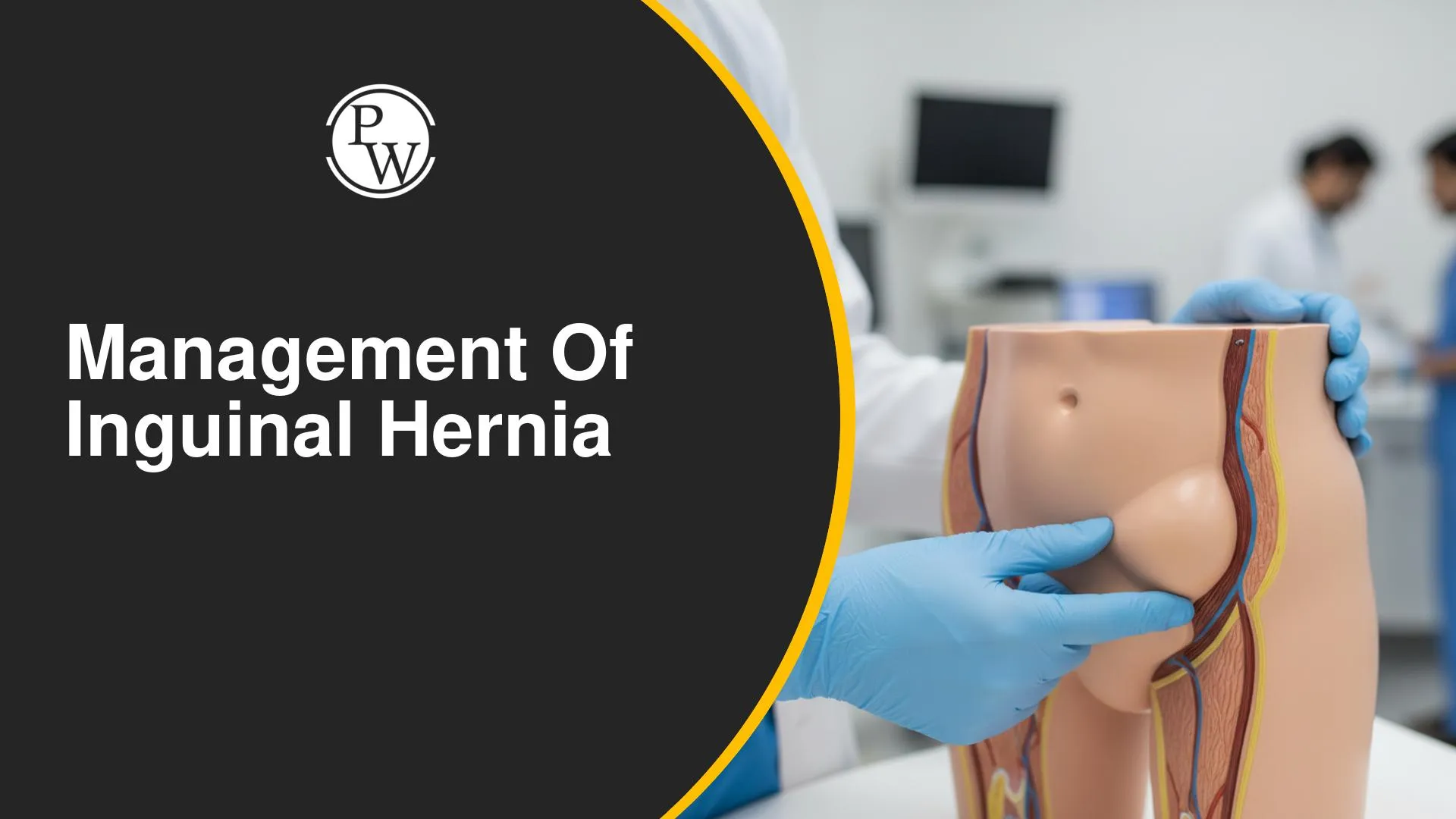
Management of an inguinal hernia is entirely surgical, and success depends not only on technique but also on precise anatomical understanding. From traditional open suture and mesh repairs to advanced laparoscopic approaches like TAP and TEP, each method requires careful navigation through the layers of the abdominal wall and inguinal canal.
Surgeons must be especially aware of high-risk anatomical zones visible during laparoscopy such as the Triangle of Doom, Triangle of Pain, and Corona Mortis where even a small mistake can lead to severe bleeding or chronic nerve injury. This makes inguinal hernia repair a true blend of surgical skill and applied anatomy.
Also Read - NEET PG 2026 Preparation
Inguinal Hernia Management Introduction
Inguinal hernias require surgical intervention, as no alternative non-surgical treatments exist. Check the fundamental surgical terms, various repair techniques, including open and laparoscopic approaches, and critical anatomical considerations essential for safe and effective inguinal hernia management. Understanding these principles is crucial for preventing surgical complications.
Key Surgical Terms
Before discussing specific repair techniques, three fundamental terms are essential to understand:
-
Herniotomy: The surgical opening of the hernia sac.
-
Herniorrhaphy: Repair of the posterior wall of the inguinal canal using the patient's own tissue and sutures.
-
Hernioplasty: Strengthening the posterior wall of the inguinal canal using a synthetic mesh.
Detailed Steps of Open Inguinal Hernia Repair and Herniotomy
Open inguinal hernia repair involves a systematic approach to access and manage the hernia sac.
Incision and Layer-by-Layer Dissection (Outside-In View)
An incision is made, followed by dissection through layers:
-
Skin
-
Subcutaneous fat (Camper's and Scarpa's fascia)
-
External oblique aponeurosis (exposing the inguinal canal)
-
Structures within the inguinal canal: Vast deferens, ilioinguinal nerve.
-
Posterior layer: Fascia transversalis (with the defect of the deep inguinal ring).
The hernia sac, a peritoneal protrusion, typically originates from the deep inguinal ring in an indirect hernia, traversing the inguinal canal and exiting via the superficial inguinal ring.
Herniotomy
The process of herniotomy involves:
-
Opening the Sac: The hernia sac is isolated and opened.
-
Reducing the Content: Any contents (e.g., bowel loops) within the sac are gently pushed back into the abdominal cavity.
-
Plication of the Sac: The empty sac is twisted or folded.
-
Excision of Redundant Sac: The plicated, redundant portion of the sac is ligated and excised.
Also Read - NEET PG 2026
Comparison: Herniorrhaphy Versus Hernioplasty
After herniotomy, the defect in the posterior wall of the inguinal canal needs repair.
|
Comparison: Herniorrhaphy Versus Hernioplasty |
||
|---|---|---|
|
Feature |
Herniorrhaphy |
Hernioplasty
|
|
Repair Method |
Uses the patient's own tissue and sutures |
Uses a synthetic mesh (e.g., Prolene mesh) |
|
Purpose |
Strengthens the posterior wall by approximating tissues |
Provides additional structural support and reinforcement |
|
Consideration |
Requires care to avoid nerve/vessel incorporation |
Minimizes tension on tissues, reduces recurrence |
Types of Hernia Repair
Hernia repairs are broadly categorized into two main types:
-
Open Repair
-
Laparoscopic Repair
Open Hernia Repair Methods
Open repair methods are classified by the materials used:
-
Open Suture Repair (Pure Tissue Repair): No mesh is used. Examples include Bassini surgery and Shouldice repair.
-
Open Mesh Repair: Involves the placement of a mesh. The Lichtenstein tension-free mesh repair is a commonly utilized technique.
-
Open Complex Mesh Repair: Generally not recommended.
-
Open Preperitoneal Repair: Examples include the Transinguinal approach and Stoppa repair.
Laparoscopic Hernia Repair Methods
Laparoscopic hernia repair uses two primary approaches:
-
TAP: Transabdominal Preperitoneal repair.
-
TEP: Total Extraperitoneal repair.
Laparoscopic Inguinal Hernia Anatomy (Inside-Out View)
Understanding the anatomy from an "inside-out" perspective is crucial for laparoscopic repair. Imagine you are inside the abdominal cavity of the patient, looking up towards the abdominal wall (Memory Tip: This 'inside-out' view helps visualize laparoscopic anatomy, much like looking at a map from a unique vantage point).
Layers from inside-out:
-
Peritoneum
-
Fascia Transversalis
-
Subcutaneous fat
-
Skin
Key anatomical landmarks visible from inside the abdominal cavity include the deep inguinal ring, superficial inguinal ring, and structures traversing these areas like the vast deferens. After carefully pulling down the peritoneum to expose the posterior wall, critical structures become visible:
-
Vast deferens
-
Testicular/Gonadal vessels (gonadal artery and vein)
-
External iliac artery
-
External iliac vein
Within this laparoscopic view, several clinically significant anatomical triangles are identified:
Triangle of Doom
This is a critical area where injury can lead to catastrophic consequences.
-
Boundaries:
-
Medially: Vast deferens
-
Laterally: Gonadal vessels
-
Inferiorly: Peritoneum
-
Apex: Deep inguinal ring
-
Content: External iliac artery and external iliac vein.
-
Clinical Significance: Injury to these major vessels can result in catastrophic hemorrhage and death.
Triangle of Pain
Adjacent to the Triangle of Doom, this area is significant due to the presence of nerves.
-
Boundaries:
-
Medially: Gonadal vessels
-
Laterally: Ilio-pubic tract
-
Inferiorly: Peritoneum
-
Apex: Deep inguinal ring
-
Content: Multiple nerves, including the lateral cutaneous nerve of the thigh and branches of the femoral nerve.
-
Clinical Significance: Injury to these nerves can cause chronic post-operative pain, often severe.
Trapezoid of Disaster / Electrical Hazard Zone
-
Definition: The combined area of the Triangle of Doom and the Triangle of Pain.
-
Clinical Significance: Represents an area of high risk for both catastrophic vascular injury and severe neurological injury. It is also referred to as the electrical hazard zone, indicating that cautery should not be used in this region due to the high risk of damaging critical vessels and nerves.
Corona Mortis (Crown of Death)
-
Definition: An abnormal communication between the inferior epigastric artery (a branch of the external iliac artery) and the obturator artery (often an aberrant obturator artery). This connection is typically located on the posterior surface of the pubic ramus, near the pubic tubercle.
-
Clinical Significance: This anomaly is extremely dangerous. During laparoscopic mesh fixation, placing a tucker (screw-like device) into the pubic bone without awareness of this variation can injure the Corona Mortis. The arteries, being elastic, will retract, leading to torrential, life-threatening hemorrhage from both the inferior epigastric and obturator arteries, which are major branches of the iliac system. This is why it is called the "Crown of Death".
Re-orientation of Anatomy for Laparoscopic View
To reinforce the laparoscopic perspective, visualize the patient's abdomen from within. The anatomical layers are peritoneum, fascia transversalis, lateral abdominal wall muscles, subcutaneous fat, and skin. The vast deferens enters the deep inguinal ring and travels medially. When the peritoneum is carefully opened and pulled down, the underlying structures, including the critical vascular and neural components forming the Triangle of Doom and Triangle of Pain, become clearly visible, highlighting their surgical importance.
| NEET PG Surgery Video-Based Questions | Video-Based Questions on Larynx for NEET PG |
| Medicine Video-Based Questions to Crack NEET PG | NEET PG 2026 Pediatrics Video-Based Questions |
Management of Inguinal Hernia FAQs
What are the three fundamental surgical terms associated with inguinal hernia repair?
How does Herniorrhaphy differ from Hernioplasty?
What are the two primary approaches for laparoscopic inguinal hernia repair?
Describe the boundaries and clinical significance of the Triangle of Doom.
What is the Corona Mortis and why is it surgically significant?




Get Free Counselling Today
and Clear up all your Doubts
 Live & recorded classes available at easeDashboard for progress trackingLakhs of practice questions

