








Biology Anatomy of Flowering Plants Diagrams for NEET by Physics Wallah
 Avisha Das14 Jul, 2026
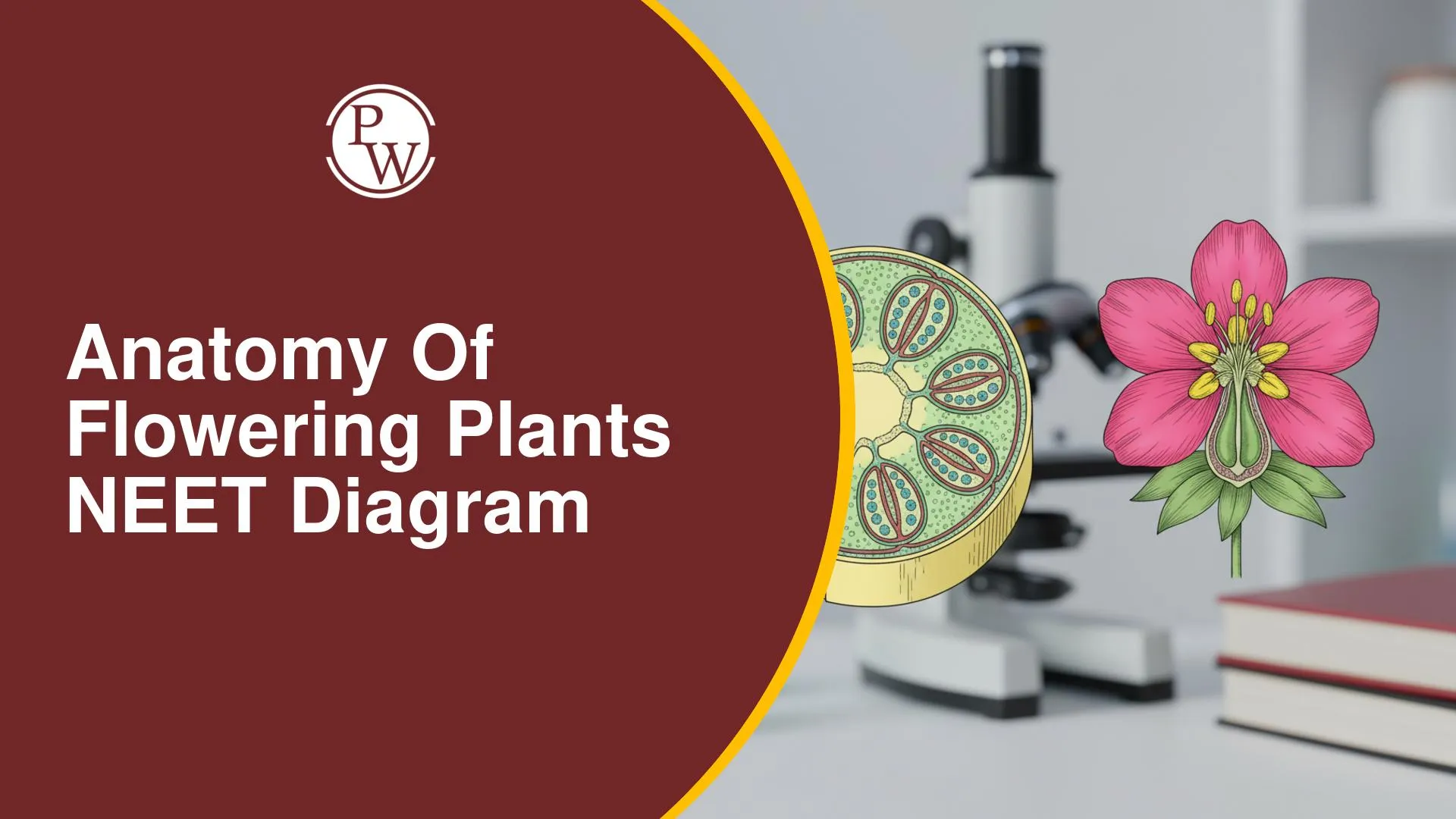
Looking at the inside of a plant is like reading its blueprint. Every tissue, vascular bundle, and cell layer has a specific role, and understanding how these structures are arranged is the key to solving Anatomy of Flowering Plants questions in NEET.
Unlike chapters that rely mainly on theory, this one demands strong visual memory. Cross-sections, tissue arrangements, and labelled anatomical features are much easier to recall when studied through diagrams. Physics Wallah provides Anatomy of Flowering Plants NEET diagrams that transform detailed anatomical structures into organised visuals, helping you identify, compare, and revise important concepts with ease.
Anatomy of Flowering Plants NEET Diagrams PDF
The Anatomy of Flowering Plants NEET diagrams PDF brings together neatly labelled cross-sections, comparison charts, and anatomical illustrations that highlight the most important topics in the chapter. It allows you to revise structural features quickly without searching through multiple pages of notes.
Download the Anatomy of Flowering Plants NEET Diagrams PDF below.
Anatomy of Flowering Plants NEET Diagrams PDF
Why Use PW Anatomy of Flowering Plants NEET Diagrams?
Well-labelled illustrations make plant anatomy easier to understand and significantly improve visual recall during examinations.
1. Makes Tissue Identification More Accurate
PW diagrams help you distinguish simple tissues, complex tissues, and their structural characteristics without confusion.
2. Simplifies Root, Stem, and Leaf Anatomy
Cross-sectional illustrations clearly highlight the arrangement of different tissues, making comparisons much easier during revision.
3. Helps You Visualise Secondary Growth
Stepwise diagrams explain cambium activity, annual ring formation, and secondary tissue development in an easy-to-follow sequence.
4. Improves Comparison-Based Learning
Visual comparison charts help you differentiate monocot and dicot roots, stems, and leaves more efficiently than text-based revision.
5. Organises Complex Structures into Simple Visual Maps
Regular exposure to labelled figures prepares you to identify anatomical structures quickly in image-based and concept-based NEET questions.
Also check:
Anatomy of Flowering Plants Diagrams FAQs
Which diagrams are most important in Anatomy of Flowering Plants for NEET?
How do diagrams help in solving NEET questions?
Does Physics Wallah provide other resources for this chapter?


Have questions about your prep?
Our experts can answer all your questions





 Live & recorded classes available at easeDashboard for progress trackingLakhs of practice questions

