Electromagnetic Induction and AC for NEET 2026 | Complete Chapter Notes

Electromagnetic Induction and AC for NEET 2026 is an important Physics chapter that explains how electricity and magnetism are interconnected. This topic covers key concepts like Faraday’s laws of electromagnetic induction, Lenz’s law, self and mutual inductance, alternating current, reactance, impedance, transformers, and power in AC circuits.
For NEET aspirants, understanding the logic behind induced EMF and the behavior of AC circuits is essential, as questions are often formula-based as well as concept-driven. With regular practice of numericals and clarity in fundamental principles, students can score well in this high-weightage and application-oriented chapter.
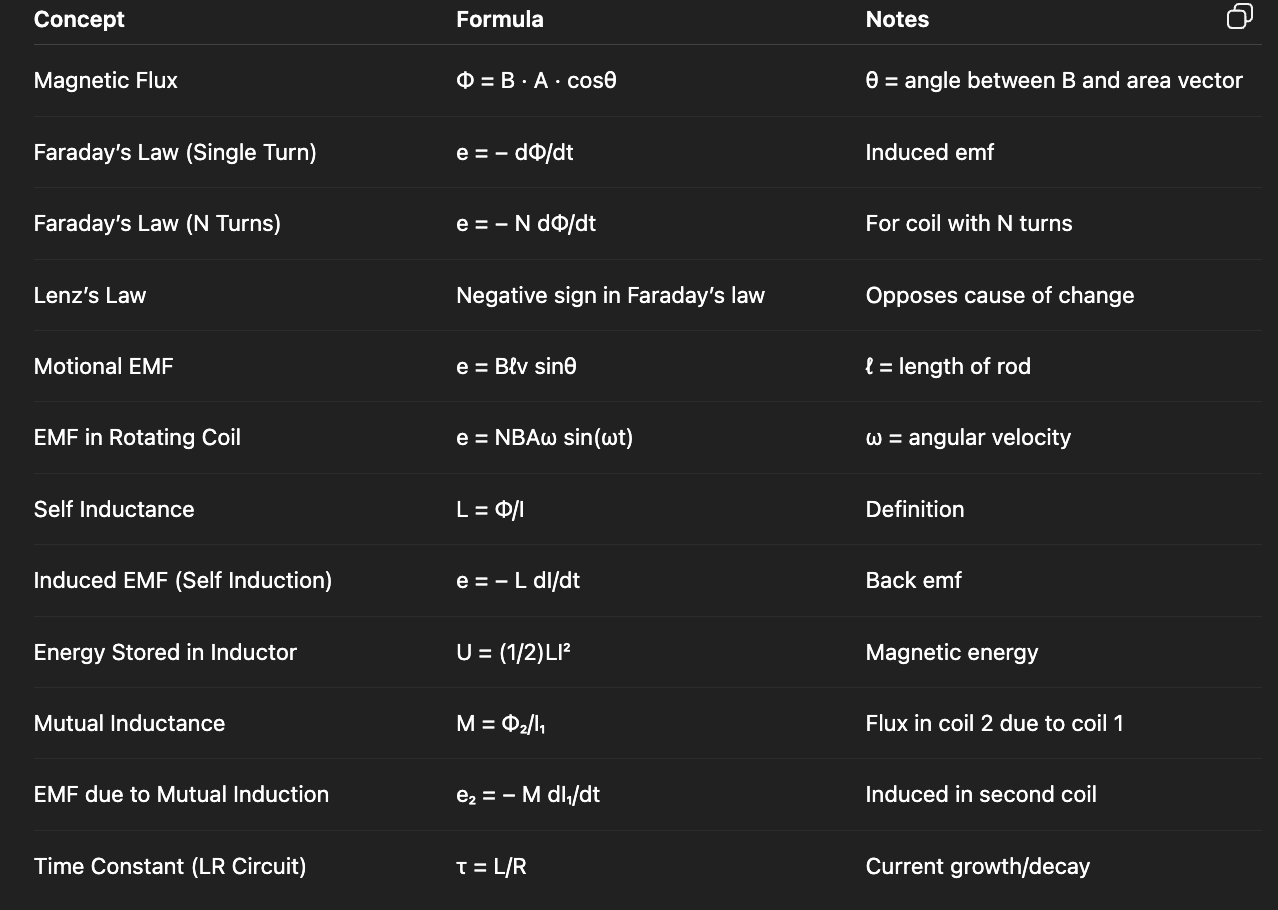
Electromagnetic Induction Formulas for NEET
Below are the important Electromagnetic Induction formulas for NEET 2026 for quick revision.
Concepts of Electromagnetic Induction (EMI)
Electromagnetic induction occurs when a change in the magnetic environment of a coil of wire causes a voltage (EMF) to be created in the coil.
Faraday’s Laws of Electromagnetic Induction
Faraday’s observations are the bedrock of EMI. His laws state:
-
First Law: Any change in the magnetic flux linked with a closed circuit induces an electromotive force (EMF) in the circuit.
-
Second Law: The magnitude of the induced EMF is determined by the rate at which the magnetic flux changes over time.
Lenz Law Explanation for NEET
A vital part of the syllabus is the Lenz law explanation for NEET. While Faraday tells us how much EMF is produced, Lenz Law tells us the direction. It states that the direction of the induced current will always be such that it opposes the change in magnetic flux that created it. This ensures the law of conservation of energy is maintained, as work must be done to move a magnet against this opposition.
Induction: Self and Mutual
Understanding self inductance and mutual inductance is essential for grasping how components like inductors and transformers work.
-
Self Inductance: This is the property of a coil where a change in current flowing through it induces an EMF in the same coil. It acts as "electrical inertia," resisting any change in the current flow.
-
Mutual Inductance: This occurs when the changing current in one coil (primary) induces an EMF in a nearby second coil (secondary) through the magnetic field shared between them.
Fundamentals of Alternating Current (AC)
Unlike Direct Current (DC), Alternating Current changes its direction and magnitude periodically. For aspirants, understanding the behavior of AC in different components is key.
RMS Value of AC Current
Since AC is constantly fluctuating, we use the rms value of AC current to compare it to DC. The RMS (Root Mean Square) value represents the effective current—the amount of DC current that would produce the same heating effect in a resistor.
Reactance and Impedance
In an AC circuit, resistance is not the only thing that hinders current.
-
Inductive Reactance: The opposition offered by an inductor to the flow of AC.
-
Capacitive Reactance: The opposition offered by a capacitor to the flow of AC.
-
Impedance: This is the total effective opposition of a circuit containing a combination of resistors, inductors, and capacitors.
LCR Circuit Resonance Condition
The LCR circuit resonance condition is a specific state in a series circuit where the inductive reactance and capacitive reactance perfectly cancel each other out. At this specific frequency:
-
The circuit's total opposition (impedance) is at its minimum.
-
The current flowing through the circuit reaches its maximum peak.
-
The circuit behaves as if it only contains a resistor.
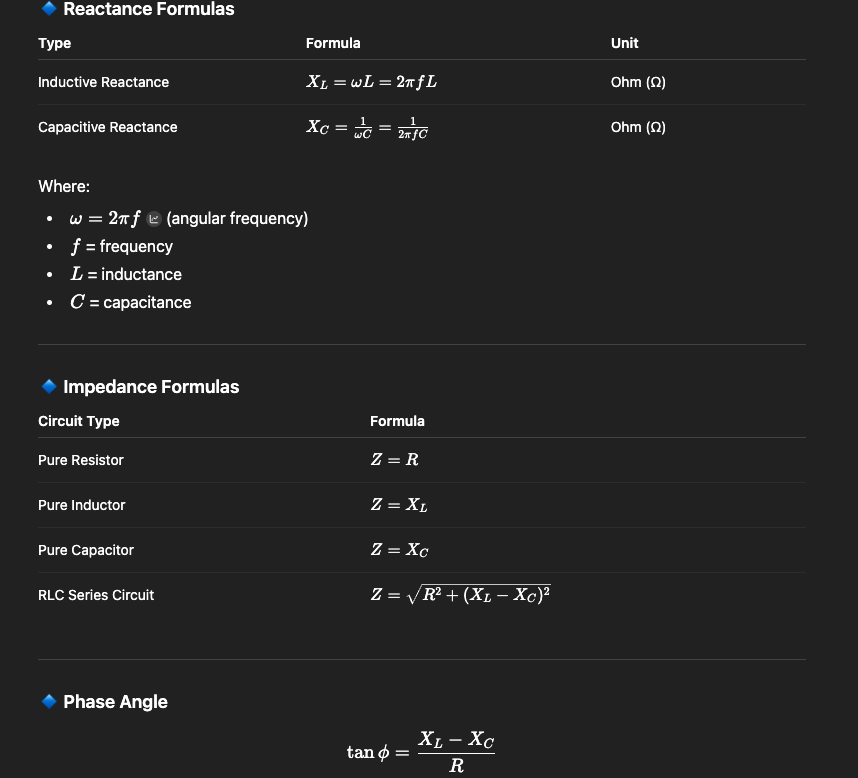
Reactance and Impedance Formula
Reactance and impedance are key concepts in alternating current (AC) circuits.
They help determine how a circuit opposes the flow of AC and are very important for NEET numericals.
Preparation Tips for NEET 2026
To solve electromagnetic induction and AC NEET MCQs effectively, candidates should focus on:
-
Conceptual Visualization: Use phasor diagrams to understand the lead-lag relationship between voltage and current.
-
Comparison Tables: Create a table comparing the properties of pure resistive, inductive, and capacitive circuits.
-
Logical Application: Practice questions that require applying Lenz Law to find the direction of induced current in various loop configurations.
Electromagnetic Induction and AC for NEET 2026 PDF Download
For students preparing for NEET 2026, understanding Electromagnetic Induction and AC is essential because it forms a crucial part of the Physics syllabus and is frequently tested in both theoretical and numerical formats. This chapter explains how changing magnetic fields induce electric current and how alternating current (AC) behaves in circuits, including transformers and reactance. To help you study this topic effectively, a comprehensive resource is available through the link below.
Electromagnetic Induction and AC for NEET 2026 PDF Download
Electromagnetic Induction and AC for NEET 2026 FAQs
Why is the direction of induced EMF negative in Faraday law?
What is the significance of the RMS value in household appliances?
How does a transformer use mutual inductance?


Have questions about your prep?
Our experts can answer all your questions