Evolution in ONE SHOT Class 12 NEET 2026 by Samapti Ma’am



Evolution is the final chapter of Class 12 Biology. It is an important chapter for NEET. Many questions are asked directly from the NCERT facts, timelines, and principles. The chapter may look scattered while reading the NCERT. A one-shot approach helps in understanding the flow of events clearly.
Evolution explains how life on Earth began and how organisms changed over time. It focuses on slow and gradual changes that happened over millions of years. These changes helped organisms survive in changing environments.
Meaning and Importance of Evolution
Evolution means gradual change in organisms over a long period of time. These changes occur across generations. Evolution helps organisms adapt to their environment. Adaptation increases chances of survival.
Evolutionary biology studies the history of life on Earth. It explains the diversity of plants and animals. It also explains how simple organisms gave rise to complex forms.
Origin of the Universe, Earth, and Life
The most accepted theory for the origin of the universe is the Big Bang Theory. According to this theory, the universe originated about 13.8 billion years ago.
Big Bang Theory
The Big Bang Theory explains the origin of the universe. According to this theory, the universe began from a very hot and dense point. This event occurred about 13.8 billion years ago. After the explosion, the universe started expanding. Galaxies, stars, and planets were formed over time.
Hydrogen and helium were the first elements formed. These gases later condensed to form stars and galaxies. Our galaxy is called the Milky Way.
Origin of Earth
The Earth was formed around 4.5 billion years ago (BYA). The conditions on primitive Earth were extremely harsh and unsuitable for life as we know it today.
Primitive Earth Conditions
-
Temperature Differential: The Earth had a very hot interior with a comparatively cooler surface.
-
Volcanic Eruptions: Frequent volcanic activity released molten lava across the surface.
-
Atmosphere Formation: Volcanic gases formed the primitive atmosphere, consisting mainly of water vapour (H₂O), carbon dioxide (CO₂), methane (CH₄), and ammonia (NH₃).
-
Reducing Atmosphere: Free oxygen (O₂) was absent.
-
Absence of Ozone Layer: Without an ozone layer, harmful ultraviolet (UV) radiation would reach the Earth’s surface directly.
UV radiation splits water vapour into hydrogen and oxygen. Hydrogen escaped into space, while oxygen reacted with other gases, maintaining the reducing nature of the atmosphere.
As the Earth cooled, water vapour condensed, resulting in continuous rainfall over thousands of years. This led to the formation of oceans. These oceans contained dissolved atmospheric gases and were described by J.B.S. Haldane as a “hot dilute soup”, where the first life is believed to have originated.
Timeline of the Origin of Life
-
Origin of the Universe: 13.8 BYA
-
Origin of the Earth: 4.5 BYA
-
Appearance of Life: Around 4 BYA
-
First Non-cellular Life Forms: Around 3 BYA (RNA, proteins)
-
First Cellular Life Forms: Around 2 BYA
Theories on the Origin of Life
Several theories have been proposed to explain the origin of life.
A. Theory of Special Creation
Proposed by Father Suarez, this theory states that life was created by a supernatural power in six days. It assumes that life is immutable and that the Earth is only 4000 years old. This theory completely rejects evolution.
B. Theory of Catastrophism
This theory suggests that life on Earth has been destroyed multiple times due to catastrophic events, and new life appeared after each event. However, it does not explain the origin of the first life.
C. Extra-terrestrial / Cosmozoic / Panspermia Theory
According to this theory, life originated elsewhere in the universe and reached Earth in the form of spores or seeds.
D. Theory of Abiogenesis (Spontaneous Generation)
This theory proposed that life could arise spontaneously from non-living matter, such as reptiles emerging from mud. This idea has been completely disproven.
Theory of Biogenesis – Disproval of Abiogenesis
The Theory of Biogenesis states that life arises only from pre-existing life (Omnis vivum ex vivo).
Louis Pasteur’s Swan-Neck Flask Experiment
Louis Pasteur experimentally disproved abiogenesis.
Setup: Two flasks containing nutrient broth were used. One had an intact S-shaped neck, while the other had a broken neck.
Observation:
-
The broth in the swan-neck flask remained clear because microbes were trapped.
-
The broth in the broken-neck flask became cloudy due to microbial growth.
Conclusion: Life arises only from pre-existing life. Pasteur did not explain how the first life originated.
| Flask Type | Air Entry | Microbe Entry | Result | Conclusion |
| Swan-Neck Flask | Yes | No | No life | No spontaneous generation |
| Broken-Neck Flask | Yes | Yes | Microbial growth | Life from life |
Theory of Chemical Evolution (Oparin-Haldane Theory)
Proposed by A.I. Oparin and J.B.S. Haldane, this theory explains the origin of life through chemical evolution under primitive Earth conditions.
Hypothesised Sequence
Free atoms → Simple inorganic molecules → Inorganic compounds → Organic monomers → Organic polymers → Protobionts → First true cells
Protobionts
Protobionts were aggregates of organic molecules with membrane-like boundaries, such as coacervates and microspheres. They acted as a bridge between non-cellular and cellular life forms.
Miller-Urey Experiment (1953)
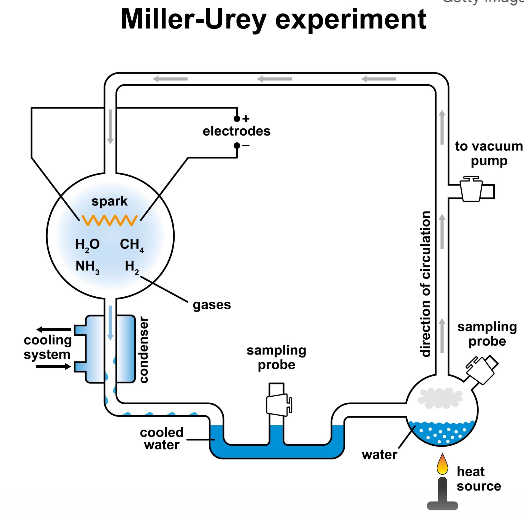
Objective: To synthesise organic molecules from inorganic substances.
Setup: Boiling water simulated oceans, spark discharge simulated lightning (75,000 volts, 800°C), and gases included methane, ammonia, and hydrogen.
Result: After 18 days, amino acids like glycine, alanine, and aspartic acid were formed.
Conclusion: Organic molecules can form under primitive Earth conditions, supporting chemical evolution.
Theories of Evolution
Lamarckism
Proposed by Jean-Baptiste Lamarck, this theory is based on the inheritance of acquired characters.
Refutation: August Weismann’s germ plasm theory disproved Lamarckism using tail-cutting experiments on mice.
Darwinism
Proposed by Charles Darwin and Alfred Russel Wallace, Darwinism explains evolution through natural selection.
Key concepts include variation, struggle for existence, survival of the fittest, branching descent, and reproductive fitness.
Mutation Theory
Proposed by Hugo de Vries, it states that evolution occurs due to sudden mutations.
Modern Synthetic Theory (Neo-Darwinism)
Evolution occurs due to mutation, natural selection, genetic recombination, gene migration, and genetic drift.
Evidence of Evolution: Divergent vs. Convergent
Anatomical structures provide the strongest evidence for evolutionary patterns:
A. Homologous Structures (Divergent Evolution)
These structures share a common origin but perform different functions. They show that different species evolved from a single ancestor to adapt to different environments. Example: Forelimbs of a human, cheetah, whale, and bat.
B. Analogous Structures (Convergent Evolution)
These structures have different origins but perform similar functions. They show that unrelated species can develop similar traits due to similar environmental pressures. Example: Wings of a butterfly and a bird; eyes of an octopus and a mammal.
The Hardy-Weinberg Principle
This principle provides a mathematical baseline to detect evolution. In an ideal population, allelic frequencies stay constant (p + q = 1).
Evolution occurs when this equilibrium is disturbed by:
-
Genetic Drift: Random changes in small populations (Founder Effect).
-
Gene Flow: Migration of individuals between populations.
-
Natural Selection and Mutation.
Human Evolution
Human evolution is characterized by a significant increase in cranial capacity (brain size) and the development of bipedalism.
| Human Evolution | |||
| Hominid | Time Period | Cranial Capacity | Key Feature |
| Dryopithecus | 15 MYA | - | More ape-like |
| Ramapithecus | 15 MYA | - | More man-like |
| Australopithecus | 2 MYA | ~500 cc | First bipedal movement |
| Homo habilis | - | 650-800 cc | First toolmaker |
| Homo erectus | 1.5 MYA | 900 cc | Used fire; ate meat |
| Neanderthal | 100k-40k YA | 1400 cc | Buried their dead |
| Homo sapiens | 75k-10k YA | ~1350 cc | Modern man; agriculture |
volution is concept-based and NCERT-driven. Diagrams, timelines, and examples are frequently asked. Regular revision and clarity of basics are essential for scoring well.
Evolution FAQs
What is evolution in biology?
Which theory best explains the origin of life on Earth?
What is the Hardy Weinberg principle used for?


Have questions about your prep?
Our experts can answer all your questions