








Free Lectures for NEET 2026 by PW Faculties – Subject-wise Playlists
Physics Wallah provides free educational content through online video lectures and playlists that students can access for concept building, revision, and topic-wise preparation. Aspirants can use these lectures along with NCERT textbooks, previous year question papers, mock tests, and regular self-study to build a structured NEET preparation routine.
This page provides the latest free lecture playlists for NEET 2026 shared for students preparing for Physics, Chemistry, Biology, and related NEET topics.
Free Lectures for NEET 2026 by PW Faculties
Free NEET lectures can help students study important concepts from home and revise topics according to their individual preparation needs. Instead of relying on random individual videos, students can follow a structured playlist so that they can study multiple lectures in sequence.
The playlists below can be used by NEET aspirants for learning and revision. Students should select the playlist relevant to their subject or preparation requirement and follow the lectures consistently.
NEET 2026 Free Lecture Playlists
| Free NEET Lecture Playlist | Access |
|---|---|
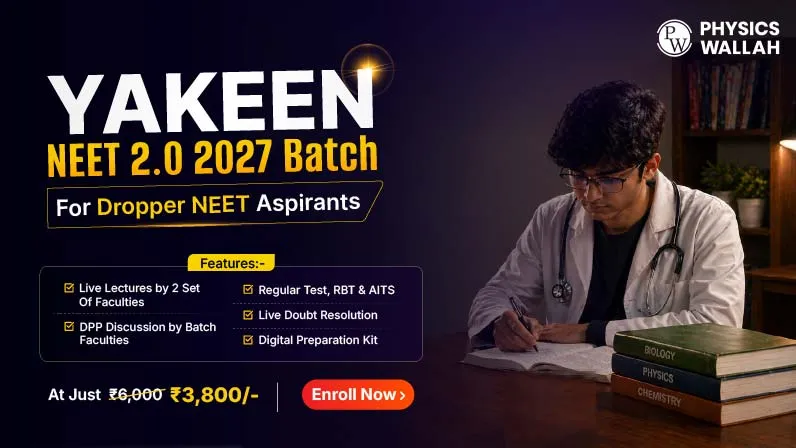
| Yakeen 2.0 2027 | Watch Playlist |
| MISSION 30 | Watch Playlist |
| MISSION 30 | Watch Playlist |
| Complete NEET PHYSICS by Saleem Sir | Watch Playlist |
| Complete NEET BOTANY by Akanksha Mam | Watch Playlist |
Note: Students should open the playlists and follow the lectures according to their current syllabus, subject requirements, and preparation level.
How to Use Free NEET 2026 Lectures Effectively?
Watching lectures alone is not enough to achieve a strong NEET score. Students should combine video learning with reading, revision, and question practice.
A simple approach is to follow these steps:
1. Study the Topic Through the Lecture
Start by watching the relevant lecture carefully. Keep your NCERT textbook and notebook nearby so that you can connect the concepts explained in the lecture with the prescribed study material.
Avoid watching lectures passively. Make short notes of important concepts, formulas, reactions, diagrams, exceptions, and points that you find difficult.
2. Read NCERT After the Lecture
For NEET preparation, students should regularly refer to NCERT textbooks, particularly for Biology and Chemistry topics.
After completing a lecture, read the corresponding NCERT chapter or section. This helps you identify important definitions, statements, diagrams, examples, and factual information that may be useful during revision.
3. Solve Questions
After completing a topic, solve relevant questions instead of immediately moving to another lecture.
Question practice helps you determine whether you actually understood the concept. It also helps identify topics that require another round of revision.
4. Revise Regularly
Do not wait until the end of the syllabus to revise completed topics.
Use short revision sessions to revisit:
- Important formulas
- NCERT facts
- Difficult concepts
- Chemical reactions
- Biology diagrams and terminology
- Previous mistakes
- Frequently asked concepts
- Questions marked for revision
5. Track Your Progress
Maintain a simple checklist of completed lectures and topics.
For every chapter, track whether you have:
Watched the lecture - Read NCERT - Made notes - Solved questions - Revised - Taken a test
This makes preparation more organized and helps prevent unfinished topics from accumulating.
Subject-wise NEET 2026 Preparation With Free Lectures
NEET preparation is divided mainly into Physics, Chemistry, and Biology. Each subject requires a different approach, so students should use free lectures according to the requirements of the topic.
Free Physics Lectures for NEET 2026
Physics requires both conceptual understanding and numerical practice. Students should focus on understanding the principles behind formulas instead of memorizing them without context.
While using free Physics lectures, students should:
- Understand the basic concept before solving numerical questions.
- Maintain a separate formula and revision notebook.
- Solve questions immediately after completing a topic.
- Practice NEET-level numerical problems.
- Review mistakes regularly.
- Revisit difficult chapters through lectures when necessary.
A useful study sequence is:
Lecture - Concept Notes - Formula Revision - Questions - Error Analysis - Revision
Students can access the available free lecture playlists from the table above and select the relevant Physics content.
Free Chemistry Lectures for NEET 2026
Chemistry requires a combination of conceptual understanding, memorization, application, and regular revision.
Students can divide their preparation into Physical Chemistry, Organic Chemistry, and Inorganic Chemistry and use lectures according to their requirements.
Physical Chemistry
Focus on:
- Understanding concepts and formulas
- Solving numerical problems
- Maintaining a formula sheet
- Practising different question types
- Revising calculations and common mistakes
Organic Chemistry
Organic Chemistry becomes easier when students understand reaction mechanisms, concepts, and relationships between different reactions.
After watching a lecture, revise important reactions and practise questions based on the topic.
Inorganic Chemistry
Students should give special importance to NCERT while preparing Inorganic Chemistry. Read the relevant NCERT sections after completing lectures and revise important facts repeatedly.
Free Biology Lectures for NEET 2026
Biology has a major role in NEET preparation, and students should combine lectures with detailed NCERT reading.
While watching free Biology lectures:
- Keep the relevant NCERT chapter open.
- Mark important concepts and facts.
- Pay attention to diagrams and terminology.
- Make concise revision notes.
- Solve chapter-wise questions.
- Revise completed chapters at regular intervals.
Students should avoid depending exclusively on lecture notes. NCERT should remain an important part of their Biology preparation and revision process.
Are Free Lectures Enough for NEET 2026 Preparation?
Free lectures can be an important part of NEET preparation, but students should not depend on lectures alone.
A complete preparation strategy should include:
- NCERT textbooks
- Concept-building lectures
- Chapter-wise question practice
- NEET previous year questions
- Mock tests
- Revision
- Error analysis
- Regular self-assessment
The purpose of free lectures should be to learn, understand, and revise concepts. Students should then test that understanding by solving questions.
How to Make a NEET 2027 Study Plan Using Free Lectures?
Students can create a simple weekly plan around the available playlists.
Step 1: Identify Pending Topics
Make a list of chapters or topics that you have not studied properly.
Step 2: Select Relevant Lectures
Choose the appropriate free lecture playlist and identify the videos required for your pending topics.
Step 3: Set Daily Targets
Instead of setting only a video target, create a complete learning target.
For example:
Lecture + NCERT reading + 40–60 questions + revision
The exact number of questions can be adjusted according to your level and available time.
Step 4: Keep a Backlog Tracker
Record unfinished lectures and topics. Try to clear the backlog systematically rather than continuously adding new lectures.
Step 5: Test Yourself
After completing a chapter, take a chapter-wise or topic-wise test. Use your mistakes to determine what needs additional revision.
Free Lectures vs Self-study for NEET 2026
Free lectures and self-study should not be considered competing methods.
They work best together.
Free lectures can help explain difficult concepts and provide structured guidance, while self-study allows students to read NCERT, revise, solve questions, and identify their own weaknesses.
A balanced preparation cycle is:
Learn - Read - Practise - Test - Analyse - Revise
Following this cycle consistently is more useful than simply completing a large number of lectures.
Free Lectures for NEET 2026 FAQs
How can I access free lectures for NEET 2026 by PW faculties?
Are PW free lectures useful for NEET preparation?
Can I prepare for NEET 2026 using free lectures?
How should I study after watching a NEET lecture?
How should I use free Physics lectures for NEET?






Get Free Counselling Today
and Clear up all your Doubts
 Live & recorded classes available at easeDashboard for progress trackingLakhs of practice questions

