







Mechanics of Solids, Gravitation and Rotational Motion: Key Concepts for NEET 2026 by PW
 Mehjabeen Hussain28 Sept, 2026
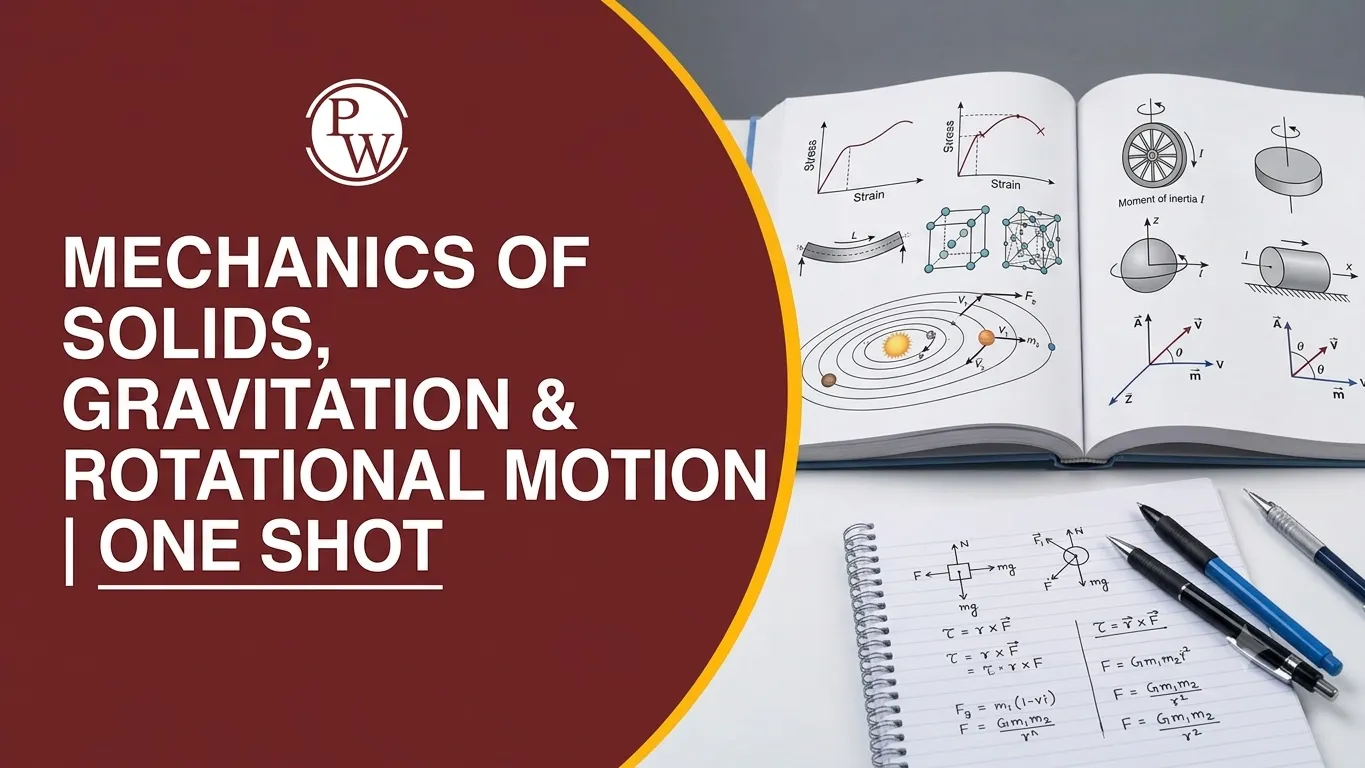
Mechanics becomes easier when you understand how force, torque, energy and motion are connected. Rotational motion requires careful consideration of the axis and perpendicular distance, while gravitation involves field, potential, orbital motion and energy relationships.
For NEET 2026 preparation, PW’s revision approach focuses on understanding the physical meaning of important formulas and applying them to numerical problems. Regular practice with torque balance, moment of inertia, rolling motion, satellite motion and gravitational concepts can help you improve accuracy while revising these topics.
Radius of Gyration
The radius of gyration is the distance from the axis at which the entire mass of a body can be assumed to be concentrated without changing its moment of inertia.
The basic relation is:
I = M k²
where:
-
I = moment of inertia
-
M = total mass
-
k = radius of gyration
Therefore:
k = √(I/M)
The radius of gyration depends on the distribution of mass and the axis of rotation.
Radius of Gyration of a Rod
For a uniform rod of length L rotating about one end:
I = ML²/3
Using I = Mk²:
k = L/√3
Radius of Gyration of a Disc About an Edge
For a disc of radius R, the parallel-axis theorem gives:
I = MR²/2 + MR²
Therefore:
I = 3MR²/2
Hence:
k = R√(3/2)
Torque or Moment of a Force
Torque, also called the moment of a force, measures the turning effect of a force about a reference point.
In vector form:
τ = r × F
Its magnitude is:
τ = rF sin θ
It can also be written as:
τ = F × r⊥
where r⊥ is the perpendicular distance between the reference point and the line of action of the force.
How to Calculate Torque
To calculate torque using the perpendicular-distance method:
-
Identify the reference point or pivot.
-
Extend the line of action of the force.
-
Draw the shortest perpendicular distance from the pivot to this line.
-
Multiply the force by the perpendicular distance.
If the line of action passes through the reference point, the perpendicular distance is zero.
Therefore:
τ = 0
When the force is perpendicular to the position vector:
τ = Fr
Only the component of force perpendicular to the position vector contributes to torque.
Net Torque and Rotational Equilibrium
When several forces act on a rigid body, calculate the torque produced by each force and assign a sign according to its direction.
A useful approach is:
-
Choose clockwise or anticlockwise as positive.
-
Assign the opposite direction a negative sign.
-
Add all torques algebraically.
For rotation about a fixed axis:
τnet = Iα
For a uniform rod rotating about one end:
I = ML²/3
Therefore:
τ = ML²α/3
Conditions for Rigid-Body Equilibrium
A rigid body is in equilibrium only when both conditions are satisfied:
ΣF = 0
and
Στ = 0
When solving equilibrium problems, it is often convenient to take moments about a point through which an unknown force acts. The torque of that force then becomes zero.
For a uniform rod supported by two strings:
T₁ + T₂ = Mg
The weight of a uniform rod acts through its centre of mass, which is located at the midpoint.
For a rod hinged at one end and supported by a tension T at the other end, taking torque about the hinge gives:
MgL/2 = TL
Therefore:
T = Mg/2
The corresponding vertical hinge reaction is also Mg/2 when no other vertical force is present.
Minimum Coefficient of Friction for a Leaning Body
Consider a body resting against a smooth wall and a rough floor.
The important forces are:
-
Weight Mg acting downward.
-
Normal reaction from the floor.
-
Normal reaction from the wall.
-
Friction acting at the floor.
Since the wall is smooth, there is no friction at the wall.
At equilibrium:
Nfloor = Mg
and the friction balances the wall's normal reaction:
f = Nwall
At limiting equilibrium:
f = μNfloor
Taking torque about the point of contact with the floor gives:
Nwall L sin θ = MgL cos θ/2
Therefore:
Nwall = Mg cot θ/2
Using f = Nwall and Nfloor = Mg:
μmin = cot θ/2
Remember that the general condition for friction is:
f ≤ μN
The equality f = μN applies only at limiting equilibrium.
Rolling Motion
A rolling body undergoes both translational and rotational motion.
For pure rolling:
v = Rω
and
a = Rα
where:
-
v = velocity of the centre of mass
-
R = radius
-
ω = angular velocity
-
a = acceleration of the centre of mass
-
α = angular acceleration
The total kinetic energy of a rolling body is:
K = Mv²/2 + Iω²/2
For a body rolling down an inclined plane:
a = g sin θ / (1 + I/MR²)
This shows that the acceleration depends on the ratio I/MR². A smaller value of this ratio gives greater acceleration.
For a disc:
I = MR²/2
Therefore:
a = 2g sin θ/3
In ideal pure rolling, the friction involved is static friction, and static friction does no net work.
Gravitational Field and Potential
The gravitational field due to a point mass M at a distance r is:
g = GM/r²
The gravitational field is directed towards the mass.
The gravitational potential is:
V = −GM/r
The negative sign indicates that the gravitational potential is taken as zero at infinity.
For two masses m₁ and m₂, the gravitational potential energy is:
U = −Gm₁m₂/r
For a system containing multiple particles, the potential energy is obtained by adding the potential energies of all unique pairs.
Gravitational Field and Potential of a Spherical Shell
For a hollow spherical shell:
-
Inside: g = 0
-
Inside: V = −GM/R
-
Outside: g = GM/r²
-
Outside: V = −GM/r
The potential inside the shell remains constant.
Gravitational Field of a Uniform Solid Sphere
For a uniform solid sphere:
Outside:
g = GM/r²
Inside:
g = GMr/R³
At the centre:
g = 0
The gravitational potential at the centre is:
V = −3GM/2R
The gravitational field and potential are related by:
g⃗ = −∇V
For one-dimensional radial variation:
g = −dV/dr
Variation of Gravitational Acceleration
The value of gravitational acceleration changes with height, depth and the rotation of Earth.
Variation of g with Height
At a height h above Earth's surface:
gₕ = g₀ [R/(R + h)]²
For h << R:
gₕ ≈ g₀(1 − 2h/R)
Thus, gravitational acceleration decreases with increasing height.
Variation of g with Depth
At a depth d below Earth's surface:
g_d = g₀(1 − d/R)
Therefore, g decreases as depth increases and becomes zero at the centre of Earth under the uniform-density approximation.
Effect of Earth's Rotation
Due to Earth's rotation:
geffective = g₀ − ω²R cos²θ
The rotational effect is greatest at the equator and zero at the poles.
Therefore, the effective value of g is maximum at the poles and minimum at the equator.
Satellite Motion
A satellite moving in a circular orbit around Earth is continuously accelerated towards Earth by gravitational force.
The orbital velocity is:
vorbital = √(GM/r)
where r is the distance of the satellite from Earth's centre.
The time period is:
T = 2π√(r³/GM)
Therefore:
T² ∝ r³
The total mechanical energy of a satellite in a circular orbit is:
E = −GMm/2r
The negative value indicates that the satellite is gravitationally bound to Earth.
Escape Velocity
Escape velocity is the minimum velocity required for an object to escape the gravitational field of a planet without further propulsion.
For a planet of mass M and radius R:
vescape = √(2GM/R)
The mass of the escaping object does not appear in the final expression. Therefore, escape velocity does not depend on the mass of the object.
For a planet with radius R and density ρ:
vescape ∝ R√ρ
Geostationary Satellite
A geostationary satellite appears stationary relative to a point on Earth's surface.
For a satellite to be geostationary, it must have:
-
A time period of approximately 24 hours
-
An orbit in the equatorial plane
-
The same direction of rotation as Earth
-
An altitude of approximately 36,000 km above Earth's surface
These conditions allow the satellite to remain above approximately the same point on Earth.
Key Takeaways for NEET 2026
-
Radius of gyration is related to moment of inertia through I = Mk².
-
Torque depends on force and its perpendicular distance from the reference point.
-
Rigid-body equilibrium requires both ΣF = 0 and Στ = 0.
-
For pure rolling, v = Rω and a = Rα.
-
The gravitational field of a point mass is g = GM/r², while its potential is V = −GM/r.
-
Gravitational acceleration changes with height, depth and Earth's rotation.
-
Satellite orbital velocity is √(GM/r), while escape velocity is √(2GM/R).
-
A geostationary satellite has a 24-hour period and moves in the equatorial plane in the same direction as Earth's rotation.
-
In numerical questions, selecting the correct axis and perpendicular distance is essential for torque and equilibrium problems.
Mechanics of Solids, Gravitation and Rotational Motion are important Physics topics for understanding torque, equilibrium, rolling motion and gravitational phenomena. Revise radius of gyration, moment of force, rotational equilibrium, rolling conditions, gravitational field and potential, variation of g, satellite motion and escape velocity along with regular formula revision, numerical practice and concept-based revision. A consistent practice routine can help you strengthen these concepts and build confidence for NEET 2026 Physics preparation.
NEET Resources You Might Like:
|
Resource |
Link |
|
NEET Syllabus |
|
|
NEET PYQs |
|
|
NEET Mind Maps |
|
|
NEET Sample Papers |
|
|
NEET Formula |
|
|
NEET MCQs |
|
|
NEET Diagrams |
FAQs
What is the formula for radius of gyration?
When is torque equal to zero?
What Resources Does PW Provide for NEET Preparation?











Get Free Counselling Today
and Clear up all your Doubts
 Live & recorded classes available at easeDashboard for progress trackingLakhs of practice questions

