








NEET Mole Concept and Redox Reactions: Important Questions, Formulae, and Solutions by PW
 Mehjabeen Hussain12 Oct, 2026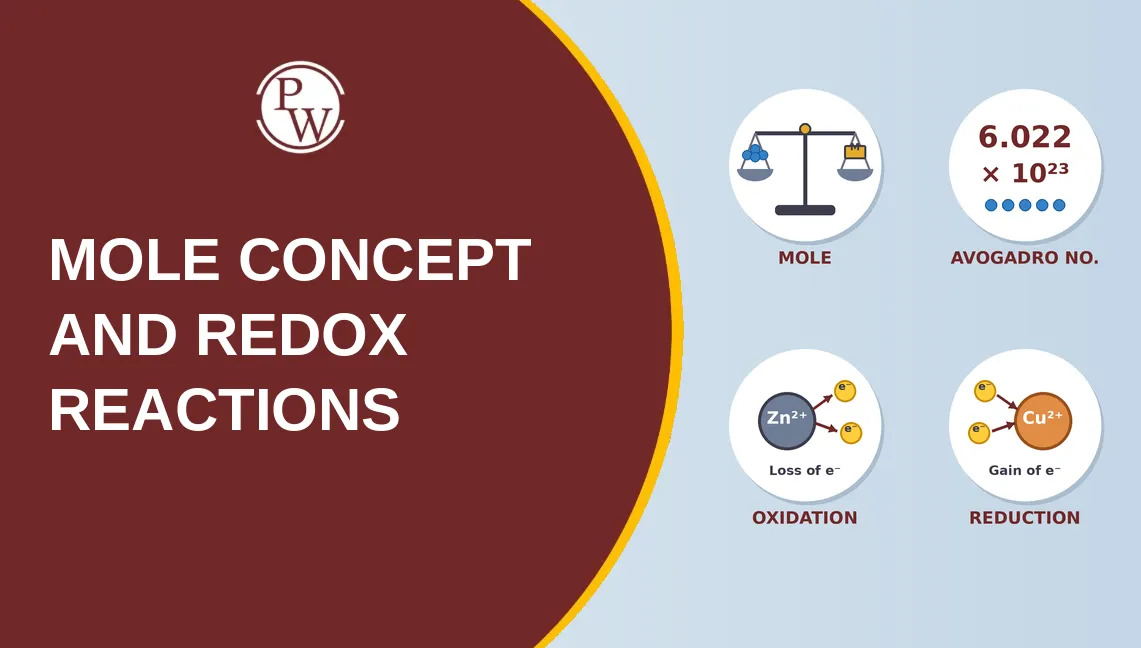
Mole Concept questions test how accurately you convert between mass, moles, particles, and volume. Redox questions require you to track changes in oxidation numbers and apply the correct rules for different chemical species. Practising these question types helps you identify the right formula, organise calculations, and avoid common numerical errors.
Physics Wallah’s Mole Concept and Redox Reactions notes help you revise the formulas, worked examples, and calculation methods needed for these topics. Use them alongside question practice to strengthen your understanding of stoichiometry, concentration calculations, oxidation numbers, and redox balancing.
Mole Concept: Important Questions and Answers
Question 1: What Is One Mole?
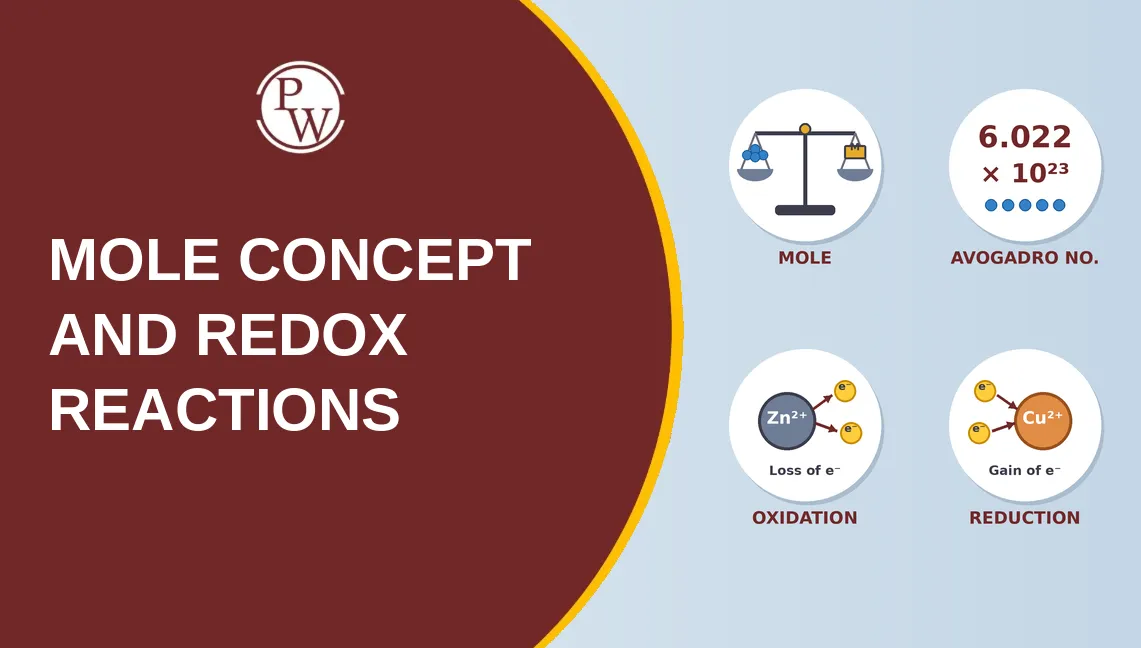
Answer: One mole contains (6.022 \times 10^{23}) specified elementary entities, such as atoms, molecules, or ions. This number is called the Avogadro constant, represented by (N_A).
For example:
-
One mole of carbon contains (N_A) carbon atoms.
-
One mole of oxygen gas contains (N_A) oxygen molecules.
-
One mole of sodium ions contains (N_A) sodium ions.
Remember: A mole represents an amount of substance, not a particular mass.
Question 2: What Is the Difference Between Atomic Mass in amu and Atomic Mass in Grams?
Answer: Atomic mass in atomic mass units (u) represents the mass of an individual atom, whereas the same numerical value in grams represents the mass of one mole of those atoms.
For example, the atomic mass of nitrogen is approximately 14 u.
-
One nitrogen atom has a mass of approximately 14 u.
-
One mole of nitrogen atoms has a mass of approximately 14 g.
The atomic mass unit is defined as one-twelfth of the mass of a carbon-12 atom.
Question 3: How Do You Calculate the Number of Moles and Atoms in a Sample?
Formula:
Moles of atoms = Given mass / Atomic molar mass
Number of atoms = Number of moles × (N_A)
Example: How many moles of lithium atoms are present in 7 g of lithium? Use its molar mass as 7 g/mol.
Moles = 7 / 7 = 1 mol
Number of atoms = (1 \times N_A)
Therefore, the sample contains approximately (6.022 \times 10^{23}) lithium atoms.
Question 4: Which Contains the Greatest Number of Atoms: 1 g Each of Magnesium, Oxygen, Lithium, and Silver?
Answer: Lithium contains the greatest number of atoms because it has the lowest atomic molar mass among these elements.
For a 1 g sample:
-
Magnesium: (1/24) mol
-
Oxygen: (1/16) mol
-
Lithium: (1/7) mol
-
Silver: (1/108) mol
The number of atoms is calculated by multiplying each mole value by (N_A).
Key concept: For equal masses of different elements, the element with the smaller atomic molar mass contains more atoms.
Question 5: How Do You Calculate Molecular Mass?
Answer: Molecular mass is the sum of the atomic masses of all the atoms present in a molecule.
Examples:
For hydrogen gas, H₂:
Molecular mass = (2 \times 1 = 2) u
For oxygen gas, O₂:
Molecular mass = (2 \times 16 = 32) u
For sulphuric acid, H₂SO₄:
Molecular mass = (2(1) + 32 + 4(16))
Molecular mass = (2 + 32 + 64 = 98) u
The corresponding molar mass of H₂SO₄ is approximately 98 g/mol.
Question 6: How Many Molecules Are Present in a Given Mass of a Substance?
Formula:
Moles of molecules = Given mass / Molar mass
Number of molecules = Number of moles × (N_A)
Example: How many molecules are present in 1.8 g of water?
Molar mass of water = 18 g/mol
Moles of water = (1.8/18 = 0.1) mol
Number of molecules = (0.1 \times N_A)
Therefore, the sample contains approximately (6.022 \times 10^{22}) water molecules.
Question 7: How Do You Calculate Moles from the Volume of a Liquid?
Answer: Convert the liquid volume into mass using its density, then divide the mass by its molar mass.
For water, using a density of approximately 1 g/mL:
Mass of 10 mL water = 10 g
Moles of water = (10/18)
Moles of water ≈ 0.556 mol
Number of molecules = (0.556 \times N_A), approximately.
Question 8: How Do You Calculate Moles from Gas Volume?
At 0°C and approximately 1 atm pressure, one mole of an ideal gas occupies approximately 22.4 L.
Formula:
Moles of gas = Gas volume / 22.4 L
Example: Calculate the number of moles in 11.2 L of an ideal gas at these conditions.
Moles = (11.2/22.4 = 0.5) mol
Important: The 22.4 L/mol relation applies to the stated temperature and pressure, not to every gas condition.
Question 9: How Do You Convert a Mass Ratio into a Mole Ratio?
Answer: Divide each mass by the corresponding molar mass, then simplify the mole values.
Example: Hydrogen and oxygen are present in a mass ratio of 1:4. Find their mole ratio.
Assume the masses are 1 g hydrogen and 4 g oxygen.
Moles of H₂ = (1/2 = 0.5) mol
Moles of O₂ = (4/32 = 0.125) mol
Mole ratio = (0.5:0.125)
Simplifying gives:
H₂ : O₂ = 4 : 1
The mass ratio and mole ratio are different because hydrogen and oxygen have different molar masses.
Question 10: What Is the Difference Between Empirical and Molecular Formulae?
Answer: The molecular formula shows the actual number of atoms of each element in a molecule. The empirical formula gives the simplest whole-number ratio of those atoms.
For glucose:
Molecular formula = C₆H₁₂O₆
Divide all subscripts by 6.
Empirical formula = CH₂O
For oxalic acid:
Molecular formula = H₂C₂O₄
Simplest ratio = 1:1:2
Empirical formula = HCO₂
Question 11: How Do You Determine the Empirical Formula from Percentage Composition?
Method:
-
Assume the sample has a mass of 100 g.
-
Convert each percentage into grams.
-
Divide each mass by the corresponding atomic molar mass.
-
Divide all mole values by the smallest value.
-
Convert the resulting ratio into the smallest whole-number ratio.
The simplified mole ratio gives the subscripts in the empirical formula.
Question 12: How Do You Solve Stoichiometry Questions?
Answer: Start with a balanced chemical equation and use the coefficients to establish the mole ratio between reactants and products.
Consider:
CaCO₃ → CaO + CO₂
The equation shows that one mole of calcium carbonate produces one mole of carbon dioxide.
Molar mass of CaCO₃ ≈ 100 g/mol
Molar mass of CO₂ ≈ 44 g/mol
Therefore, 100 g of pure CaCO₃ produces 44 g of CO₂.
For 4 g of pure CaCO₃:
Mass of CO₂ = ((4 \times 44)/100)
Mass of CO₂ = 1.76 g
Question 13: How Do You Calculate Percentage Purity?
Formula:
Percentage purity = (Mass of pure substance / Mass of sample) × 100
Example: A 20 g impure sample of magnesium carbonate produces 8 g of magnesium oxide on heating. Calculate its percentage purity.
Reaction:
MgCO₃ → MgO + CO₂
Molar mass of MgCO₃ ≈ 84 g/mol
Molar mass of MgO ≈ 40 g/mol
Mass of pure MgCO₃ corresponding to 8 g MgO:
Mass = ((8 \times 84)/40)
Mass of pure MgCO₃ = 16.8 g
Percentage purity = ((16.8/20) \times 100)
Percentage purity = 84%
Molarity and Molality: Important Questions
Question 14: What Is the Difference Between Molarity and Molality?
Answer:
Molarity (M) is the number of moles of solute per litre of solution.
Molarity = Moles of solute / Volume of solution in litres
Molality (m) is the number of moles of solute per kilogram of solvent.
Molality = Moles of solute / Mass of solvent in kilograms
Molarity depends on solution volume, which can change with temperature. Molality depends on solvent mass and is independent of temperature-related volume changes.
Question 15: How Do You Convert Molarity into Molality Using Density?
Example: A 1 M solution has a density of 1.25 g/mL, and the solute has a molar mass of 85 g/mol. Calculate the molality.
Assume 1 L of solution.
Mass of solution = (1000 \times 1.25 = 1250) g
Moles of solute = 1 mol
Mass of solute = (1 \times 85 = 85) g
Mass of solvent = (1250 - 85 = 1165) g
Mass of solvent = 1.165 kg
Molality = (1/1.165)
Molality ≈ 0.858 mol/kg
Redox Reactions: Important Questions and Answers
Question 16: What Are Oxidation and Reduction?
Answer:
-
Oxidation: Increase in oxidation number or loss of electrons.
-
Reduction: Decrease in oxidation number or gain of electrons.
Both processes occur together in a redox reaction.
When one species loses electrons, another species gains electrons.
Question 17: What Rules Should You Remember When Assigning Oxidation Numbers?
Answer: Use the following rules for common NEET-level questions.
-
Alkali metals generally have an oxidation number of +1.
-
Alkaline-earth metals generally have an oxidation number of +2.
-
Oxygen generally has an oxidation number of −2.
-
Oxygen in peroxides has an oxidation number of −1.
-
Oxygen in superoxides has an average oxidation number of −1/2.
-
Hydrogen generally has an oxidation number of +1.
-
Hydrogen in metal hydrides has an oxidation number of −1.
-
Halogens generally have an oxidation number of −1, with exceptions when bonded to more electronegative elements.
For a neutral compound, the sum of the oxidation numbers is zero. For a polyatomic ion, the sum equals the overall ionic charge.
Question 18: How Do You Calculate an Unknown Oxidation Number?
Example: Find the oxidation number of carbon in CH₄ and CCl₄.
In CH₄:
Let the oxidation number of carbon be x.
(x + 4(+1) = 0)
(x = -4)
In CCl₄:
Let the oxidation number of carbon be x.
(x + 4(-1) = 0)
(x = +4)
Change in oxidation number:
(+4 - (-4) = +8)
Therefore, carbon's oxidation number increases by 8.
Question 19: What Is the Oxidation Number of Chromium in CrO₅?
Answer: The oxidation number of chromium in CrO₅ is +6.
CrO₅ contains peroxide oxygen atoms as well as oxygen atoms with the usual oxidation number of −2.
-
Two peroxide oxygen atoms contribute (2(-1) = -2).
-
Three other oxygen atoms contribute (3(-2) = -6).
Total oxygen contribution = −8
Since CrO₅ is neutral:
Oxidation number of Cr − 8 = 0
Oxidation number of Cr = +8?
No. The correct structure of CrO₅ contains one oxo oxygen and two peroxide groups, accounting for one oxygen at −2 and four peroxide oxygens at −1 each.
Total oxygen contribution = ((-2) + 4(-1) = -6)
Therefore:
Oxidation number of Cr − 6 = 0
Oxidation number of Cr = +6
Remember: In CrO₅, four oxygen atoms belong to peroxide groups and one is an oxo oxygen.
Question 20: What Is a Disproportionation Reaction?
Answer: A disproportionation reaction is a redox reaction in which the same element undergoes oxidation and reduction simultaneously.
For example, copper in the +1 oxidation state can form copper in the +2 oxidation state and elemental copper in the 0 oxidation state.
Copper undergoes oxidation:
Cu⁺ → Cu²⁺
Copper also undergoes reduction:
Cu⁺ → Cu
Because the same initial oxidation state changes in both directions, the reaction is an example of disproportionation.
Question 21: How Do You Determine the Reactant Mole Ratio Using the n-Factor Method?
Answer: Calculate the total change in oxidation number for each reactant species, accounting for the number of atoms undergoing the change. Then balance the electron loss and gain.
A useful relation is:
n-factor = Number of atoms undergoing change × Change in oxidation number per atom
Example: Manganese changes from +7 to +2, while two carbon atoms each change from +3 to +4.
For manganese:
n-factor = (1 \times 5 = 5)
For carbon:
n-factor = (2 \times 1 = 2)
The ratio of the total oxidation-number changes is 5:2. The corresponding reactant mole ratio is obtained by balancing the total electron loss and gain.
Important: Do not use the n-factor ratio blindly. Identify which species is oxidised and which is reduced, then equate the electrons lost and gained to establish the correct coefficients.
Mole Concept and Redox Reactions become easier to revise when you practise converting between mass, moles, and particles and apply oxidation-number rules systematically. Focus on stoichiometry, empirical formulae, purity, solution concentrations, redox exceptions, and balancing calculations. Physics Wallah’s Mole Concept and Redox Reactions question-based notes can help you review these methods and apply them to Chemistry problems.
NEET Resources You Might Like:
|
Resource |
Link |
|
NEET Syllabus |
|
|
NEET PYQs |
|
|
NEET Mind Maps |
|
|
NEET Sample Papers |
|
|
NEET Formula |
|
|
NEET MCQs |
|
|
NEET Diagrams |
Elevate your NEET preparation with Physics Wallah’s NEET Online Courses. Get access to comprehensive live classes, expert guidance, quality study materials, practice tests, and more—all designed to help you prepare effectively for the NEET exam. Explore Now!
FAQs
What Is One Mole?
What Is a Disproportionation Reaction?
What Resources Does PW Provide for NEET Preparation?








Have questions about your prep?
Our experts can answer all your questions
 Live & recorded classes available at easeDashboard for progress trackingLakhs of practice questions

