








Biology Morphology of Flowering Plants Diagrams for NEET by Physics Wallah
 Avisha Das14 Jul, 2026
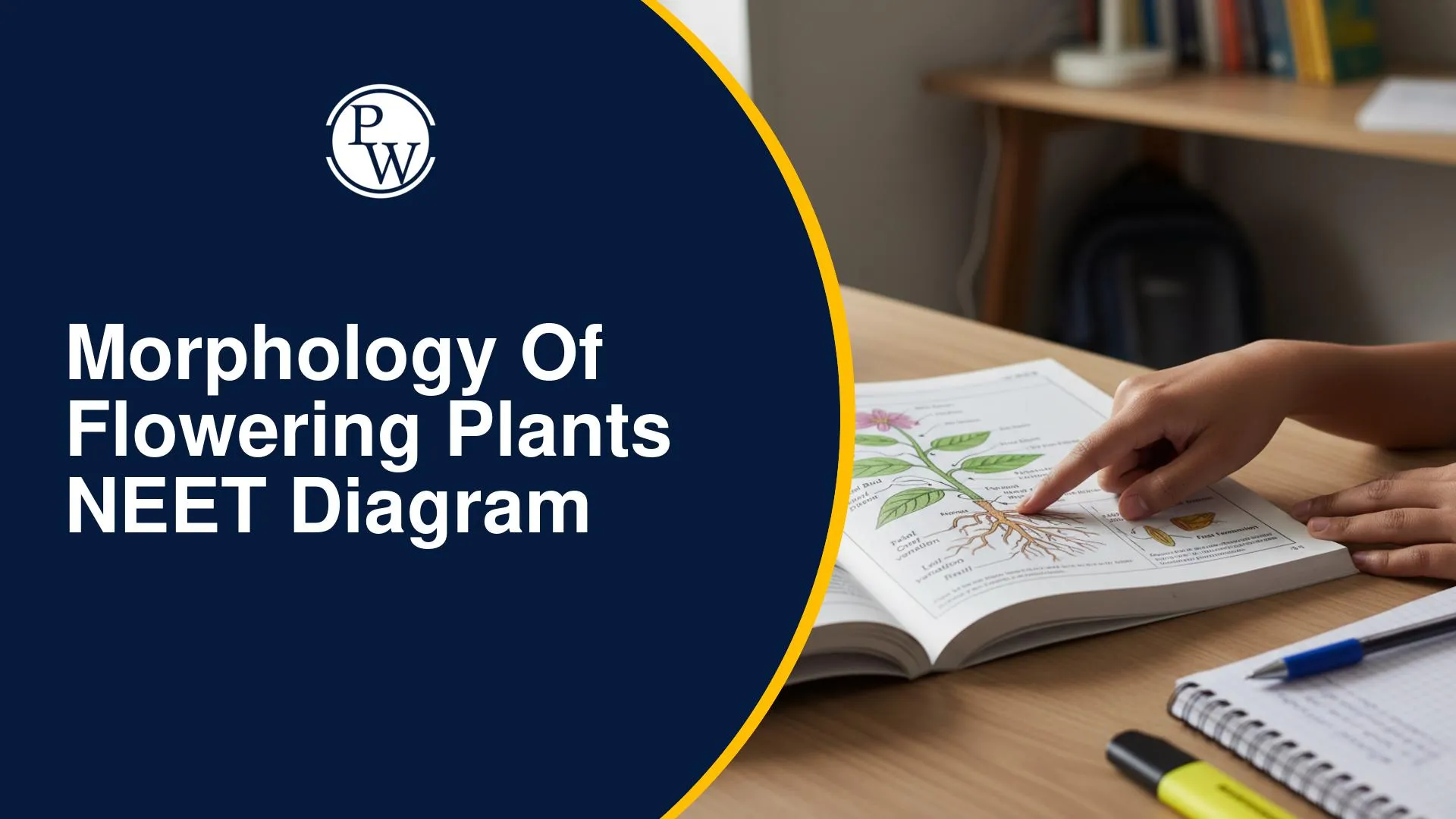
Walk through a garden, and no two plants look exactly alike. Some have fibrous roots, others tap roots. Leaves may be simple or compound, while flowers differ in shape, arrangement, and symmetry. These variations are not random; they help scientists classify plants and understand how each part contributes to a plant's survival and reproduction.
Because this chapter is highly visual, reading descriptions alone often makes revision difficult. Seeing labelled diagrams allows you to identify structures instantly and compare different morphological features with ease. Morphology of Flowering Plants Diagrams by PW turns textbook descriptions into clear illustrations, helping you build stronger observation skills and prepare more effectively for NEET.
Morphology of Flowering Plants NEET Diagram PDF
The Morphology of Flowering Plants Diagram PDF compiles important illustrations from the chapter into an easy-to-follow visual resource. It helps you revisit plant structures, compare different morphological features, and reinforce learning without spending time searching through multiple pages.
Whether you are studying the chapter for the first time or revising before NEET, the PDF provides a convenient way to refresh important concepts.
Morphology of Flowering Plants NEET Diagrams PDF
Why Use PW Morphology of Flowering Plants Diagrams?
Understanding plant morphology becomes much easier when structures can be observed rather than imagined. Visual learning strengthens both recognition and conceptual clarity.
1. Helps You Identify Plant Parts Accurately
Clearly labelled diagrams make it easier to recognise roots, stems, leaves, flowers, fruits, and seeds along with their important characteristics.
2. Simplifies Different Types of Inflorescence
Visual comparisons help you distinguish racemose and cymose inflorescences along with their common variations, reducing confusion during revision.
3. Makes Floral Structure Easier to Interpret
Illustrations explain floral symmetry, aestivation, placentation, and ovary position, helping you understand the organisation of a flower more confidently.
4. Strengthens Identification of Plant Families
Comparative diagrams highlight the characteristic features of important families, making it easier to recognise similarities and differences in NEET questions.
5. Improves Observation-Based Question Solving
Regular practice with diagrams develops the ability to identify structures quickly and answer image-based and concept-driven questions with greater confidence.
Also check:
Morphology of Flowering Plants Diagrams FAQs
Why should you use the Morphology of Flowering Plants diagrams for NEET?
How do diagrams help in understanding plant families?
Does Physics Wallah provide other resources for this chapter?


Have questions about your prep?
Our experts can answer all your questions





 Live & recorded classes available at easeDashboard for progress trackingLakhs of practice questions

