Motion in a Plane: Concepts and Important Topics
Motion in a plane involves two-dimensional movement tracked using vectors (magnitude + direction). Core concepts include vector addition, resolution, projectile motion, uniform circular motion, centripetal acceleration, and relative velocity. Mastering vector operations, diagrams, and formulas helps students solve real-world physics problems. Download PDF for revision.

Motion in a plane is an important concept in physics because it shows how objects move when both horizontal and vertical positions change simultaneously. Unlike straight-line motion, where only one coordinate changes. Here, students must track the x and y components of displacement, velocity, and acceleration. Vectors are essential to learn because they provide both magnitude and direction. It must be noted that they are different from scalars, which have only size.
Learning vector operations, such as addition, subtraction, and component resolution, helps students analyse two-dimensional motion. Motion in a plane also introduces students to projectile motion, uniform circular motion, centripetal acceleration, and relative velocity. It helps them link concepts to real-world problems like balls, rivers, or satellites.
Motion in a Plane Overview
Motion in a plane occurs when two coordinates are required to describe an object’s position. Students must recognise that scalars have magnitude only, while vectors include magnitude and direction. Understanding vectors allows students to apply vector algebra to calculate total displacement, velocity, or force in two dimensions.
The knowledge of this topic is essential for students to analyse projectiles, circular paths, and relative motion. Students are advised to practice drawing diagrams, resolving vectors into components, and applying formulas step by step. This develops strong problem-solving skills and helps them visualise motion. Further, this topic is important for them to clear the entrance exams and board-level physics problems.
Vector Addition and Subtraction
Vector addition and subtraction are used to combine two or more vectors to find a resultant. Students should first practice graphical methods, such as the triangle law and parallelogram law, which give a visual understanding of how vectors combine. Then, they can use the analytical method, splitting vectors into x and y components, adding or subtracting them to get the exact resultant.
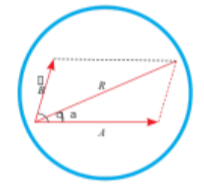
Further, these operations are particularly important for combining velocities or forces in two dimensions. Students should practise both graphical sketches and component calculations to build confidence and avoid mistakes. Understanding vector addition is crucial for almost all topics in motion in a plane.
Concept:
When two or more vectors combine, we get a resultant vector. Students can use triangle law or parallelogram law for a visual understanding. Analytical methods with components help calculate exact magnitude and direction.
Example:
A person walks 4 m east and then 3 m north.
-
Resultant displacement:
R=42+32=5 mR = \sqrt{4^2 + 3^2} = 5 \text{ m}R=42+32=5 m
-
Direction:
θ=arctan(3/4)≈36.9∘ north of east\theta = \arctan(3/4) \approx 36.9^\circ \text{ north of east}θ=arctan(3/4)≈36.9∘ north of east
Formula Recap:
R=Rx2+Ry2,θ=arctan(Ry/Rx)R = \sqrt{R_x^2 + R_y^2}, \quad \theta = \arctan(R_y / R_x)R=Rx2+Ry2,θ=arctan(Ry/Rx)
Resolution of Vectors
Resolution of vectors involves breaking a vector into x and y components, which simplifies calculations for two-dimensional motion. Students are required to project the vector along horizontal and vertical axes using trigonometric functions such as sine and cosine. Understanding direction cosines and component algebra also prepares students for three-dimensional problems.
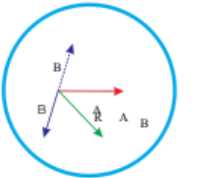
Component resolution helps students to reconstruct vectors using unit vectors and analyse forces, displacements, or velocities more easily. Practising this skill helps students to solve projectile motion, circular motion, and relative velocity problems. It helps students in making calculations accurate and diagrams clear for exams.
Concept:
Any vector can be split into horizontal and vertical components using sine and cosine. This simplifies motion calculations in 2D and prepares students for 3D problems.
Example:
A force of 60 N acts at 60° to the horizontal:
Fx=60cos60∘=30 N,Fy=60sin60∘≈51.96 NF_x = 60 \cos 60^\circ = 30 \text{ N}, \quad F_y = 60 \sin 60^\circ \approx 51.96 \text{ N}Fx=60cos60∘=30 N,Fy=60sin60∘≈51.96 N
Formula Recap:
F⃗=Fxi^+Fyj^\vec F = F_x \hat i + F_y \hat jF=Fxi^+Fyj^
Projectile Trajectory
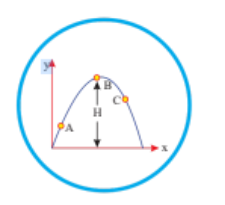
Projectile motion is when an object moves under gravity in a curved path. Students are required to separate motion into horizontal (constant speed) and vertical (accelerated) components. Here, formulas for time of flight, maximum height, and range are essential to solve problems. Understanding the parabolic shape and symmetry of the trajectory helps students predict motion and calculate exact positions.
Practising diagrams and derivations of the trajectory formula helps candidates develop a visual and mathematical understanding of projectiles.
Concept:
An object under gravity moves along a parabolic path. Horizontal motion is uniform, while vertical motion is accelerated due to gravity.
Example:
A ball is thrown at 20 m/s at 30° above the horizontal.
-
Horizontal speed:
ux=ucosθ=20cos30∘≈17.32 m/su_x = u \cos \theta = 20 \cos 30^\circ \approx 17.32 \, \text{m/s}ux=ucosθ=20cos30∘≈17.32m/s -
Vertical speed:
uy=usinθ=20sin30∘=10 m/su_y = u \sin \theta = 20 \sin 30^\circ = 10 \, \text{m/s}uy=usinθ=20sin30∘=10m/s -
Time of flight:
T=2usinθg=2⋅20⋅sin30∘9.8≈2.04 sT = \frac{2 u \sin \theta}{g} = \frac{2 \cdot 20 \cdot \sin 30^\circ}{9.8} \approx 2.04 \, \text{s}T=g2usinθ=9.82⋅20⋅sin30∘≈2.04s -
Range:
R=u2sin2θg=202⋅sin60∘9.8≈35.3 mR = \frac{u^2 \sin 2\theta}{g} = \frac{20^2 \cdot \sin 60^\circ}{9.8} \approx 35.3 \, \text{m}R=gu2sin2θ=9.8202⋅sin60∘≈35.3m -
Maximum height:
H=(usinθ)22g=1022⋅9.8≈5.1 mH = \frac{(u \sin \theta)^2}{2g} = \frac{10^2}{2 \cdot 9.8} \approx 5.1 \, \text{m}H=2g(usinθ)2=2⋅9.8102≈5.1m
Uniform Circular Motion
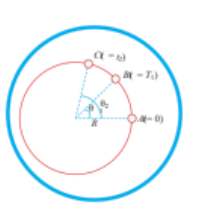
Uniform circular motion describes motion in a circle at constant speed, where the velocity direction changes continuously. Students should learn angular speed, period, and frequency under this topic. It links linear and rotational motion. Understanding centripetal force and acceleration is important for the candidates because it keeps objects moving in a circle.
Furthermore, students can apply these concepts to satellites, cars on curves, or rotating discs. Practising velocity and acceleration diagrams helps students visualise circular motion and solve related problems easily.
Concept:
An object moves at constant speed along a circle. Velocity direction changes continuously. Angular speed, period, and frequency link linear and rotational motion.
Example:
Car on circular track, radius 50 m, speed 10 m/s:
-
Angular speed: ω=v/r=0.2 rad/s\omega = v/r = 0.2 \text{ rad/s}ω=v/r=0.2 rad/s
-
Period: T=2πr/v≈31.4 sT = 2 \pi r / v \approx 31.4 \text{ s}T=2πr/v≈31.4 s
ω=vr,v=rω,T=2πrv\omega = \frac{v}{r}, \quad v = r \omega, \quad T = \frac{2 \pi r}{v}ω=rv,v=rω,T=v2πr
Centripetal Acceleration
Centripetal acceleration is the inward acceleration that keeps an object moving in a circle. Students should calculate its magnitude with ( a_c = v^2 / r ) and understand that it points toward the centre.
This acceleration is caused by a net inward force such as tension, gravity, or friction. Students can apply this to satellites, banked curves, or centrifuges. Practising with diagrams of velocity and acceleration vectors helps visualise how the motion is maintained in circular paths.
Concept:
Inward acceleration keeps an object in circular motion. Caused by net radial force (tension, gravity, or friction).
Example:
Satellite of mass 500 kg, speed 7 km/s, orbit radius 7000 km:
-
Acceleration: ac=v2/r≈7 m/s²a_c = v^2 / r \approx 7 \text{ m/s²}ac=v2/r≈7 m/s²
-
Centripetal force: Fc=mac=3500 NF_c = m a_c = 3500 \text{ N}Fc=mac=3500 N
Formulas Recap:
ac=v2r,Fc=maca_c = \frac{v^2}{r}, \quad F_c = m a_cac=rv2,Fc=mac
Relative Velocity in 2D
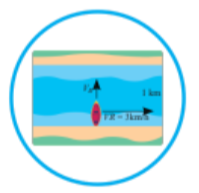
Relative velocity is how motion appears from a moving observer. Students are required to subtract velocity vectors and resolve them into x and y components. Classic examples include rain on a moving car, or a swimmer in a river. Students must calculate the resultant magnitude and direction to solve such problems correctly. Practising diagrams and components helps visualise motion in different frames and reduces mistakes.
Concept:
Motion as seen from a moving observer. Subtract vectors, resolve into components.
Example:
Swimmer 3 m/s, river current 2 m/s perpendicular:
-
Resultant speed: 32+22≈3.6 m/s\sqrt{3^2 + 2^2} \approx 3.6 \text{ m/s}32+22≈3.6 m/s
-
Angle: arctan(2/3)≈33.7∘\arctan(2/3) \approx 33.7^\circarctan(2/3)≈33.7∘ downstream
Formulas Recap:
v⃗A/B=v⃗A−v⃗B,v=vx2+vy2\vec v_{A/B} = \vec v_A - \vec v_B, \quad v = \sqrt{v_x^2 + v_y^2}vA/B=vA−vB,v=vx2+vy2
Motion in a Plane PDF Download
Motion in a Plane PDF file includes diagrams, solved examples, and practice exercises. Students can use it to revise step by step. It can help them compare calculations with diagrams and practice more problems. Printing or saving it helps with offline study and last-minute exam revision.
This PDF is a complete resource for students who want to master motion in a plane. It contains detailed diagrams, step-by-step solved examples, and multiple practice problems to strengthen understanding. Students can use the PDF to revise concepts, verify calculations, and practise drawing vectors, components, projectile trajectories, and circular motion paths.
Aspirants are encouraged to mark key formulas and important diagrams for quick reference. The PDF can be printed or saved for offline study, making it easy to revise anytime. Regular use of this resource helps students gain confidence and improve problem-solving skills.
Motion in a Plane FAQs
What is the difference between a scalar and a vector in motion in a plane?
How is vector addition done for velocities in two dimensions?
Which formula gives the projectile trajectory of a particle, and how is it used?
How does centripetal acceleration relate to uniform circular motion?
How can relative velocity in 2D be determined for problems like rain or a moving observer?
Why is practising diagrams important in motion in a plane?


Have questions about your prep?
Our experts can answer all your questions