







NEET 2026 Chemistry Paper Analysis (21 June Re-Exam): Difficulty Level, Question Review & Solutions
NEET UG 2026 Re-Exam was conducted on 21 June 2026 after the cancellation of the earlier 3 May examination. The Chemistry section was rated medium to hard, with a balanced mix of Physical, Organic, and Inorganic Chemistry questions. This analysis covers difficulty level, chapter-wise and class-wise weightage, question pattern, student reactions, answer key updates, detailed solutions, and comparison with the cancelled NEET 2026 paper.

NEET UG 2026 Re-Exam was conducted on 21 June 2026 for candidates affected by the cancellation of the earlier examination held on 3 May 2026. Based on the analysis of the Chemistry paper, the section was of medium to hard difficulty level, with most questions falling in the moderate category. The paper included a balanced mix of Physical, Organic, and Inorganic Chemistry, with a strong focus on NCERT concepts along with application-based questions.
This NEET 2026 Chemistry Paper Analysis provides a detailed review of the Chemistry section, including difficulty level, chapter-wise weightage, class-wise distribution, question patterns, student reactions, answer key updates, and comparison with the cancelled 3 May examination. The analysis is based on paper insights, topic distribution, and expert review of the 21 June re-exam.
Also Check:
- NEET UG Re-Exam Live Update
- NEET 2026 Exam Answer Key
- NEET 2026 Question Paper
- NEET 2026 Paper Analysis
NEET 2026 Chemistry Paper Analysis Highlights
The table below highlights the major observations from the Chemistry section of the NEET UG 2026 re-examination. Detailed analysis is provided in the following sections.
| Particulars | Details |
| Exam | NEET UG 2026 |
| Exam Date | 21 June 2026 |
| Subject | Chemistry |
| Total Questions | 45 |
| Difficulty Level | Medium to Hard |
| Most Asked Section | Coordination Compounds (6 Questions) |
| NCERT Weightage | High |
NEET 2026 Chemistry Difficulty Level – Tough or Easy?
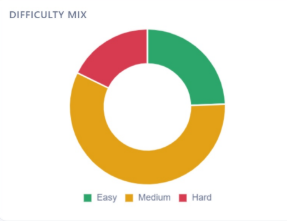
The Chemistry section was rated medium to hard overall. According to the paper insights, 57.8% of the questions were of medium difficulty, 24.4% were easy, and 17.8% were difficult. The average difficulty score of the paper was 1.93 on a 3-point scale.
Students reported that the section contained a mix of direct NCERT-based questions and conceptual application-based questions. While several questions were straightforward, others required a deeper understanding of concepts, particularly from Coordination Chemistry, Thermodynamics, Electrochemistry, and Organic Chemistry.
Compared to Physics, the Chemistry section was relatively less lengthy and offered scoring opportunities for candidates with strong conceptual preparation and NCERT revision.
NEET 2026 Chemistry Question Paper Overview
The Chemistry paper consisted of 45 questions distributed across Physical Chemistry, Organic Chemistry, and Inorganic Chemistry. The exact distribution will be updated after detailed paper analysis.
| Type | Questions |
| Physical Chemistry | 16 |
| Organic Chemistry | 14 |
| Inorganic Chemistry | 15 |
| Total Questions | 45 |
The paper maintained a balanced distribution across all three branches of Chemistry. Inorganic Chemistry carried slightly higher weightage due to the strong presence of Coordination Compounds, d & f Block Elements, and Periodic Properties.
Section-Wise NEET 2026 Chemistry Analysis
Physical Chemistry Analysis
Physical Chemistry was rated moderate to difficult by many candidates. The section included both direct formula-based questions and application-oriented numerical problems. Topics such as Thermodynamics, Electrochemistry, Chemical Kinetics, Solutions, Redox Reactions, and Some Basic Concepts of Chemistry contributed significantly to the paper.
Several students found a few questions calculation-intensive, requiring conceptual clarity rather than direct formula substitution. Overall, Physical Chemistry demanded careful problem-solving and strong fundamentals.
Organic Chemistry Analysis
Organic Chemistry carried a balanced weightage and was largely based on standard NCERT concepts. Major chapters included Amines, Hydrocarbons, Aldehydes, Ketones and Carboxylic Acids, Biomolecules, Alcohols, Phenols and Ethers, and Organic Chemistry: Some Basic Principles and Techniques.
Most questions tested reaction understanding, functional group chemistry, and conceptual application. Students who had revised NCERT thoroughly found this section manageable, although a few questions required deeper conceptual understanding.
Inorganic Chemistry Analysis
Inorganic Chemistry emerged as one of the most important parts of the paper, with Coordination Compounds accounting for 6 questions and d & f Block Elements contributing 4 questions, making them the highest-weightage chapters in the Chemistry section. Questions from Periodic Properties, Chemical Bonding, Classification of Elements, and p-Block Elements were also present.
Many questions were NCERT-focused, but some required conceptual understanding of coordination chemistry and inorganic reactions. Students with strong NCERT preparation generally found this section scoring.
Chemistry Analysis PDF Download
Chemistry Analysis PDF Download
Chapter-Wise Weightage in NEET 2026 Chemistry
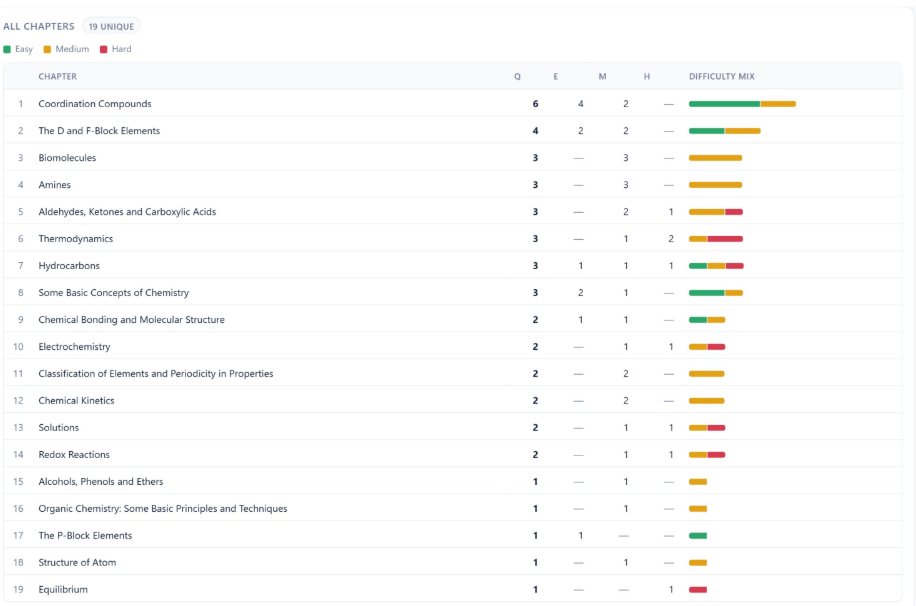
The chapter-wise distribution helps students understand which chapters received the highest weightage in the examination.
| Chapter | Questions |
| Coordination Compounds | 6 |
| The d and f Block Elements | 4 |
| Biomolecules | 3 |
| Amines | 3 |
| Aldehydes, Ketones and Carboxylic Acids | 3 |
| Thermodynamics | 3 |
| Hydrocarbons | 3 |
| Some Basic Concepts of Chemistry | 3 |
| Chemical Bonding and Molecular Structure | 2 |
| Electrochemistry | 2 |
| Classification of Elements and Periodicity | 2 |
| Chemical Kinetics | 2 |
| Solutions | 2 |
| Redox Reactions | 2 |
The final analysis will highlight the most asked units, the highest-weightage chapters, student-friendly chapters, and comparatively difficult chapters.
Class 11 vs Class 12 Chemistry Weightage
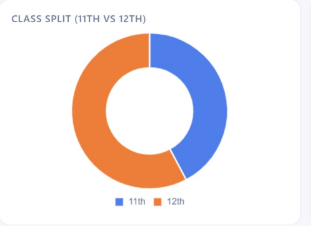
The class-wise distribution provides insights into the contribution of Class 11 and Class 12 topics in the Chemistry section.
| Class | Questions |
| Class 11 | 19 |
| Class 12 | 26 |
Class 12 Chemistry contributed a larger share of questions, accounting for approximately 57.8% of the paper, while Class 11 topics contributed around 42.2%. Coordination Chemistry, Biomolecules, Amines, and Aldehydes emerged as major contributors from the Class 12 syllabus.
Question Type Analysis in NEET 2026 Chemistry
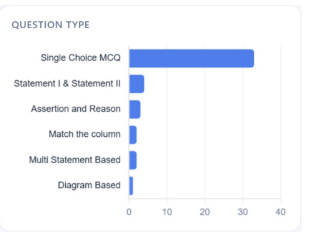
The question type analysis helps students understand the overall paper pattern and the balance between direct and conceptual questions.
| Question Type | Count |
| MCQ | 36 |
| Assertion & Reason | 1 |
| Statement I & II Based | 2 |
| Match the Column | 1 |
| Multi Statement | 2 |
| Diagram Based | 1 |
The analysis will also highlight any new formats, conceptual trends, and changes compared to previous years.
NEET 2026 Chemistry Question Paper PDF
The NEET UG 2026 Re-Exam Chemistry paper consisted of 45 questions covering 19 chapters and 37 topics. The paper maintained a balanced distribution across Physical, Organic, and Inorganic Chemistry, with the highest weightage given to Coordination Compounds, d & f Block Elements, Biomolecules, Amines, and Thermodynamics.
NEET 2026 Chemistry Answer Key & Detailed Solutions
The NEET 2026 Chemistry Answer Key and detailed solutions will help candidates estimate their probable scores and analyse their performance in the examination.
Based on the paper analysis, several questions were asked from Coordination Compounds, d & f Block Elements, Biomolecules, Amines, Aldehydes, Ketones and Carboxylic Acids, Thermodynamics, and Electrochemistry. Detailed solutions will explain the concepts, formulas, and reasoning behind each answer.
The answer key section will include:
-
Code-wise answer keys
-
Detailed solutions
-
Expert explanations
-
Score estimation support
-
Question-wise analysis
Also Read: NEET 2026 Answer Key
Student Reactions – How Was NEET 2026 Chemistry Paper?
Initial student reactions indicate that the Chemistry paper was moderately challenging and required strong conceptual understanding. Many candidates found the paper balanced across Physical, Organic, and Inorganic Chemistry, although Coordination Chemistry and some Physical Chemistry questions required careful application of concepts.
Several students reported that the paper was less lengthy than Physics and contained a healthy mix of direct NCERT-based questions and conceptual questions. Candidates with strong NCERT preparation were likely to find the section manageable, while others found certain chapters such as Coordination Compounds, Thermodynamics, and Electrochemistry relatively demanding.
NEET 2026 Chemistry Paper vs NEET 2025
The NEET 2026 Re-Exam Chemistry paper was generally rated medium to hard, with nearly 58% of the questions falling in the moderate difficulty category and around 18% in the difficult category. The paper featured a combination of direct NCERT-based questions and application-oriented conceptual questions.
Compared to NEET 2025, the 2026 paper showed:
- Greater emphasis on Coordination Chemistry and d & f Block Elements.
- Balanced representation of Physical, Organic, and Inorganic Chemistry.
- Strong NCERT alignment with additional conceptual application.
- Moderate numerical presence from Thermodynamics, Electrochemistry, and Chemical Kinetics.
- Higher focus on conceptual understanding rather than direct factual recall.
Students with strong NCERT preparation and conceptual clarity were likely to find the paper more manageable. A detailed year-on-year comparison with exact chapter trends and question patterns can be added after the official question paper and answer key are released.
Cancelled NEET 2026 Chemistry Paper Analysis (3 May Exam) – Reference Only
The analysis below relates to the cancelled NEET UG 2026 examination conducted on 3 May 2026. It is retained only for reference and comparison purposes.
Chemistry Difficulty Level (3 May Exam)
The Chemistry section of the cancelled 3 May examination was rated moderate in difficulty. The paper contained a balanced mix of Physical, Organic, and Inorganic Chemistry questions.
Class-wise Distribution (3 May Exam)
| Class | Questions |
| Class 11 | 22 |
| Class 12 | 23 |
Chapter-wise Distribution (3 May Exam)
Major chapters included:
-
Coordination Compounds – 4 Questions
-
Equilibrium – 4 Questions
-
Organic Chemistry: Basic Principles and Techniques – 4 Questions
-
Amines – 3 Questions
-
Chemical Kinetics – 3 Questions
-
Thermodynamics – 3 Questions
-
Chemical Bonding – 3 Questions
Question Type Analysis (3 May Exam)
-
Single Choice MCQs – 35 Questions
-
Multi Statement Based – 2 Questions
-
Match the Column – 7 Questions
-
Diagram-Based – 1 Question
-
Assertion & Reason – 0 Questions
Student Reactions (3 May Exam)
Most students described the Chemistry section as easy to moderate. Organic and Inorganic Chemistry were considered largely NCERT-based. Physical Chemistry contained a few calculative questions but remained manageable for well-prepared candidates.
Related NEET 2026 Resources
Students can also check the following resources:
NEET 2026 Chemistry Paper Analysis FAQs
How was the NEET 2026 Chemistry paper?
What was the difficulty level of Chemistry in NEET 2026?
Where can I download the NEET 2026 Chemistry question paper PDF?
Where can I check the NEET 2026 Chemistry answer key and solutions?










Get Free Counselling Today
and Clear up all your Doubts
 Live & recorded classes available at easeDashboard for progress trackingLakhs of practice questions

