








NEET Properties of Alkanes: Free-Radical Halogenation, Product Prediction and Named Reactions Notes by PW
 Mehjabeen Hussain12 Oct, 2026
Predicting the products of alkane reactions can be challenging when different types of hydrogen atoms, reaction conditions and radical stabilities influence the outcome. For NEET, you need to understand free-radical halogenation, identify the major product, distinguish important named reactions and remember the conditions that determine the products of different chemical transformations.
Physics Wallah offers notes on the properties of alkanes help you revise these concepts systematically, from reaction mechanisms and product prediction to important reactions and physical properties. Focus on the reaction conditions, characteristic products and differences between similar reactions to strengthen your understanding and recall during NEET preparation.
Halogenation of Alkanes
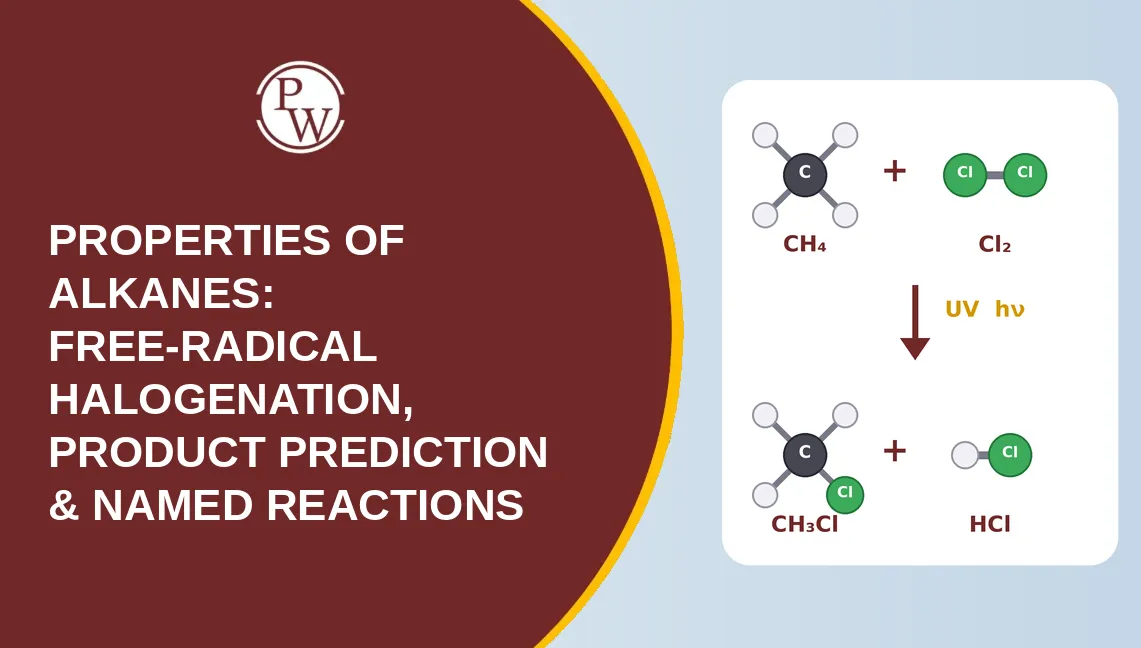
Halogenation is an important substitution reaction of alkanes in which a hydrogen atom is replaced by a halogen atom. The reaction generally occurs in the presence of ultraviolet light or sunlight and follows a free-radical chain mechanism.
General Reaction
RH + X₂ → RX + HX (in the presence of sunlight)
Here, R represents an alkyl group, and X represents a halogen, generally chlorine or bromine.
During halogenation, a hydrogen atom in an alkane is replaced by a halogen atom. Depending on the structure of the alkane, substitution at different positions can produce different products.
Free-Radical Halogenation Mechanism
The mechanism consists of three stages: chain initiation, chain propagation and chain termination.
Chain Initiation
Ultraviolet light causes the homolytic cleavage of a halogen molecule, producing two halogen radicals.
Cl₂ ⟶ 2Cl• (in the presence of sunlight, hν)
Each chlorine atom receives one electron from the original covalent bond, forming a free radical.
Chain Propagation
During propagation, a radical reacts with a molecule to form a product and another radical. The newly formed radical continues the chain reaction.
For methane chlorination, the two propagation steps are:
1. Cl+CH4HCl+CH3
2. CH3+Cl2CH3Cl+Cl
The regeneration of the chlorine radical allows the chain reaction to continue.
Chain Termination
Termination occurs when two radicals combine to form a stable molecule, removing radicals from the reaction mixture.
Examples include:
1. Cl+ClCl2
2. CH3+ClCH3Cl
3. CH3+CH3C2H6
Chain Initiation: Formation of free radicals.
Chain Propagation: Reactions that regenerate radicals and form products.
Chain Termination: Combination of radicals to form stable products.
Memory tip: Initiation starts the chain, propagation continues it, and termination ends the chain.
Important Features of Free-Radical Halogenation
The major product of halogenation depends on the number and type of hydrogen atoms present, the stability of the radicals formed and the reactivity of the halogen.
Stability of Alkyl Radicals
The general stability order of simple alkyl radicals is:
Tertiary > Secondary > Primary > Methyl
Greater alkyl substitution generally stabilises a radical through hyperconjugation and the electron-releasing effect of alkyl groups.
Radical stability is important when comparing possible substitution products. However, the number of available hydrogen atoms and the relative reactivity of the halogen must also be considered.
Reactivity of Halogens
The general reactivity order of halogens towards alkanes is:
F₂ > Cl₂ > Br₂ > I₂
Fluorination is highly reactive, while iodination is generally unfavourable under ordinary conditions because the reaction is reversible and thermodynamically unfavourable.
Oxidising agents such as nitric acid may help remove hydrogen iodide and drive iodination forward under suitable conditions.
Chlorination Versus Bromination
Chlorination and bromination differ in their reaction rates and selectivity. Chlorination is generally faster but less selective, whereas bromination is slower and more selective towards the formation of the more stable radical.
|
Feature |
Chlorination |
Bromination |
|
Relative reactivity |
Higher |
Lower |
|
Selectivity |
Lower |
Higher |
|
Influence of radical stability |
Less pronounced |
More pronounced |
|
Product prediction |
Consider hydrogen count and relative reactivity |
Strongly consider radical stability and relative reactivity |
Predicting the Major Product in Chlorination
For a typical monohalogenation problem, calculate the contribution of each type of hydrogen by multiplying its number by its relative reactivity.
Using the commonly quoted relative rates for chlorination:
-
Primary hydrogen: 1
-
Secondary hydrogen: 3.8
-
Tertiary hydrogen: 5
For propane, the calculation is:
-
Primary contribution: (6 \times 1 = 6)
-
Secondary contribution: (2 \times 3.8 = 7.6)
The secondary position has the larger contribution. Therefore, 2-chloropropane is the major product under these assumptions.
Predicting the Major Product in Bromination
Bromination is more selective because the difference in reactivity between primary, secondary and tertiary hydrogen atoms is much greater.
Using commonly quoted relative rates:
-
Primary hydrogen: 1
-
Secondary hydrogen: 82
-
Tertiary hydrogen: 1600
To predict the major product:
-
Identify the different types of hydrogen atoms.
-
Count the number of hydrogen atoms of each type.
-
Multiply each count by its relative reactivity.
-
Compare the resulting contributions and identify the major product.
Memory tip: For chlorination, compare the weighted contributions of the different hydrogen atoms. For bromination, pay particular attention to the stability of the radical formed.
Allylic and Benzylic Substitution
Allylic and benzylic positions are especially important in radical substitution because the radicals formed at these positions can be stabilised by resonance.
An allylic carbon is directly adjacent to a carbon–carbon double bond. A benzylic carbon is directly adjacent to an aromatic ring, such as benzene.
Role of NBS
N-bromosuccinimide (NBS) is commonly used for allylic bromination and can also be used for benzylic bromination under suitable conditions. It helps maintain a low concentration of bromine while supporting radical substitution.
To predict the product:
-
Identify the allylic or benzylic hydrogen.
-
Determine the possible radical formed after hydrogen abstraction.
-
Consider the resonance stabilisation of the radical.
-
Identify the substitution product formed at the relevant position.
Memory tip: NBS is commonly associated with allylic and benzylic bromination.
Counting Monohalogenated Products
The number of monohalogenated products depends on the number of chemically non-equivalent hydrogen positions in an alkane. Replacing equivalent hydrogen atoms produces the same constitutional product.
For example:
-
Methane produces one constitutional monohalogenation product.
-
Ethane produces one constitutional monohalogenation product.
-
Propane produces two constitutional monohalogenation products.
-
n-Butane produces two constitutional monohalogenation products.
Constitutional Products and Stereoisomers
Constitutional isomers differ in the connectivity of their atoms, whereas stereoisomers have the same connectivity but differ in their three-dimensional arrangement.
When counting products, consider the following:
-
Identify the chemically distinct positions where substitution can occur.
-
Determine whether the resulting product contains a stereogenic centre.
-
Check whether the molecule has symmetry that makes certain configurations equivalent.
-
Count distinct stereoisomers separately when the question requires them.
For monohalogenation, using an excess of the alkane helps favour substitution at only one position per molecule. Excess halogen can lead to further substitution.
For example, successive chlorination of methane can produce chloromethane, dichloromethane, trichloromethane (chloroform) and tetrachloromethane (carbon tetrachloride).
Wurtz, Fittig, Wurtz–Fittig and Kolbe Reactions
These named reactions are important for understanding how carbon–carbon bonds form and how alkanes or aromatic compounds can be prepared from suitable starting materials.
Wurtz Reaction
The Wurtz reaction involves coupling alkyl halides using sodium metal in dry ether.
2R-X + 2Na --(dry ether)--> R-R + 2NaX
It is particularly useful for preparing symmetrical alkanes. Using two different alkyl halides can produce a mixture of products, which limits the usefulness of the reaction for preparing a single unsymmetrical alkane.
Fittig and Wurtz–Fittig Reactions
The Fittig reaction couples aryl halides, while the Wurtz–Fittig reaction couples an alkyl halide with an aryl halide.
|
Reaction |
Reactants and conditions |
Main product |
|
Wurtz |
Alkyl halide, sodium, dry ether |
Alkane |
|
Fittig |
Aryl halide, sodium, dry ether |
Biaryl |
|
Wurtz–Fittig |
Alkyl halide and aryl halide, sodium, dry ether |
Alkylbenzene |
Kolbe Electrolysis
Kolbe electrolysis involves the electrolysis of an aqueous solution of a sodium or potassium carboxylate. At the anode, carboxylate ions undergo oxidation, releasing carbon dioxide and forming radicals. These radicals combine to form an alkane.
The overall reaction for a carboxylate salt can be represented as:
2RCOO⁻ → R–R + 2CO₂ + 2e⁻
Hydrogen is generally evolved at the cathode during the electrolysis of an aqueous solution.
Examples:
-
Sodium acetate produces methyl radicals, which combine to form ethane.
-
Sodium propanoate produces ethyl radicals, which combine to form butane.
Memory tip: Kolbe electrolysis forms a carbon–carbon bond by coupling radicals generated from carboxylate ions.
Other Important Properties of Alkanes
Alkanes undergo several other reactions that depend on their structure, temperature, catalysts and reaction conditions. These include isomerisation, aromatisation, oxidation, combustion and cracking.
Isomerisation
Isomerisation converts a straight-chain alkane into a branched-chain isomer without changing its molecular formula. Suitable catalysts and reaction conditions are required.
For example, n-butane can be converted into 2-methylpropane (isobutane).
Aromatisation
Aromatisation converts suitable higher alkanes into aromatic hydrocarbons through cyclisation and dehydrogenation. It is commonly associated with alkanes containing six or more carbon atoms and requires suitable catalysts and elevated temperatures.
Examples include:
-
n-Hexane forming benzene.
-
n-Heptane forming toluene.
Aromatisation is an important transformation because it produces aromatic compounds from aliphatic hydrocarbons.
Oxidation
The products formed during alkane oxidation depend on the alkane, the oxidising conditions and the catalyst used. Under controlled conditions, methane can be oxidised to oxygen-containing compounds, while stronger oxidation or different conditions may lead to other products.
For NEET, revise the specific alkane, catalyst and product combinations prescribed in your study material rather than assuming that every alkane undergoes the same oxidation reaction.
Combustion
Complete combustion of an alkane in sufficient oxygen produces carbon dioxide and water.
For methane:
CH₄ + 2O₂ → CO₂ + 2H₂O
When oxygen is insufficient, incomplete combustion can produce carbon monoxide and/or carbon (soot), along with water.
Pyrolysis or Cracking
Pyrolysis is the decomposition of a substance by heating. Cracking involves breaking larger hydrocarbon molecules into smaller molecules, often producing a mixture of alkanes and alkenes.
These processes are important in the conversion of heavier hydrocarbons into smaller, more useful compounds.
Memory tip: Cracking breaks larger hydrocarbon molecules into smaller ones.
Boiling Point of Alkanes
The boiling point of alkanes generally increases with increasing molecular mass within a homologous series because intermolecular dispersion forces become stronger.
Among isomers with the same molecular formula, increased branching generally lowers the boiling point. Branching reduces the effective surface contact between molecules and generally weakens dispersion interactions.
A strong understanding of alkane reactions helps you predict products, compare reaction pathways and solve mechanism-based questions in NEET Chemistry. Revise the reaction conditions, radical stability orders, named reactions and characteristic products together instead of memorising isolated facts. Physics Wallah supports your revision by bringing these key concepts into one place, helping you revisit important reactions and strengthen your conceptual understanding.
NEET Resources You Might Like:
|
Resource |
Link |
|
NEET Syllabus |
|
|
NEET PYQs |
|
|
NEET Mind Maps |
|
|
NEET Sample Papers |
|
|
NEET Formula |
|
|
NEET MCQs |
|
|
NEET Diagrams |
Elevate your NEET preparation with Physics Wallah’s NEET Online Courses. Get access to comprehensive live classes, expert guidance, quality study materials, practice tests, and more—all designed to help you prepare effectively for the NEET exam. Explore Now!
FAQs
What is the mechanism of alkane halogenation?
Which is more selective: chlorination or bromination?
What Resources Does PW Provide for NEET Preparation?








Have questions about your prep?
Our experts can answer all your questions
 Live & recorded classes available at easeDashboard for progress trackingLakhs of practice questions

