








Chemistry Purification & Characterisation Syllabus for NEET 2026

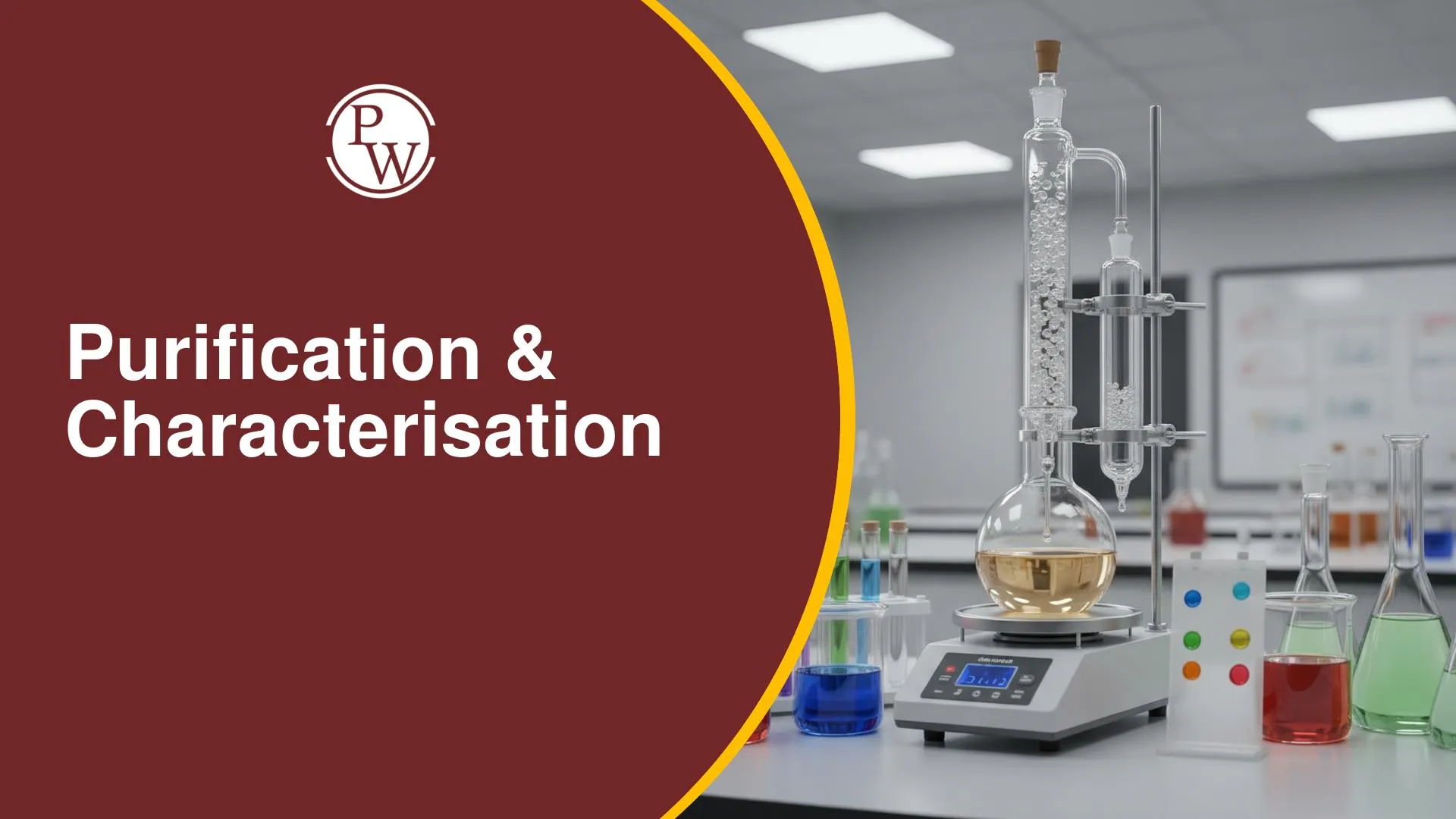
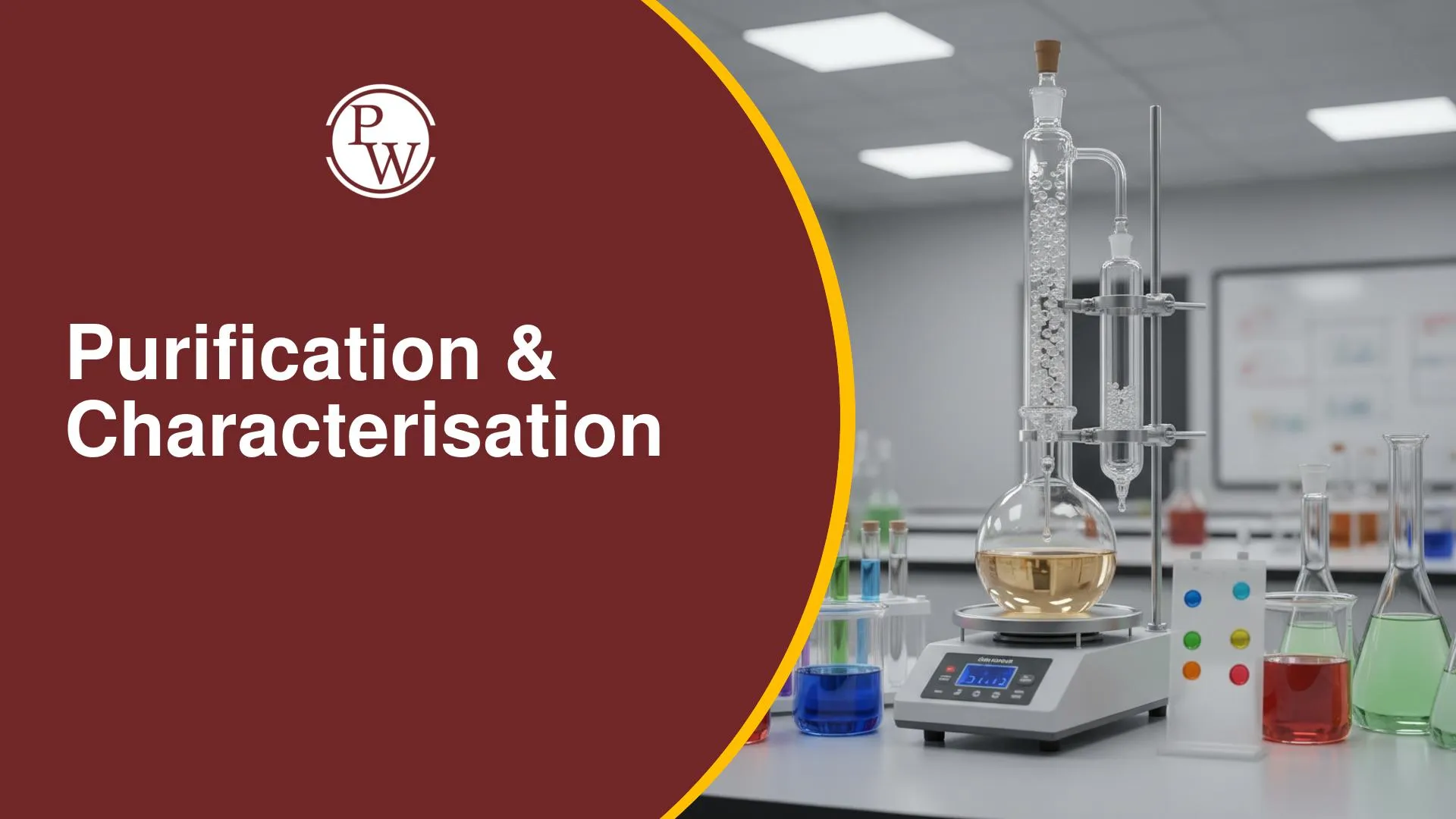
Before studying the reactions and properties of organic compounds, chemists must first separate substances from impurities and identify the elements present within them. Purification and Characterisation Techniques make it possible to obtain pure compounds, determine their composition, and analyse their chemical nature through systematic laboratory methods.
This unit introduces important separation techniques such as crystallization, distillation, sublimation, and chromatography, along with methods used for qualitative and quantitative analysis of organic compounds. It also explains how empirical and molecular formulae are calculated from experimental data, linking analytical chemistry with numerical problem-solving.
Purification Techniques in Organic Chemistry
Purification methods are used to separate pure substances from mixtures or impurities based on differences in physical properties such as solubility, boiling point, or volatility.
Crystallization is commonly used to purify solid compounds by dissolving them in a suitable solvent and allowing pure crystals to separate upon cooling. Sublimation helps purify substances that directly convert from solid to vapour without passing through the liquid state.
Distillation is used for separating liquids based on differences in boiling points, while differential extraction separates compounds using differences in solubility between two immiscible solvents.
Chromatography is an important analytical technique used to separate components of a mixture through differential adsorption or partition. It is widely used for the identification, separation, and purification of organic compounds.
Qualitative Analysis of Organic Compounds
Qualitative Analysis helps determine which elements are present in an organic compound.
The syllabus includes the detection of:
-
Nitrogen
-
Sulphur
-
Phosphorus
-
Halogens
These elements are usually detected after converting covalent compounds into ionic forms using sodium fusion methods. Different chemical tests produce characteristic colours or precipitates that indicate the presence of specific elements.
Understanding reaction observations and test principles is important while studying qualitative organic analysis.
Quantitative Analysis and Formula Calculations
Quantitative Analysis deals with determining the amount or percentage composition of elements present in an organic compound. Basic estimation principles include:
-
Carbon and hydrogen estimation
-
Nitrogen estimation
-
Sulphur and phosphorus estimation
-
Halogen estimation
The data obtained from Quantitative Analysis is used to calculate empirical and molecular formulae.
Empirical Formula represents the simplest whole-number ratio of atoms, while the Molecular Formula gives the actual number of atoms present in a molecule.
Applications of Purification and Analytical Techniques
Purification and Analytical methods are widely used in pharmaceutical industries, forensic science, food testing, environmental chemistry, and research laboratories.
Chromatography helps identify components in mixtures, while purification methods ensure accurate preparation of chemicals and medicines. Quantitative analysis is important for determining the purity and composition of compounds in industrial and laboratory processes.
These techniques form the practical foundation of Analytical Chemistry and Organic Compound identification.
Purification & Characterisation: Study Resources By PW
Physics Wallah provides concept-based study material and practice resources for purification techniques, analytical chemistry, and numerical problem-solving.
|
Resource |
Access |
|
Purification & Characterisation PYQs |
TBR |
|
Purification & Characterisation MCQs |
TBR |
|
Purification & Characterisation Notes |
TBR |
|
Purification & Characterisation Mind Maps |
TBR |
FAQs
What is Crystallization?
Why is Chromatography used?
What is Qualitative Analysis?
What is an Empirical Formula?


Have questions about your prep?
Our experts can answer all your questions