S-Block NEET Mindmaps, Notes, Formulas, and PDF
The S-Block NEET Mindmaps 2025 provide concise notes, formulas, and reactions for Alkali and Alkaline Earth Metals to simplify last-minute revision. Download the S-Block NEET Mindmap PDF to quickly review trends, exceptions, and key compounds, and boost your NEET Chemistry score with visual learning.

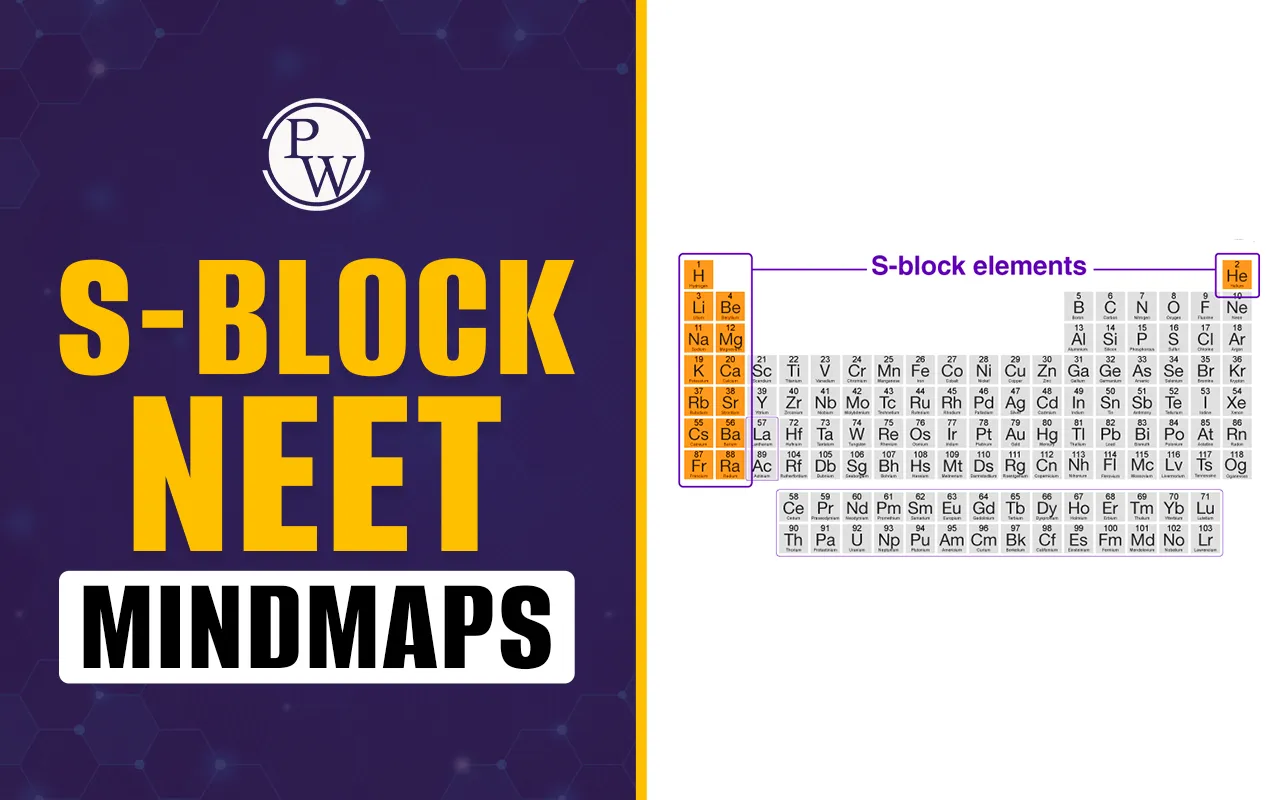
S-Block NEET Mindmaps: Preparing effectively for NEET Chemistry requires structured revision. Among all topics, the S-Block Elements chapter is one of the most important areas from which NEET asks regular questions. With so many properties, reactions, anomalies, and compounds, revising from books alone can feel difficult.
S-Block NEET Mindmaps are useful for revision. This one-page summary summarizes the entire Group 1 (Alkali Metals) and Group 2 (Alkaline Earth Metals) into a simple, visual chart. With S-Block NEET mindmap notes, formulas, questions, and a PDF, you can revise easily, remember better, and score higher in NEET Chemistry.
S-Block NEET Mindmaps Overview
The S-Block Elements chapter is scoring because the questions are straightforward and formula-based. Almost every year, NEET includes 2–3 questions from this unit. With the help of S-Block NEET mindmaps, you can revise every concept properly. The topics include:
-
General Trends like the Atomic size, ionisation enthalpy, density, melting/boiling points, flame colour.
-
Anomalous Behavior, i.e., Lithium and Beryllium show properties different from the rest of their groups.
-
Reactions with Oxygen, Water, and Nitrogen as quick, predictable patterns often asked in MCQs.
-
Diagonal Relationship between Li–Mg and Be–Al. Questions based on similarities frequently appear in NEET questions.
-
Important Compounds like Caustic soda, washing soda, baking soda, quicklime, bleaching powder, plaster of Paris.
S-Block NEET Mindmap PDF
The S-Block NEET mindmap PDF is useful for last-minute preparation. It includes all essential formulas, reactions, and trends in a compact format. You can combine PW NEET notes and S-Block NEET mindmap questions for better preparation. The PDF will help you prepare concepts like group properties, solve practice problems faster, and strengthen weak areas. Below is the S-Block NEET Mindmap PDF:
S-Block NEET Mindmap Notes
The S-Block NEET mindmap notes are carefully structured to cover both Group 1 and Group 2. These S-Block NEET mindmap notes help revise every concept easily:

S-Block NEET Mindmap Formulas and Reactions
Here are some important S-Block NEET mindmap formulas and reactions included in the notes:
|
S-Block NEET Mindmap Formulas and Reactions |
|
|
Concept |
Formula / Reaction |
|
Reaction of Alkali Metals with Water |
2Na + 2H₂O → 2NaOH + H₂↑ |
|
Reaction of Alkali Metals with Oxygen |
4Li + O₂ → 2Li₂O (oxide), 2Na + O₂ → Na₂O₂ (peroxide), K + O₂ → KO₂ (superoxide) |
|
Lithium & Nitrogen Reaction |
6Li + N₂ → 2Li₃N |
|
Quicklime Preparation |
CaCO₃ →(Δ) CaO + CO₂ |
|
Slaked Lime Formation |
CaO + H₂O → Ca(OH)₂ |
|
Plaster of Paris |
2CaSO₄·2H₂O →(Δ) CaSO₄·½H₂O + 1½H₂O |
|
Diagonal Relationship |
LiCl and MgCl₂ both deliquescent, BeCl₂ and AlCl₃ both covalent Lewis acids |
How to Revise S-Block with Mindmaps
The S-Block chapter includes many reactions and exceptions. But with S-Block NEET mindmaps, you can prepare well. Here are some tricks to prepare well:
-
Keep Group 1 and Group 2 trends side by side for better recall.
-
Remember, Exceptions like Lithium and Beryllium show anomalous behaviour due to small size and high charge density. Note them separately in the mindmap.
-
Use the diagonal relationship (Li–Mg, Be–Al) to connect properties logically.
-
After revising, solve the S-Block NEET mindmap questions to strengthen memory.
-
Associate flame test colours with real visuals (e.g., Li – crimson red, Ba – apple green).
Also Check:
- NEET Exam Pattern 2026
- NEET 2026 Admit Card
- NEET Eligibility Criteria 2026
- NEET 2026 Exam Centres
- NEET Candidate Login 2026
S-Block NEET Mindmaps FAQs
What is included in the S-Block NEET mindmaps?
Can I download the S-Block NEET mindmap PDF?
Are formulas included in the S-Block NEET mindmap notes?
How should I study using the mindmaps?
Why are Li and Be exceptions in the S-Block?