






CBSE Issues New Three-Language Policy Guidelines Under NEP 2020; No Change for Current Class 10 Students

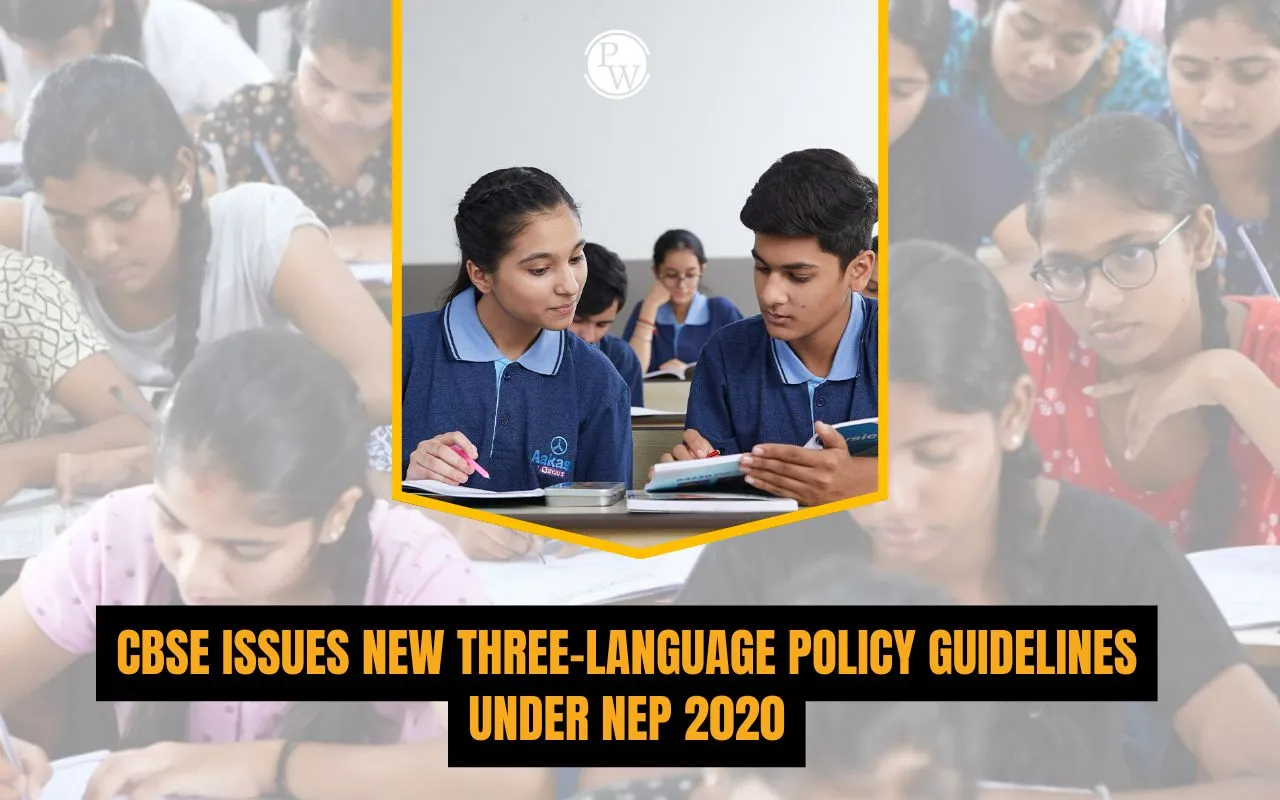
CBSE Three-Language Policy 2026: The Central Board of Secondary Education (CBSE) has released detailed guidelines for implementing the three-language policy in affiliated schools from the 2026–27 academic session, in line with the recommendations of the National Education Policy (NEP) 2020. The Board has clarified that students currently studying in Class 10 during the 2026–27 academic year will continue under the existing two-language system and will not be required to study or appear for a third language. The new guidelines also provide transitional relaxations for students in Classes VII, VIII, and IX to ensure that no learner is adversely affected during the implementation process.
No Change for Current Class 10 Students
CBSE has reiterated that students who are in Class 10 during the 2026–27 academic session will continue following the existing language scheme.
They will study only two languages, as per the current pattern, and will not be required to take a third language or appear for any additional language examination.
The Board said this exemption has been provided to ensure a smooth transition while implementing the recommendations of NEP 2020.
Three-Language Formula to Begin for Class 9 Students
Students entering Class 9 in the 2026–27 academic session will study three languages, with at least two of them being Bhartiya Bhashas (Indian languages).
Examples of Bhartiya Bhashas include:
-
Hindi
-
Sanskrit
-
Tamil
-
Telugu
-
Kannada
-
Malayalam
-
Marathi
-
Bengali
-
Punjabi
-
Gujarati
-
Odia
-
Assamese
Students may choose a foreign language such as English, French, German, Arabic, or Spanish as the third language only if the other two languages are Indian languages.
Special Relaxation for Current Class 9 Students
To avoid disruption for students already pursuing different language combinations, CBSE has introduced a one-time relaxation.
Students currently studying two foreign or non-native languages, such as English and French, will be allowed to continue with both languages. However, they must add one Bhartiya Bhasha as the third language.
Importantly, the Board clarified that this third language will be assessed only through internal school-based assessment.
There will not be a CBSE Board examination for the third language when these students appear for their Class 10 Board examinations in 2027–28.
Relief for Current Classes VII and VIII
CBSE has also provided transitional benefits for students currently studying in Classes VII and VIII.
Students who have already opted for two non-native languages can continue studying them and simply add one Indian language. Like the current Class IX batch, they will not have to appear for a Board examination in the third language when they reach Class 10.
The Board stated that schools will assess the third language through internal assessments only.
Class VI Students to Follow Full NEP Language Policy
The new policy will be implemented fully for students studying in Class VI during the 2026–27 academic session and future batches.
These students will study three languages, including two Bhartiya Bhashas, throughout middle and secondary school.
Unlike the transitional batches, these students will appear for the CBSE Board examination in the third language when they reach Class 10.
To support implementation, NCERT is making dedicated textbooks available in all 22 scheduled Indian languages.
CBSE Introduces Flexible Implementation Measures
To help schools adopt the revised language policy smoothly, CBSE has announced several implementation measures.
These include:
-
Flexible teacher recruitment and staffing arrangements.
-
Use of retired teachers and postgraduate language experts.
-
Sharing of teachers through Sahodaya school complexes.
-
Virtual and hybrid teaching wherever required.
-
Grade-appropriate learning resources prepared by CBSE and NCERT.
The Board said these measures are intended to ensure that schools can offer multiple Indian languages without creating additional pressure on students.
Exemptions Under Three-Language Policy
Certain categories of students have been exempted from the mandatory third-language requirement.
These include:
-
Children with Special Needs (CwSN), as per the Rights of Persons with Disabilities (RPwD) Act, 2016.
-
Students studying in CBSE-affiliated schools located outside India.
-
Foreign students returning to India.
Additionally, students whose parents are transferred to another state may continue with their previously chosen third language, provided the school makes adequate arrangements to support their learning.
Focus on Meaningful Language Learning
CBSE emphasized that the revised guidelines are designed to encourage multilingual learning without increasing examination stress.
According to the Board, the objective is to make language education meaningful, engaging, and enjoyable, while promoting conceptual understanding, cultural awareness, and holistic development.