NTA JEE Main 2026 Dress Code: Thick Soles Banned, Large Buttons Banned, Kara & Kirpan Allowed
NTA has printed binding dress code instructions directly on the JEE Main 2026 admit card. Thick-soled shoes and large-button garments are banned for everyone. Sikh candidates get an official religious exemption for Kara and Kirpan — but must arrive early. Gate closes at 8:30 AM (Shift 1) and 2:30 PM (Shift 2), and even a toilet break triggers mandatory re-frisking. Violate any of this and your JEE Main 2026 exam is over before it begins.
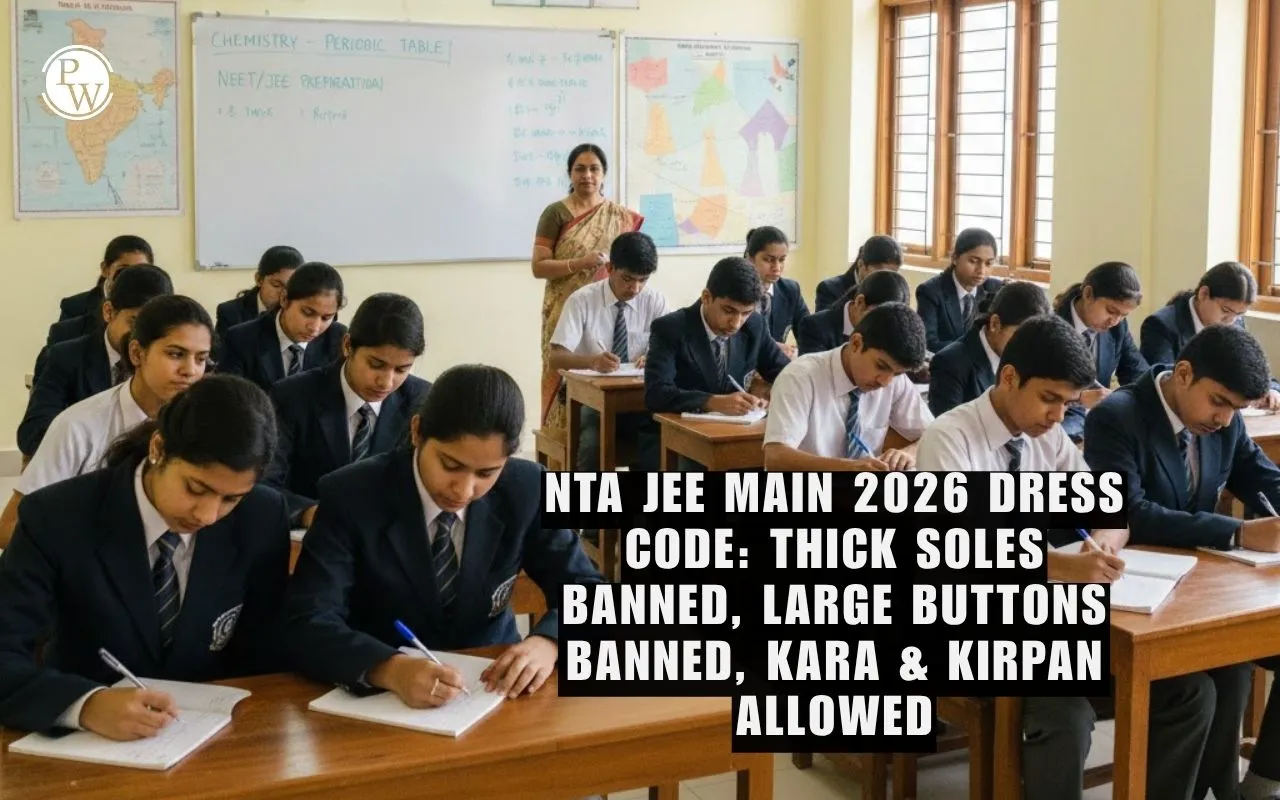
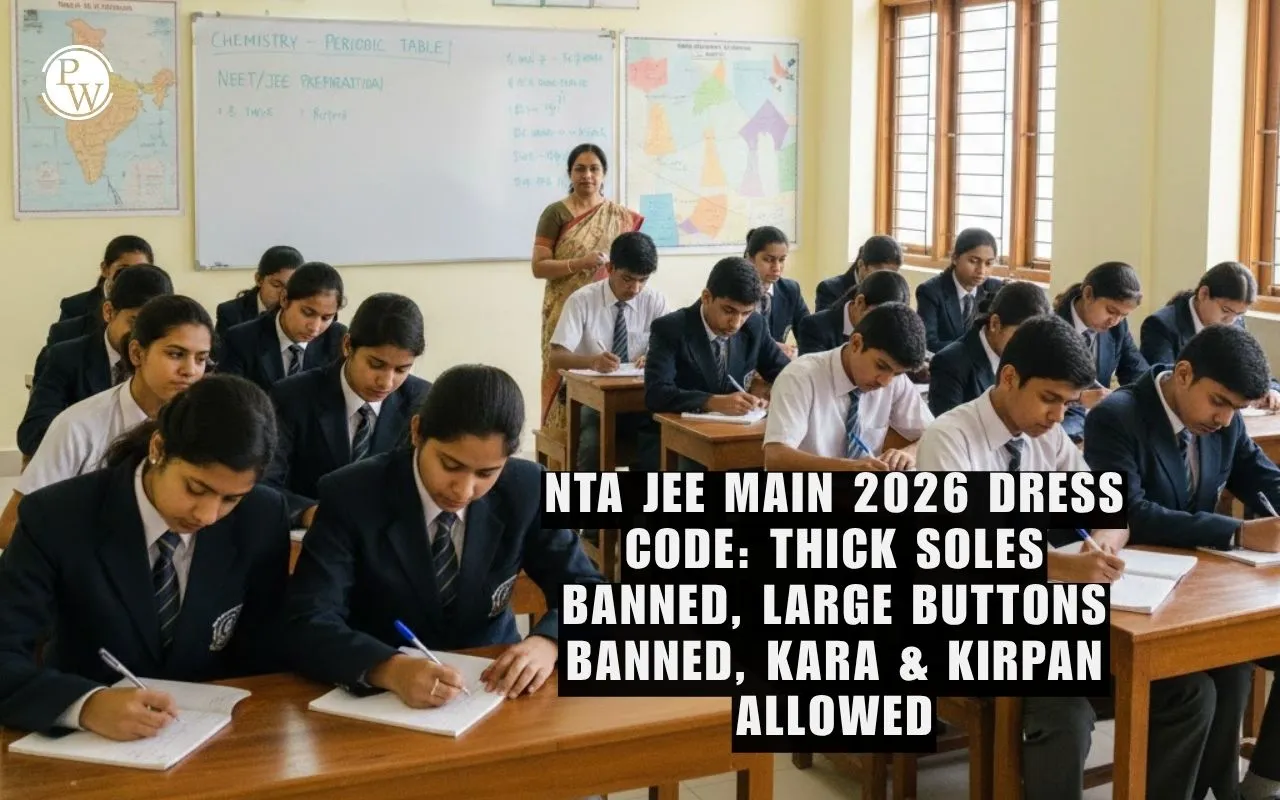
Every year, lakhs of JEE Main candidates walk into exam centres unprepared for something they never studied — the dress code. In 2026, NTA has made this harder to ignore than ever before by printing specific dress code restrictions directly on the admit card itself. This is a formal, enforceable instruction backed by NTA's growing surveillance infrastructure of AI cameras, biometric scanners, and flying squads.
Miss even one of these rules and you risk a delayed entry, a detailed inspection, or being turned away entirely. This is the most complete, most deeply researched guide to JEE Main 2026 dress code rules, prohibited items, religious exemptions, gate closing times, and what happens inside the exam hall — for both candidates and parents.
Also Read: JEE Main 2026 April Shift Wise Marks vs Percentile: Based 2025 JEE Main Trends
Why NTA Is Getting Stricter on Dress Codes — The Malpractice Background Every Candidate Must Know
Before diving into the rules, understand why they exist — because this context will make every rule make complete sense.
On the very first day of JEE Main 2024 April Session, NTA — using AI-based technology — caught 10 cases of cheating. In one case, a candidate was found to have been substituted, while in 9 other cases, unfair means were detected.
NTA has a zero-tolerance policy toward cheating. Candidates found using unfair means face immediate disqualification and a ban from appearing in future JEE Main exams for up to 3 years, along with potential criminal proceedings.
NTA utilises advanced AI-based monitoring and multi-stage biometric verification, including facial recognition technology at entry points to verify the identity of aspirants against their registered photographs. PW
This is the arms race that explains every dress code rule. Bluetooth chips have been found hidden in shoe soles. Micro-cameras have been concealed behind large buttons. Wireless earpieces have been tucked under clothing. By controlling what candidates wear, NTA controls what they can smuggle. The dress code is not bureaucracy — it is a frontline anti-cheating measure.
Also Read: JEE Main 2026 Session 2 Self-Declaration Form: How to Fill It & Mistakes to Avoid
Official Dress Code Rule 1: Thick-Soled Shoes Are Banned — No Exceptions
The main rule mentioned on the JEE Main admit card is: "Shoes with thick soles and garments with large buttons are not allowed."
Thick-soled footwear — platform shoes, chunky sneakers, heavily cushioned sports shoes, thick foam trainers — is completely prohibited. Only sandals or slippers with thin soles are allowed inside the JEE Main exam centre during Session 2. Shoes or sneakers with thick soles will not be permitted.
Why specifically shoes? Because shoe soles have been documented in India's examination fraud ecosystem as a hiding place for Bluetooth transmitters, SIM-enabled earpiece controllers, and chit material. A candidate wearing thick-soled shoes at the gate can expect a mandatory detailed inspection that will cost significant time — and if anything suspicious is found, entry will be denied.
The night-before rule: Decide your footwear the evening before your exam. Pack your sandals or chappals with your documents. Do not leave this for exam morning.
For female candidates specifically: High-heeled shoes, platform sandals, and thick-soled wedges all fall under the prohibited category. Choose flat sandals or simple flat chappals.
FAQ: Are sports shoes allowed in JEE Main 2026? No. Sports shoes almost universally have thick cushioned soles and are prohibited by the dress code printed on the JEE Main 2026 admit card. Wear thin-soled sandals, chappals, or flat canvas shoes instead.
FAQ: What if I accidentally wear thick-soled shoes to the exam? You will be subjected to a detailed security inspection. At minimum, you may be asked to remove your shoes for checking. This will cost you precious time before gate closing. In cases where invigilators are not satisfied, entry may be refused. There is no workaround.
Official Dress Code Rule 2: Garments With Large Buttons Are Banned
The second rule printed directly on the JEE Main 2026 admit card is equally specific. Garments with large buttons — shirts, kurtas, jackets, blazers, ethnic wear tops, or any clothing item with oversized or decorative buttons — are not allowed.
The primary rule is that no metallic accessories or attachments should be present on any clothing item you wear to the JEE Main exam centre. When in doubt, choose the simplest and most lightweight clothing option available.
Large buttons — especially hollow or thick ones — have been used in exam fraud to conceal miniature cameras facing outward, allowing candidates to transmit question paper images to external handlers. NTA's dress code rule directly counters this threat.
What to wear: Plain cotton t-shirts with no buttons, simple shirts with small standard flat buttons, plain kurtas with no embellishment, simple salwar kameez without large decorative elements.
What to avoid: Blazers with large buttons, shirts with oversized decorative buttons, ethnic wear with tikki-work or large button embellishments, denim jackets with large metal fasteners.
FAQ: Can I wear a full-sleeve shirt to JEE Main 2026? Jackets and full-sleeved clothing are generally permitted as long as they do not include metal buttons, zippers, or large accessories that may require additional checking at the entry point. Full sleeves are not categorically banned — large buttons and metallic elements are.
FAQ: Can female candidates wear ethnic wear like salwar kameez or lehenga to JEE Main 2026? Simple salwar kameez without heavy embroidery, large buttons, or metallic work is acceptable. Heavily embellished or decorated ethnic wear will trigger a detailed security inspection and is strongly discouraged.
FAQ: Are belts allowed at the JEE Main 2026 exam centre? Wallets, handbags, and belts with metallic buckles are on the prohibited items list. Wear trousers or jeans with elastic waistbands, or use a simple thin belt with a small non-metallic buckle to avoid any complications during frisking.
Also Read: What to Do 12 Hours Before JEE Main 2026: Complete Last 12 Hours Plan
Religious Exemption: Sikh Candidates Are Officially Allowed to Wear Kara and Kirpan
This is the most under-reported part of NTA's dress code advisory — and the most important for Sikh candidates across India.
NTA has confirmed that Sikh candidates are allowed to wear religious or customary attire such as turbans, Kara, or Kirpans at the JEE Main 2026 examination centre.
The Kara is the steel bracelet that forms one of the five Panj Kakars of Sikh religious identity. The Kirpan is the ceremonial dagger — typically worn in a small, symbolic form — that represents courage and justice in the Sikh faith. NTA has formally exempted these items from its general prohibited items restrictions, recognising that denying them would constitute a violation of a candidate's fundamental religious rights.
This exemption is printed in the official NTA advisory and cannot be overridden by individual exam centre staff. If any invigilator at an exam centre objects to a Sikh candidate's Kara or Kirpan, the candidate should calmly refer to the official NTA advisory on the admit card.
The critical practical instruction: Examinees wearing any special attire due to religious reasons are advised to reach the exam centres earlier to undergo thorough checking and mandatory frisking. This is not optional advice. Sikh candidates with turban, Kara, or Kirpan will undergo a more thorough check at the entry gate — which takes additional time. If they arrive at the standard time, this extra check could push them past the gate closing time.
Recommended arrival time for Sikh candidates: At least 30 to 45 minutes earlier than the already-recommended early arrival time. For Shift 1, aim to be at the centre gate by 6:30 AM at the latest.
FAQ: Are Sikh candidates allowed to wear Kara at JEE Main 2026? Yes. NTA has officially permitted Sikh candidates to wear Kara and Kirpan as religious articles at JEE Main 2026 exam centres. These items are exempted from the general metallic items prohibition. However, they will be inspected at the entry gate, so Sikh candidates must arrive significantly earlier than the standard recommended time.
FAQ: Will a Sikh candidate be asked to remove their Kara or Kirpan at the exam centre? NTA's advisory does not require removal — it requires inspection. The invigilating staff will examine the items as part of the mandatory frisking procedure. Sikh candidates should be cooperative and patient during this process.
Gate Closing Time: The Hardest Rule in the Entire Advisory
Of everything in NTA's JEE Main 2026 advisory, this is the one that ends careers with no recourse at all.
No candidate will be allowed to enter the JEE Mains exam centre if they arrive after the gate closing time. All candidates have to be present at the exam centre before the gate closes for their respective shifts.
The exact gate closing times are: Gates close strictly at 8:30 AM for Shift 1 and at 2:30 PM for Shift 2. Late entry is not allowed under any circumstances.
This means the following entry window for security checks, biometric verification, document verification, frisking, and finding your seat: For morning shifts, students must reach the exam centre by 7:00 AM, with gates shutting promptly at 8:30 AM. For afternoon shifts, reporting begins at 1:00 PM and gates close at 2:30 PM.
Late arrivals will not be permitted to enter after the gate closes — there are absolutely no exceptions to this rule, regardless of the reason for delay.
Traffic jam, auto breakdown, bus delay, family emergency, alarm clock failure — NTA does not accept any of these as grounds for late entry. The NTA will not be held responsible for any delays in a candidate's arrival at the examination centre.
The real timeline on exam day: The entry process at a JEE Main centre is not a quick scan-and-walk-in. This process takes one to one-and-a-half hours, so early arrival is necessary. Security frisking, biometric fingerprint scanning, document verification of admit card and photo ID, AI-based facial recognition check, and walking to your assigned seat — all of this must happen before the gate closes.
Parent advisory: If your child's exam centre is in a city that is prone to traffic congestion, book their accommodation nearby the night before. A hotel stay 15 minutes from the exam centre is far cheaper than three years of re-preparation.
FAQ: What is the gate closing time for JEE Main 2026 Session 2? Gates close strictly at 8:30 AM for Shift 1 (morning) and 2:30 PM for Shift 2 (afternoon). Verify the exact time on your specific admit card, as it is the authoritative document.
FAQ: What happens if I arrive at the JEE Main 2026 exam centre one minute after gate closing? You will be denied entry with no exceptions. There is no emergency provision, no grace period, no compensatory exam date, and no refund. Your JEE Main 2026 Session 2 attempt for that day is cancelled.
FAQ: Is reporting time the same as gate closing time? No. Reporting time is when you must reach the JEE Mains centre, while exam time is when the test starts. Gate closing falls between these two. The gate closing time is the hard deadline — not the reporting time and not the exam start time.
The Toilet Break Rule Nobody Talks About — Mandatory Re-Frisking
This is a critical rule that almost every competitor website has missed entirely. It directly relates to the dress code because it means the frisking is not a one-time event.
Apart from the biometric attendance and frisking at entry, if a candidate goes for a bio-break or toilet, they must undergo mandatory frisking and biometrics again.
Every single time a candidate leaves the exam hall during the examination — for any reason — they are treated as if they are entering for the first time. This is NTA's mechanism to prevent candidates from receiving external assistance or retrieving hidden material during a toilet break.
The practical implication for dress code: do not wear any clothing item that makes re-frisking unnecessarily complicated. Simple clothing, thin-soled footwear, and no metallic accessories mean each frisking pass is fast and uneventful. Complex clothing means a longer re-frisking window that eats into your exam time.
FAQ: Can I take a toilet break during JEE Main 2026? Yes, but you must undergo mandatory frisking and biometric verification again before re-entering the exam hall. There is no exception to this rule. Plan accordingly — avoid drinking excessive water before the exam.
Complete Prohibited Items List for JEE Main 2026 Exam Centre
Candidates are not allowed to carry instruments, geometry or pencil boxes, handbags, purses, any kind of paper or stationery or textual material, eatables and water (loose or packed), mobile phones, earphones, microphones, pagers, calculators, DocuPen, slide rules, log tables, cameras, tape recorders, electronic watches with calculator features, any metallic item, or electronic gadgets or devices into the examination centre, hall, or room.
In plain language — leave your mobile phone at home or in your vehicle. Leave your wallet outside (carry ID separately). Leave your smartwatch, fitness band, and analogue watch at home. Leave your calculator, geometry box, and stationery at home unless you are a B.Arch candidate appearing for the Drawing Test. Leave your bag, purse, and handbag outside. Do not carry any water bottle unless it is fully transparent (and only diabetic candidates are permitted eatables).
Complete JEE Main 2026 Exam Day Dress Code — Final Consolidated Rules
Explicitly prohibited by NTA (printed on admit card): Thick-soled shoes of any kind. Garments with large buttons.
Generally prohibited (standard exam day rules): Caps, mufflers, scarves, stoles, hoodies over head. Any jewellery — earrings, rings, necklaces, bracelets (except Kara for Sikh candidates). Watches of all kinds — analogue, digital, smart. Belts with large metallic buckles. Metallic accessories of any kind.
Permitted: Plain t-shirts, simple shirts with small standard buttons. Plain jeans, trousers, salwar kameez without heavy embellishment. Thin-soled sandals, chappals, flat footwear. Kara and Kirpan for Sikh candidates, subject to inspection. Turban for Sikh candidates, subject to inspection.
The Parent's Exam Day Checklist
Lay these out the night before so there is no last-minute confusion:
Printed colour admit card on A4 paper, original valid photo ID matching the application, simple clothing without large buttons, thin-soled sandals or flat chappals already set aside, Kara and Kirpan for Sikh candidates with a plan to arrive 45 minutes earlier than normal, transparent water bottle for diabetic candidates only, no mobile phone to be carried inside, no wallet with metallic items, and an alarm set for at least 2.5 hours before the gate closing time.
Master FAQ: JEE Main 2026 Dress Code, Gate Time & Prohibited Items
Q: Why is NTA banning thick-soled shoes and large buttons? Both have been documented as hiding spots for electronic cheating devices in India's exam fraud ecosystem. NTA uses AI-based monitoring, high-frequency jammers, and Aadhaar-linked biometric verification — the dress code is the physical counterpart to this digital security system.
Q: Can I wear a hoodie or jacket to JEE Main 2026? Hooded garments are not permitted. Hooded garments, caps, and scarves are not permitted because they interfere with frisking and candidate identification. A thin, plain jacket without large buttons and without a hood is acceptable.
JEE Main 2026 FAQ
Will I be allowed entry if I forget my admit card but have my photo ID?
What if my name or photograph is unclear on the admit card printout?
Do I need to carry my Class 10 or Class 12 marksheet or certificate to the JEE Main 2026 exam?
Can I use a photocopy of my Aadhaar card as photo ID at the JEE Main 2026 centre?


Have questions about your prep?
Our experts can answer all your questions