UPSC Common Mistakes While Filling OMR Sheet and Scannable Attendance List: Check Official Guidelines



Union Public Service Commission (UPSC) has issued an official guide on common mistakes made while filling the OMR Sheet and Scannable Attendance List (SAL). Candidates appearing in UPSC objective-type examinations should carefully follow the instructions while entering details and marking responses.
The official document highlights mistakes related to booklet series, subject code, roll number, prohibited areas, answer bubbling, and attendance details. Candidates should check these points before submitting their OMR Sheet and SAL.
UPSC Common Mistakes in OMR Sheet and SAL PDF
Candidates can refer to the official UPSC PDF for illustrations of the correct and incorrect ways of filling the OMR Sheet and Scannable Attendance List.
Official PDF: Download UPSC Common Mistakes in OMR Sheet/SAL PDF
UPSC OMR Sheet: Common Mistakes to Avoid
The UPSC exam document highlights the following mistakes while filling the OMR Sheet:
| UPSC OMR Sheet: Common Mistakes to Avoid | ||
| Area | Common Mistake | What Candidates Should Do |
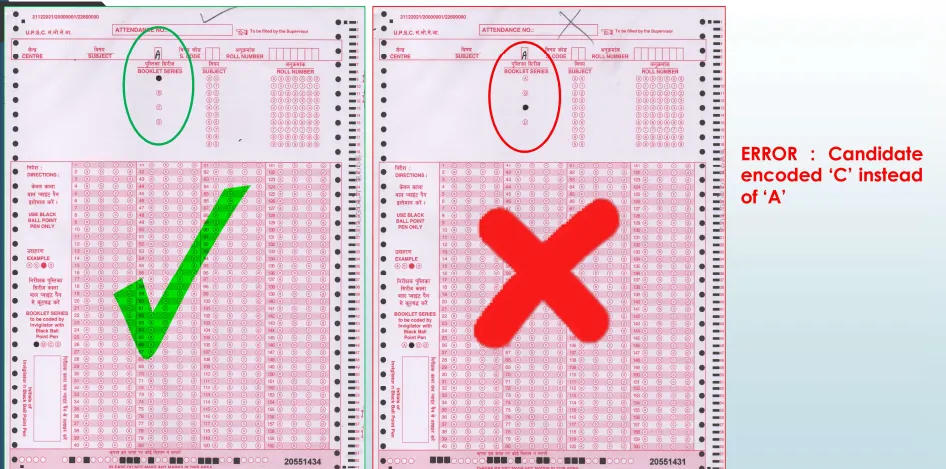
| Booklet Series | Encoding a different booklet series instead of the series provided to the candidate | Encode the booklet series correctly as instructed |
| Booklet Series | Not encoding the booklet series | Ensure the required series is encoded |
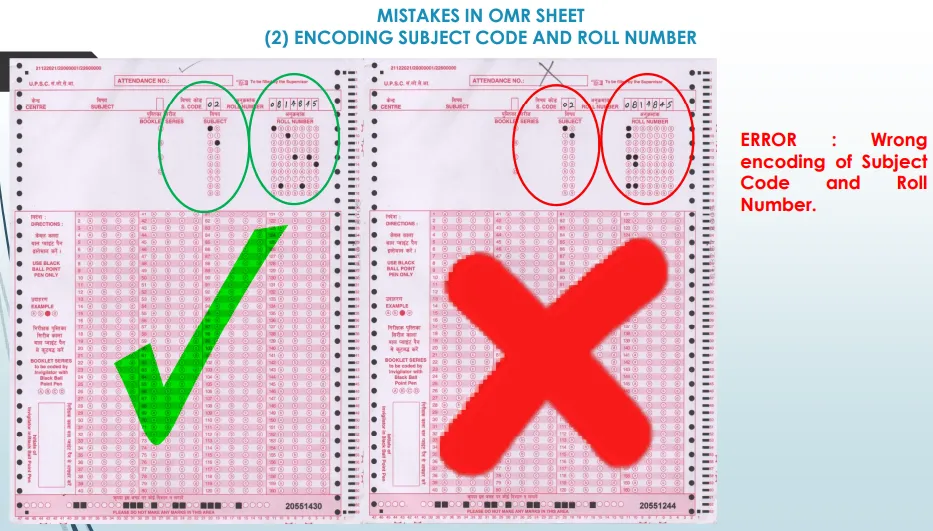
| Subject Code & Roll Number | Incorrect encoding of the subject code or roll number | Carefully enter and encode the required details |
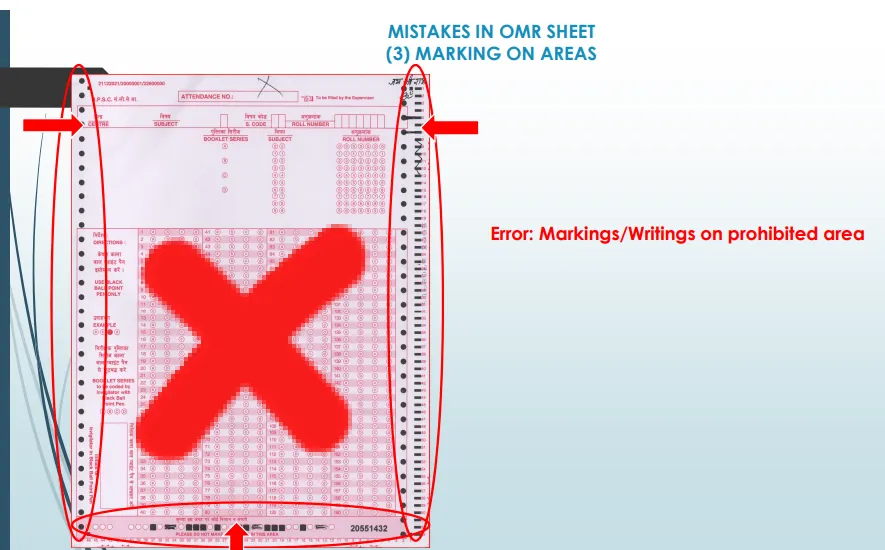
| Prohibited Areas | Writing or making marks in areas where marking is not permitted | Leave prohibited areas untouched |
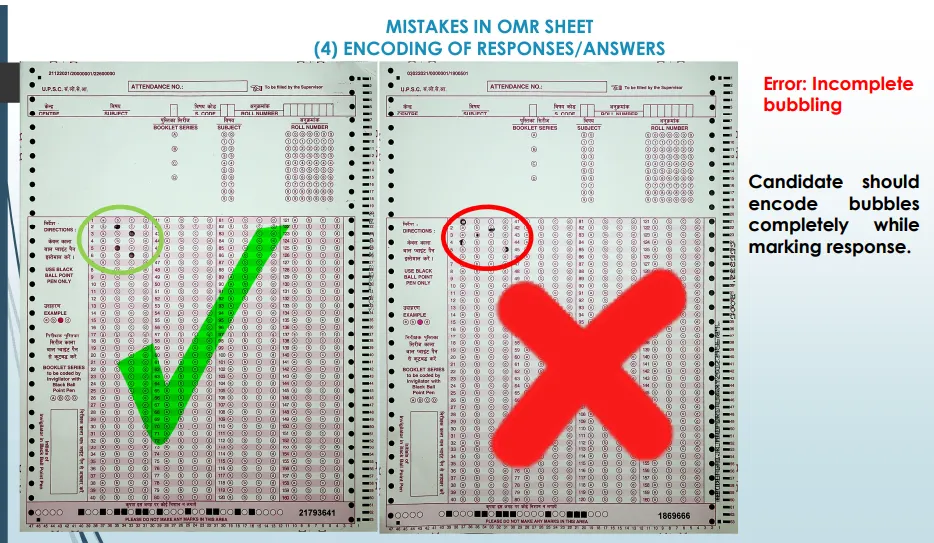
| Responses/Answers | Incomplete bubbling of the answer bubble | Completely fill the appropriate bubble while marking a response |
These are the specific categories of OMR-related mistakes illustrated in the UPSC's official document.
1. Incorrect Booklet Series Encoding
Candidates may receive question booklets with different series. One mistake highlighted by UPSC is encoding a booklet series different from the one served to the candidate.
For example, the official illustration shows a candidate receiving Series A but encoding Series C on the OMR Sheet. Another mistake is leaving the booklet-series encoding incomplete or not doing it.
What to remember: Check the series printed on the question booklet and carefully follow the instructions for encoding it on the OMR Sheet.
2. Wrong Subject Code or Roll Number Encoding
UPSC also highlights wrong encoding of the subject code and roll number as a common mistake.
Candidates should pay close attention while entering these details and ensure that the required numbers are encoded in the designated areas of the OMR Sheet.
3. Marking or Writing in Prohibited Areas
Another mistake shown in the official UPSC guide is making markings or writing in prohibited areas of the OMR Sheet.
Candidates should use only the designated portions of the sheet for the information and responses requested. Unnecessary markings should be avoided.
4. Incomplete Bubbling of Answers
UPSC specifically highlights incomplete bubbling while encoding responses.
When marking an answer, candidates should fill the bubble completely rather than leaving it partially shaded. The official document illustrates incomplete bubbling as an error.
Common Mistakes While Filling the Scannable Attendance List (SAL)
The UPSC document also covers mistakes related to the Scannable Attendance List (SAL). The key issues highlighted are related to the placement of candidate details.
1. Filling Details at the Wrong Place
Candidates may enter their details at a place other than the designated location on the SAL.
The official guidance illustrates the correct location for entering candidate details and contrasts it with an incorrect placement. Candidates should therefore carefully identify the prescribed area before making an entry.
2. Filling Details at Multiple Places
Another mistake highlighted by UPSC is entering candidate details at multiple places.
Candidates should enter the required information only at the designated location on the Scannable Attendance List and avoid making additional entries elsewhere.
UPSC OMR Sheet and SAL: Quick Checklist
Before completing the OMR Sheet and Scannable Attendance List, candidates should check:
-
Correct booklet series has been encoded.
-
Booklet series has not been left unencoded.
-
Subject code is correctly encoded.
-
Roll number is correctly encoded.
-
No writing or markings have been made in prohibited areas.
-
Answer bubbles are completely filled.
-
Details on the SAL are entered at the designated place.
-
The same details are not entered at multiple places.
These points are based on the mistakes specifically illustrated in the UPSC's official guidance.