RRB Staff Nurse General Science, Check Important Topics, Type of Question, Time Table
 Priyanka Agarwal23 Sept, 2024
RRB Staff Nurse General Science : The General Science section of the RRB Staff Nurse exam evaluates candidates on fundamental scientific principles in Physics, Chemistry, and Life Sciences. This section consists of 10 multiple-choice questions, each worth 1 mark, totaling 10 marks, focusing on concepts relevant to nursing and healthcare. To excel, candidates should study the 10th standard CBSE syllabus and master key topics such as laws of motion, chemical reactions, and human physiology. Various types of questions are included, such as conceptual, application-based, and diagram-based questions, ensuring a comprehensive assessment of knowledge. Additionally, sample MCQs provide insights into the exam's structure and question types, helping candidates prepare effectively for their assessment
Key Highlights of the RRB Staff Nurse General Science Section
The RRB Staff Nurse General Science Section designed to evaluate candidates' understanding of fundamental scientific principles across various disciplines, including Physics, Chemistry, and Life Sciences. This section plays a crucial role in assessing how well candidates can apply scientific knowledge in nursing contexts.- Total Questions : 10 questions to test your scientific knowledge.
- Scoring : Each question carries 1 mark, totaling 10 marks.
- Format : All questions are in Multiple Choice format (MCQs).
- Content Areas : Covers Physics, Chemistry, and Life Sciences up to 10th Standard.
- Relevance : Focuses on concepts applicable to nursing and healthcare.
- Quick Responses : Emphasizes speed and accuracy in answering questions.
- Foundation Knowledge : Requires a solid understanding of basic scientific principles.
How to Study for RRB Staff Nurse General Science Section
To effectively prepare for the General Science section, candidates should adopt a structured study plan. Start by reviewing the 10th standard CBSE syllabus for Physics, Chemistry, and Life Sciences. Utilize standard textbooks and reference materials to build a solid understanding of fundamental concepts. Practice regularly with previous years' question papers and sample MCQs to familiarize yourself with the exam pattern. Additionally, joining study groups or online forums can provide valuable insights and motivation. Consistency and regular revision are key to mastering this section.Important Topics for RRB Staff Nurse General Science
To excel in the RRB Staff Nurse General Science section, candidates should concentrate on key areas that encompass foundational concepts in physics, chemistry, and life sciences. Mastering these topics will not only enhance understanding but also improve performance in the examination. A strong grasp of these subjects is essential for aspiring nursing professionals, as they form the basis for various practical applications in healthcare settings. When preparing for the RRB Staff Nurse General Science section, focus on the following important topics:| Important Topics for RRB Staff Nurse General Science | |
|---|---|
| Subject | Important Topics |
| Physics | Laws of motion |
| Work, energy, and power | |
| Heat and thermodynamics | |
| Properties of matter | |
| Chemistry | Basic concepts of chemistry |
| Periodic table and elements | |
| Acids, bases, and salts | |
| Chemical reactions and equations | |
| Life Sciences | Human physiology and health |
| Basic principles of genetics | |
| Plant and animal biology | |
| Ecosystems and environmental science | |
Types of Questions Asked in the RRB Staff Nurse General Science
The General Science section typically features multiple-choice questions (MCQs) that test various levels of understanding, ensuring that candidates can demonstrate both foundational knowledge and the ability to apply concepts in practical scenarios. Common types of questions include:- Conceptual Questions: These assess your understanding of fundamental principles, such as laws of motion or chemical reactions.
- Application-Based Questions: These require candidates to apply their knowledge to real-life scenarios relevant to nursing.
- Diagram-Based Questions: Candidates may be asked to interpret or label diagrams related to human anatomy or scientific processes.
- Assertion and Reasoning: Questions where candidates must determine the validity of statements and provide justifications.
RRB Staff Nurse General Science MCQs
- Which law states that for every action, there is an equal and opposite reaction?
- A) Newton's First Law
- B) Newton's Second Law
- C) Newton's Third Law
- D) Law of Conservation of Momentum
Answer : C) Newton's Third Law
- What is the chemical formula for table salt?
- A) NaCl
- B) KCl
- C) CaCO3
- D) H2O
Answer : A) NaCl
- Which part of the human body is primarily responsible for gas exchange?
- A) Heart
- B) Liver
- C) Lungs
- D) Kidneys
Answer : C) Lungs
Sample MCQs for RRB Staff Nurse General Science
Here are some sample MCQs that reflect the kind of questions you may encounter in the RRB Staff Nurse General Science section:Conceptual Question:
What is the principle behind the conservation of energy? a) Energy can be created and destroyed. b) Energy can neither be created nor destroyed, only transformed. c) Energy is constant in a closed system. d) Energy increases in a closed system.Answer: b) Energy can neither be created nor destroyed, only transformed.
Application-Based Question:
If a patient has a high fever, which of the following methods is most effective for cooling the body? a) Wrapping in a thick blanket b) Applying ice packs to the forehead and neck c) Drinking hot beverages d) Taking a hot bathAnswer: b) Applying ice packs to the forehead and neck.
Diagram-Based Question:
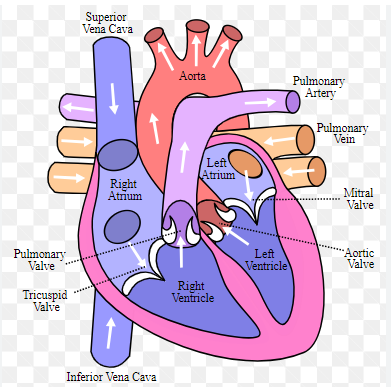 In the diagram of the human heart, which chamber is responsible for pumping oxygenated blood to the body?
a) Right Atrium
b) Left Ventricle
c) Right Ventricle
d) Left Atrium
In the diagram of the human heart, which chamber is responsible for pumping oxygenated blood to the body?
a) Right Atrium
b) Left Ventricle
c) Right Ventricle
d) Left Atrium
Answer: b) Left Ventricle.
Assertion and Reasoning:
Assertion: Water boils at 100°C at sea level. Reason: Atmospheric pressure affects the boiling point of liquids. a) Both assertion and reason are true, and reason is the correct explanation for assertion. b) Both assertion and reason are true, but reason is not the correct explanation for assertion. c) Assertion is true, but reason is false. d) Assertion is false, but reason is true.Answer: a) Both assertion and reason are true, and reason is the correct explanation for assertion.
Conceptual Question:
Which of the following best describes the pH scale? a) A measure of the density of a solution b) A measure of the acidity or alkalinity of a solution c) A measure of the temperature of a solution d) A measure of the electrical conductivity of a solutionAnswer: b) A measure of the acidity or alkalinity of a solution
RRB Staff Nurse General Science Study Timetable
6 Days a Week, 1.5 Hours Per Day:
| Day | Activity | Time |
|---|---|---|
| Monday | Review Physics | 5:00 - 6:00 PM |
| Tuesday | Review Chemistry | 5:00 - 6:00 PM |
| Wednesday | Review Life Sciences | 5:00 - 6:00 PM |
| Thursday | Revision of All Subjects | 5:00 - 6:00 PM |
| Friday | Mock Test and Solve Previous Papers | 5:00 - 6:00 PM |
| Saturday | Review Notes | 5:00 - 6:00 PM |
| Sunday | Rest and Recap | — |
Key Tips:
- Stay Focused : Maintain concentration during each study session.
- Track Progress : Review your progress at the end of the week.
- Create Concise Notes : Write down key points for quick revision.
RRB Staff Nurse General Science FAQs
What subjects are covered in the RRB Staff Nurse General Science section?
How many questions are there in the General Science section, and what is the scoring system?
What types of questions can I expect in the exam?
How should I prepare for the General Science section?
Why is the General Science section important for nursing candidates?



 Live & recorded classes available at easeDashboard for progress trackingMillions of practice questions at your fingertips