Professional Certification Program in AI and Machine Learning from IIT Patna with PW Online Degree
 Mridula Sharma30 Oct, 2026

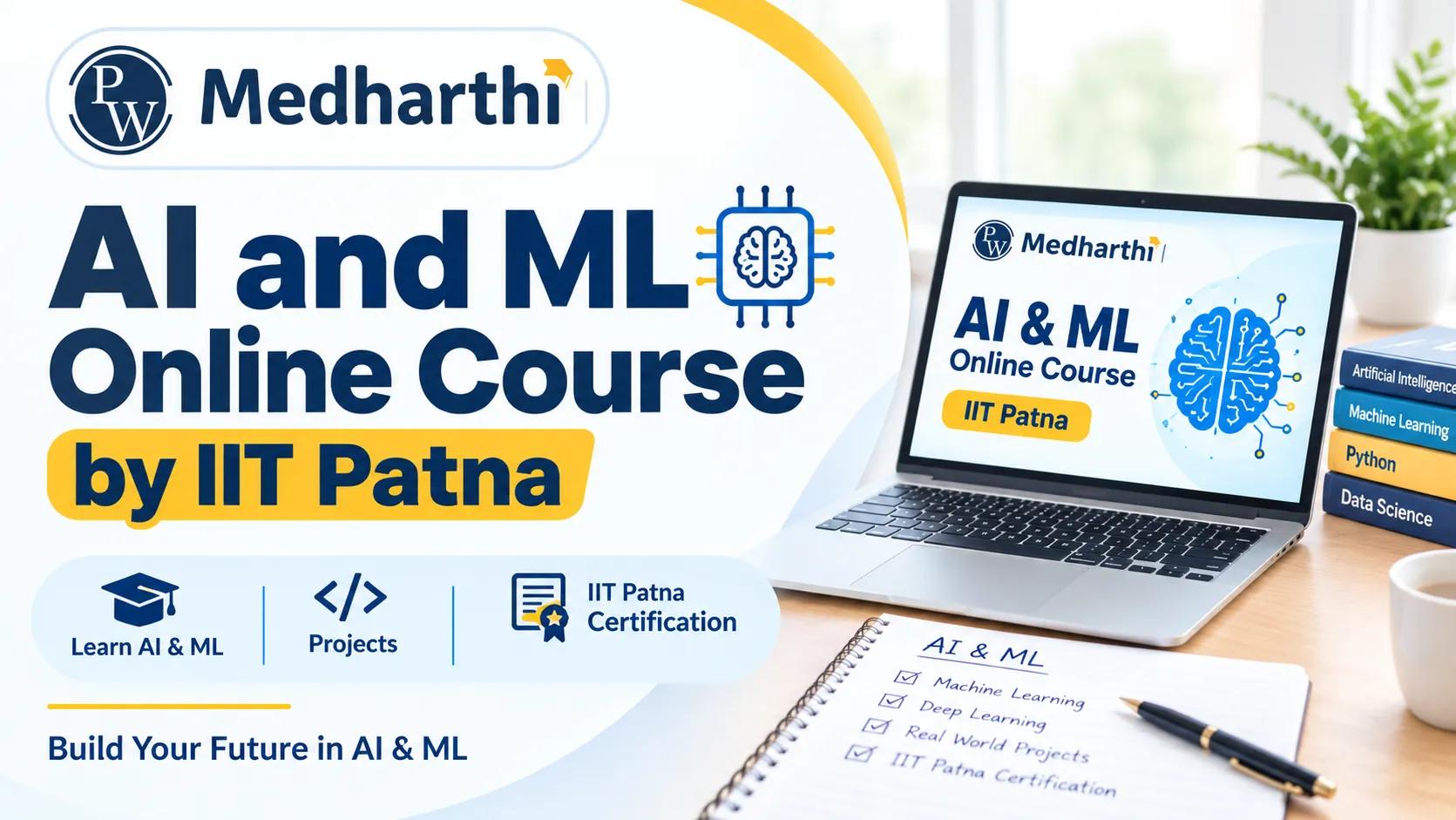
Artificial Intelligence is moving beyond basic automation and content generation. Organisations are increasingly exploring machine learning models, large language models, multimodal systems and AI-powered applications to solve complex problems. Working with these technologies requires more than familiarity with AI tools. You need to understand how models work, how to train and fine-tune them, and how to deploy them for practical use.
The Advanced Certificate Programme in Generative AI and Machine Learning by IIT Patna, offered by PW Online Degree, is designed for learners who want to develop foundational and advanced knowledge of AI, ML and Generative AI. The 9-month programme combines mathematical concepts, coding, live faculty-led sessions, practical labs and industry use cases to help you work towards building and deploying AI systems.
Why Move Beyond Using AI Tools to Building AI Systems with PW Online Degree?
Knowing how to use an AI application is different from understanding the technology behind it. This programme focuses on the concepts and implementation skills involved in developing, improving and deploying AI systems.
Here is what you can gain from the programme:
-
Learn from IIT Patna faculty: Attend live, interactive lectures delivered by faculty from IIT Patna.
-
Build advanced AI and ML knowledge: Study mathematical foundations, machine learning, deep learning, generative models and large language models.
-
Work with industry-relevant tools: Get hands-on experience with Python, PyTorch and TensorFlow through coding sessions and practical labs.
-
Explore real-world applications: Understand how AI and ML are applied in healthcare, BFSI, retail, manufacturing, education and robotics.
-
Learn to deploy AI solutions: Explore MLOps, model deployment, monitoring and scalable AI engineering.
-
Develop research and innovation skills: Work towards a research-led capstone project involving the design, implementation and deployment of a Generative AI system.
-
Earn an IIT Patna certificate: Receive a Certificate of Completion from IIT Patna after meeting the prescribed attendance and evaluation requirements.
From Machine Learning Foundations to Multimodal AI: What Will You Learn?
The programme covers 15 learning modules, moving from mathematical and machine learning foundations to advanced Generative AI systems, responsible AI and product development.
|
Module |
Key Topics Covered |
|
Mathematical Foundations for Advanced AI |
Vector spaces, linear operators, eigen decompositions, optimisation, probability, Bayesian inference and information theory |
|
Foundations of Machine Learning |
Statistical learning theory, ensemble methods, boosting, kernel methods, SVMs, regularisation and model interpretability |
|
Deep Learning Architectures |
CNNs, ResNet, DenseNet, EfficientNet, RNNs, GRUs, LSTMs and self-supervised learning |
|
Generative Models: Fundamentals |
Probabilistic graphical models, Variational Autoencoders (VAEs), GANs and energy-based generative models |
|
Transformers and Large Language Models |
Transformer architecture, attention, positional encoding, GPT, BERT, LLaMA, instruction tuning and RLHF |
|
Multimodal Generative AI |
Vision-language models, diffusion models, text-to-image, text-to-video, speech and audio generation |
|
Advanced NLP and Conversational AI |
Pretraining, fine-tuning, few-shot and zero-shot learning, RAG, conversational agents and guardrails |
|
Reinforcement Learning and Generative AI |
Deep reinforcement learning, DQN, PPO, A3C, RLHF and applications in robotics and gaming |
|
Scaling Generative AI Systems |
Distributed training, GPU clusters, TPUs, Flash Attention, mixed precision training and model persistence |
|
Trustworthy, Responsible and Explainable AI |
Fairness, accountability, transparency, SHAP, LIME, adversarial robustness and AI ethics |
|
Applied Generative AI in Domains |
Applications in healthcare, finance, education, manufacturing, robotics and engineering |
|
AI Engineering and MLOps for GenAI |
API-based deployment, containers, microservices, Kubeflow, MLflow, model monitoring and cloud deployment |
|
Edge AI and Responsible Scaling |
On-device inference, quantisation, pruning, TinyML, federated learning and differential privacy |
|
Research Frontiers in Generative AI |
Neural-symbolic AI, reasoning models, autonomous agents, generalist models and AI for scientific discovery |
|
Innovation and Productisation with GenAI |
AI startups, business models, intellectual property, copyright, data ownership and industry case studies |
Inside the Modern AI Development Toolkit
The programme introduces several technologies and frameworks used across modern AI development, including:
-
Machine Learning: XGBoost, CatBoost, LightGBM and Support Vector Machines.
-
Deep Learning: CNNs, RNNs, GRUs, LSTMs and self-supervised learning methods.
-
Generative AI: VAEs, GANs, diffusion models and multimodal foundation models.
-
Large Language Models: GPT, BERT, LLaMA, instruction tuning, LoRA and quantisation.
-
Conversational AI: Retrieval-Augmented Generation (RAG), AI agents and memory-augmented LLMs.
-
AI Engineering: PyTorch, TensorFlow, Kubeflow, MLflow and cloud-based deployment platforms.
Learn Through Live Classes, Coding Labs and an Industry-Led Capstone
The programme combines live instruction with practical learning so you can connect theory with implementation.
|
Learning Component |
Details |
|
Live online lectures |
Interactive sessions delivered by IIT Patna faculty |
|
Coding and practical labs |
Hands-on sessions using Python, PyTorch and TensorFlow |
|
Case studies |
Applications across healthcare, BFSI, retail and manufacturing |
|
Doubt-solving |
Dedicated doubt sessions to clarify concepts |
|
Assessments |
Quizzes, assignments, mid-term evaluations and final project presentations |
|
Capstone project |
End-to-end design, implementation and deployment of a Generative AI system |
Build a Research-Led Generative AI Project
The programme includes a 6-credit capstone project in which participants work in teams on a research-led, industry-validated problem statement. The objective is to design, implement and deploy a Generative AI system.
Potential project areas include:
-
Domain-specific large language models
-
Multimodal search engines
-
Generative design tools
-
AI tutors
-
Healthcare diagnostic models
Programme Duration, Schedule and Evaluation
The programme runs for 9 months (36 weeks) and carries 16 credits. It is delivered online, with weekend classes to accommodate learners with academic or professional commitments during the week.
|
Programme Detail |
Information |
|
Duration |
9 months (36 weeks) |
|
Total credits |
16 |
|
Total learning hours |
240 hours |
|
Live online sessions |
216 hours |
|
Doubt sessions |
24 hours |
|
Class days |
Saturdays and Sundays |
|
Weekly schedule |
6 hours per week |
|
Daily session duration |
3 hours per day |
|
Mode |
Live online |
|
Minimum attendance |
70% |
How Is Your Performance Evaluated?
Your performance is assessed through quizzes, assignments and the capstone project or end-term examination.
|
Assessment Component |
Weightage |
|
Quizzes |
25% |
|
Assignments |
25% |
|
Capstone project/End-term examination |
50% |
|
Total |
100% |
Participants must meet the applicable attendance and evaluation requirements to receive the Certificate of Completion from IIT Patna.
Also Read: Gousia Rashid's AI Learning Journey with PW Medarthi and IIT Patna
Who Can Apply for the IIT Patna AI and ML Programme?
The programme is intended for learners interested in building their knowledge of AI, ML and analytics. Applicants should have adequate familiarity with high-school-level mathematics.
The stated eligibility includes:
-
Graduates with a 10+2+3 qualification from a recognised university or institution, from any stream.
-
Students currently pursuing graduation.
-
Diploma holders with a 10+2+3 qualification from a recognised institution.
-
Diploma holders with at least one year of work experience.
-
Candidates with a 10+2/HSC qualification and at least one year of work experience.
Who Is This Programme Designed For?
The programme may be relevant to:
-
Early-career professionals: Those working in IT, data science, engineering, finance or consulting who want to develop advanced AI skills.
-
AI/ML engineers and developers: Professionals looking to explore advanced architectures, Generative AI and scalable deployment.
-
Graduates and postgraduates: Learners aspiring to build careers in AI-driven fields.
-
Researchers and academicians: Those interested in Generative AI research and emerging technologies.
-
Mid-career professionals: Individuals from technology, BFSI, healthcare and consulting who want to understand AI applications in their sectors.
-
Entrepreneurs and innovators: Those interested in using AI to develop products and explore new business models.
Why Choose IIT Patna AI & ML Course Through PW Online Degree?
PW Online Degree offers undergraduate and postgraduate programmes across different fields, along with specialised courses for learners looking to develop academic and professional skills.
Key features include:
-
Wide Range of Programmes: Explore degree and certificate options across management, commerce, technology, and other fields.
-
Flexible Learning: Access online learning opportunities that can fit around your existing commitments.
-
Digital Learning Resources: Use online study materials and learning resources to support your studies.
-
Competitive Exam Preparation: Find programmes that combine higher education with preparation for competitive exams.
-
Academic Support: Get guidance and assistance to help you understand course concepts and progress with your learning.
-
Career Development: Explore opportunities to build job-relevant skills and prepare for future career goals.
The Advanced Certificate Programme in Generative AI and Machine Learning by IIT Patna offers an opportunity to move from understanding AI concepts to exploring how advanced models are developed, fine-tuned and deployed. With live IIT Patna faculty sessions, practical coding labs, industry use cases and a research-led capstone, the programme covers several areas of modern AI development.
If you want to build advanced AI and ML skills through a live online programme, explore the IIT Patna AI and ML course through PW Online Degree. Review the eligibility, curriculum, schedule and fee details to see whether the programme aligns with your learning and career goals.
FAQs
What is the AI and ML course offered by IIT Patna?
What is the duration of the IIT Patna Generative AI and Machine Learning programme?
What is the fee for the IIT Patna AI and ML course?
Are live classes included in the programme?