







AI May Not Take Your Job, but It Could Change What Your Job Requires
 Avisha Das1 Nov, 2026


“Employees may not be changing jobs, but their jobs are changing around them,” says Phil Willburn, Vice President, People Systems, Intelligence & Support at Workday. This captures a key workplace shift: AI may change job requirements more than workforce size. Workday's October 2026 report found that 40% of business leaders expect AI to help them get more out of existing employees, while 28% expect it to reduce headcount.
However, employees may not be getting enough support to adapt. As demand shifts towards practical AI skills and internal career opportunities become harder to access, keeping pace with changing job requirements is becoming increasingly challenging.
THE BIG TAKEAWAY: AI may not replace every job; it can influence it, but it can change the skills needed to perform that job. The challenge for employees and employers is to keep pace with these changing expectations before the gap between existing capabilities and workplace requirements grows further.
AI May Improve Workforce Productivity Rather Than Reduce Employee Numbers
The majority of business leaders surveyed by Workday expect AI to improve workforce productivity rather than reduce employee numbers.
The report found that 40% of business leaders expect AI to help them get more out of their existing employees, compared with 28% who expect it to reduce headcount. This suggests that organisations may increasingly use AI to change how employees complete tasks and contribute to business outcomes.
For employees, this could mean that their job titles remain unchanged while their responsibilities evolve. Tasks that once involved manual reporting, information processing or repetitive work may increasingly involve using AI tools, checking their outputs and applying the results to decisions.
However, this transition is taking place alongside wider organisational changes. Nearly 4 in 10 employees said their company had undergone a reorganisation or restructuring in the previous year.
This means employees may have to adjust not only to new technology but also to changing team responsibilities, reporting arrangements and expectations at work. The ability to perform a familiar role may no longer be enough if the skills required to perform it are changing.
Key takeaway: AI-related workplace changes may first appear as revised responsibilities and higher skill expectations, even when employees continue in their existing roles.
Basic AI Skills Are Losing Value as Employers Look for People Who Can Build With AI
Knowing how to use an AI tool may be a starting point, but employers are increasingly looking for people who can apply AI to practical tasks and workflows.
Workday analysed skills data from job requisitions across more than 550 employers using Workday Recruiting. The findings show a clear difference in demand for basic and hands-on AI capabilities.
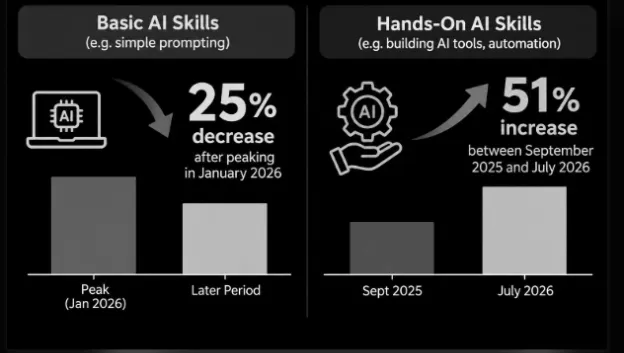
The decline in demand for basic AI skills does not mean that prompting has become irrelevant. Rather, it indicates that simply knowing how to interact with an AI tool may no longer be enough to stand out. Employers are showing greater interest in people who can build AI tools, automate workflows and apply technical knowledge to workplace problems.
This changes what being AI-ready can mean for employees. Depending on their roles, they may need to understand how AI systems work, identify where they can be applied and assess whether their outputs are reliable and useful.
Key takeaway: Basic AI familiarity can help employees get started, but practical capabilities such as building tools and automating workflows are becoming more important in job requirements.
Want to move beyond basic AI prompting and learn to build AI solutions? Explore IIT Patna Professional Certification Program in AI and Machine Learning.
Employees Know Which Skills They Need, but Workplace Support Is Falling Short
The challenge is not just recognising the need to learn new skills. Employees also need access to the training and opportunities that help them develop those skills.
Workday's September 2026 survey of 6,001 full-time employees and business leaders found a gap between employees' awareness of changing skill requirements and the support they receive from their organisations.
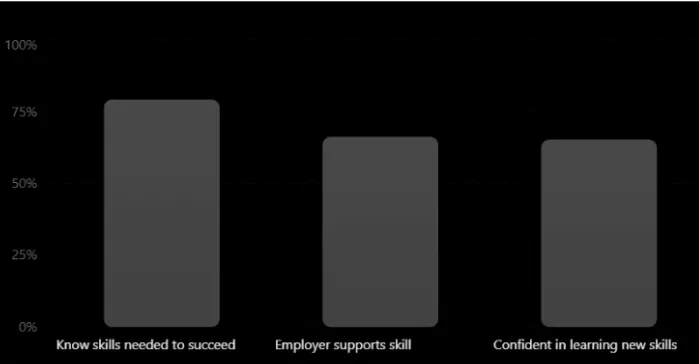
The difference between the first two figures is particularly important. Although 79% of employees know which skills they need, only 66% say their employer helps them develop those skills. This leaves a 13-percentage-point gap between awareness and support.
Employees are not necessarily unwilling to adapt. In fact, 65% said they were confident they could learn new skills if asked. The challenge is whether organisations provide enough opportunities, training and time for that learning to happen.
The report also found that employers were asking for fewer mentions of certain skills in job requisitions. Between September 2025 and July 2026, mentions of management and leadership skills fell 7%, while mentions of training skills fell 13%.
This creates a difficult situation. Employees are expected to adjust to changing responsibilities, but the skills that can help them manage transitions and support others are appearing less frequently in job requirements.
Key takeaway: Employees may be willing to learn, but organisations need to turn that willingness into access to relevant training and opportunities to apply new skills.
Prepare for changing job requirements by building AI and automation skills. Explore PW's Advanced Certificate Programme in AI-Driven Supply Chain and Industry 4.0.
Fewer Internal Moves Are Making Career Progression Harder
Even when employees develop new skills, limited opportunities within their organisations can make it difficult to use those skills to move forward.
Workday's workforce data shows that internal moves fell to 57% of employers year over year, while global promotion rates remained essentially flat. This suggests that familiar routes to career growth are becoming harder to access.
The report found that employees who tried to move internally faced several barriers:
-
Hiring pauses: Recruitment for the internal role had been put on hold.
-
Lack of managerial support: Their managers did not support the move.
-
Unfair selection processes: Employees felt that the process for choosing candidates was not fair.
About half of employees did not try to move internally during the previous year. Among those who did not attempt a move, 27% said they could not see an attractive opportunity within their company.
This matters because internal mobility gives employees a way to take on new responsibilities, explore different roles and progress without changing employers. When these opportunities become limited, even employees who are ready to develop new skills may struggle to find a suitable next step.
Key takeaway: When internal career opportunities narrow, employees may find it harder to turn new skills into promotions or different roles. Learning opportunities and career progression need to go hand in hand.
For professionals interested in developing their understanding of business and management, an Online MBA Degree is one postgraduate learning option to explore.
More Job Applications, but Fewer Assurances of Getting Hired
AI is helping job seekers apply to more roles, but competition is increasing without making hiring faster.
Workday's August 2026 AI@Work Pulse survey of 5,944 workers found that 84% of job seekers used AI during their job search. Meanwhile, the median number of applicants per filled job rose from 58 to 69, while the average time to fill a role remained around 60 days.
Competition was particularly high in technology and media, where applicants per filled job increased 40%, and financial services, where they rose 27%.
More than half of applicants in these sectors also said AI had increased the number of roles they applied to. However, more applications do not necessarily mean more suitable candidates. Roles often remain open because applicants lack the required skills or because expectations around pay, location or flexibility do not match.
For job seekers, this makes demonstrating relevant skills and the ability to adapt more important than simply increasing the number of applications.
Key takeaway: AI can make applying for jobs easier, but it cannot replace the skills and role fit employers are looking for.
Will your finance skills keep up as AI reshapes the industry? Build an edge with PW's Gen AI in Financial Markets, Investment and Risk Management (FIRM) programme.
What Should Employees and Employers Do as Job Requirements Change?
Adapting to AI-related workplace changes requires more than learning to use new tools. Employees need relevant skills, while employers need to create opportunities for people to develop and apply them.
For employees, a few practical steps can help:
-
Look beyond basic AI use: Understand how AI can support tasks in your field, including analysis, workflow improvement and problem-solving.
-
Build practical capabilities: Apply new knowledge through projects, work assignments and real-world problems.
-
Review changing job requirements: Pay attention to the skills mentioned in roles you want to pursue and identify gaps in your current experience.
-
Make learning part of career planning: Do not wait for a promotion or job change to develop skills that may become important.
-
Demonstrate how you apply your skills: Be prepared to explain how you have used technology, data or technical knowledge to complete work or improve a process.
Employers also have a role in making this transition possible:
-
Identify changing skill requirements: Explain how AI may affect responsibilities across teams and roles.
-
Invest in employee development: Provide training that reflects the capabilities employees increasingly need.
-
Make internal opportunities visible: Communicate available roles and explain how employees can qualify for them.
-
Support career movement: Address barriers such as paused hiring, lack of managerial support and unclear selection processes.
-
Look beyond retention: Understand whether employees feel supported, engaged and able to progress, not just whether they remain employed.
Key takeaway: Employees need to keep their skills relevant, while employers need to provide the learning and career opportunities that make adaptation possible.
Key Takeaways
-
AI is changing job requirements: 40% of business leaders expect AI to help them get more out of existing employees, while 28% expect it to reduce headcount.
-
Practical AI skills are gaining importance: Demand for hands-on AI skills rose 51%, while demand for basic AI skills fell 25% after peaking in January 2026.
-
Learning support has a gap: 79% of employees know which skills they need, but only 66% say their employer helps them develop those skills.
-
Internal career movement is slowing: Internal moves fell at 57% of employers, while promotion rates remained essentially flat.
-
Job competition is rising: The median number of applicants per filled job increased from 58 to 69, even as hiring time remained around 60 days.
-
Retention does not guarantee satisfaction: Employees who plan to stay are less likely to recommend their employer across every industry analysed.
AI may not eliminate every role it can influence, but it is already changing what employers expect people to know and do. As demand shifts towards practical AI capabilities, employees may need to develop skills that go beyond basic familiarity with new tools.
The challenge is that employees are being asked to keep pace while training support and internal career opportunities remain uneven. For individuals, staying relevant will mean treating skill development as an ongoing part of their working lives. For employers, it will mean giving people a genuine opportunity to learn, contribute and progress.
The future of work may not be defined only by how many jobs AI replaces. It may depend just as much on whether employees and organisations can adapt to what those jobs are becoming.


Have questions about your prep?
Our experts can answer all your questions

Get Free Counselling Today
and Clear up all your Doubts
 Live & recorded classes available at easeDashboard for progress trackingLakhs of practice questions


