Not Interested in Coding? R&D, Hardware and Retail Roles Recorded Strong Hiring Growth



Not every career in technology or business starts with writing code. If you prefer working with products, research, equipment, customers or day-to-day operations, recent hiring data points to several job functions worth watching.
The latest Naukri JobSpeak report shows that Research & Development and Engineering - Hardware & Networks both recorded 19% year-on-year hiring growth in September 2026. Merchandising, Retail & eCommerce followed closely at 18%.
The figures offer a useful signal for people exploring career options beyond software development. They do not mean every role in these fields is non-technical or guarantees a job, but they show that hiring activity is not limited to conventional software roles.ˀ
R&D and Hardware & Networks hiring each grew 19%, while Retail & eCommerce hiring rose 18% in September 2026, according to Naukri JobSpeak.
R&D, Hardware and Retail Lead Hiring Growth Across Key Job Functions
Naukri’s September 2026 data shows growth across several functions that can lead to different kinds of work. Research, hardware, retail and construction roles each recorded double-digit year-on-year growth.
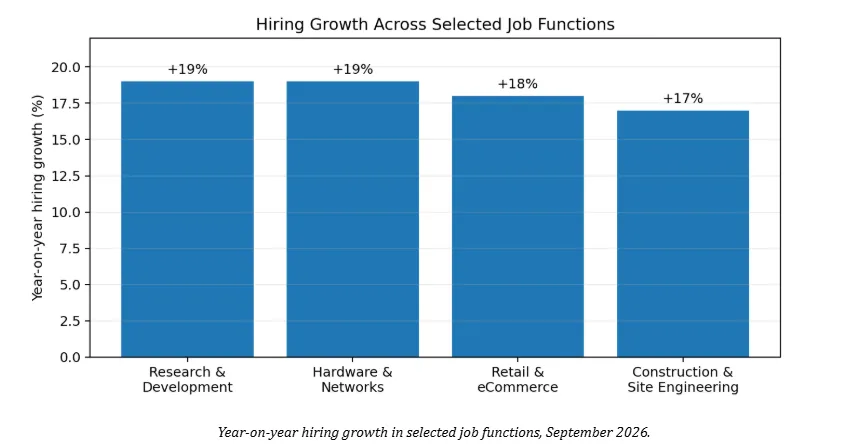
Year-on-year hiring growth in selected job functions, September 2026.
-
Research & Development (+19%): R&D roles may involve testing ideas, conducting experiments, analysing results or helping improve products and processes. The work varies by industry and can require specialist scientific or technical knowledge.
-
Engineering - Hardware & Networks (+19%): These roles can focus on physical devices, network equipment, testing, installation, maintenance or technical support. Some positions require engineering expertise, while others focus more on operations and support.
The devices we use every day rely on tiny, complex chips, and designing these chips is a specialised field in its own right. If you want to understand how this technology is built, the VLSI Design course from IIT Madras is a relevant place to start.
-
Merchandising, Retail & eCommerce (+18%): Work in this area can include product selection, stock planning, catalogue management, online store operations, sales analysis and customer experience.
-
Construction & Site Engineering (+17%): This function may involve site coordination, project execution, quality checks, safety procedures and tracking materials or timelines.
The strongest growth in this group was shared by R&D and Hardware & Networks, but the skills and day-to-day work in these functions can be very different.
Does This Mean You Can Build a Career Without Coding?
Potentially, yes, depending on the role you choose. Coding is essential for some jobs, but it is not a universal requirement across R&D, hardware, retail or construction. For example, a retail operations role may prioritise inventory, communication and spreadsheet skills, while a hardware testing role may require technical knowledge of devices and networks. Some R&D positions, particularly in software or data-heavy fields, may still involve programming. If you are considering robotics and automation, your choice of degree should also depend on the technical skills and career paths you want to pursue.
That is why it is better to shortlist roles by their actual responsibilities rather than by the department name alone. Read job descriptions carefully and check the tools, qualifications, experience and technical skills employers ask for.
Treat these hiring figures as a starting point for career research, not proof that every job in these fields is coding-free.
How to Prepare for Roles Beyond Software Development?
The right preparation depends on the role and industry. Start by reviewing current job descriptions for positions that interest you, then look for the skills that appear repeatedly.
-
For R&D: Build subject knowledge, research skills, attention to detail and the ability to document and interpret findings.
-
For Hardware & Networks: Check whether roles require electronics, networking, troubleshooting, equipment testing or other technical training. For technical roles involving connected devices and automated systems, understanding the essential skills for mechatronics engineers can help you identify relevant areas of technical preparation.
-
For Retail & eCommerce: Develop communication, product and inventory knowledge, spreadsheet skills, customer understanding and familiarity with online selling platforms.
-
For Construction & Site Engineering: Look into site coordination, safety awareness, quality control, project tracking and the qualifications required for the specific position.
Short projects, internships, practical assignments and relevant certifications can help you test whether a field suits you. Avoid choosing a course based only on a hiring-growth percentage; first confirm the entry requirements and the type of work you want to do.
What Job Seekers Should Take Away from the Latest Hiring Data?
The October 2026 Naukri JobSpeak report says overall white-collar hiring grew 2% year-on-year in September, with the index reaching 3,053 compared with 3,002 a year earlier. Within this broadly steady market, hiring trends differed by function: R&D and Hardware & Networks rose 19% each, Retail & eCommerce grew 18%, and Construction & Site Engineering increased 17%.
These numbers measure hiring activity on Naukri’s platform. They do not reveal the total number of vacancies across India, the number of people hired, or the qualifications needed for every job. Use them to identify areas worth investigating, then validate your options against actual job listings and employer requirements.
You do not have to choose a career based on whether it involves coding alone. Start with the work you enjoy, identify the skills it requires and check where employers are hiring.