Will Online Degrees Make Traditional College Degrees Less Relevant?


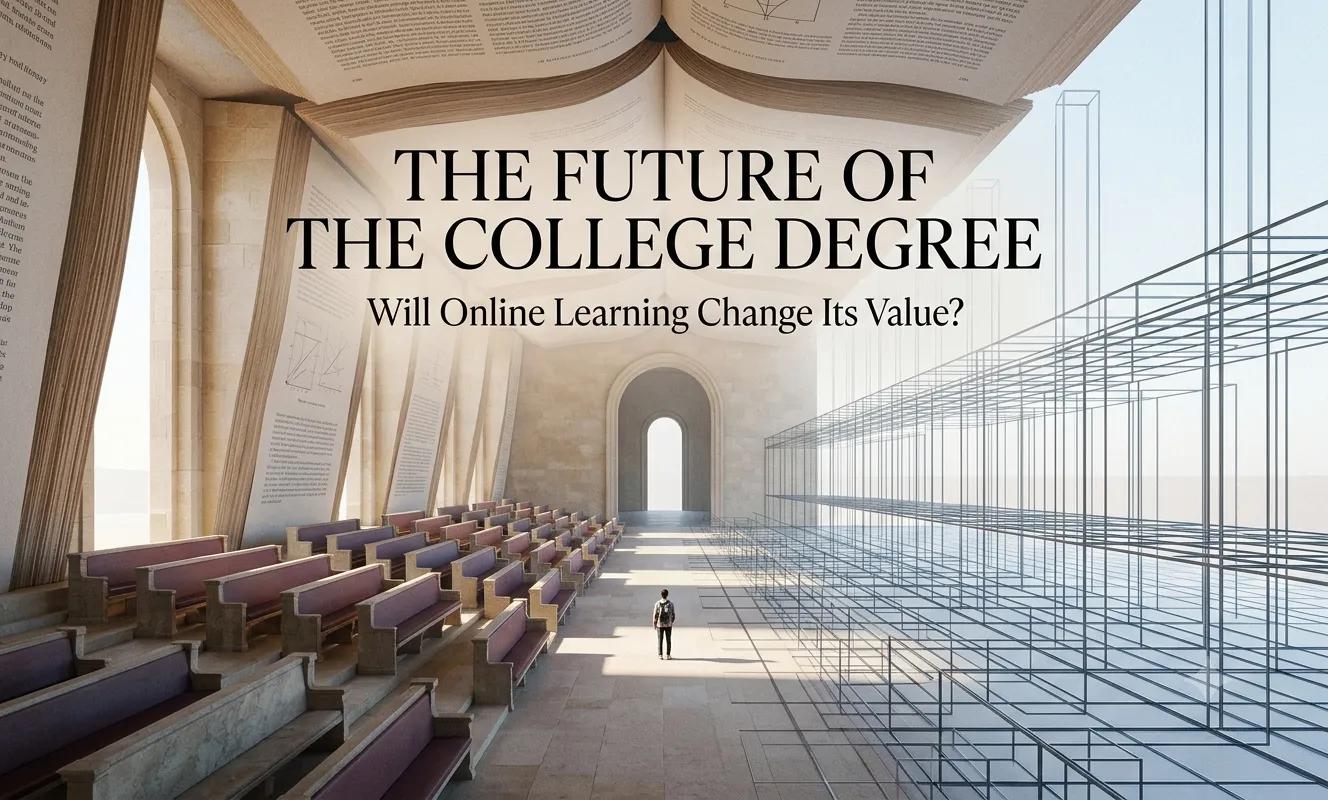
For years, a degree in India meant a campus. That is changing. Makreo Research's India Higher Education Market report points to 9.5 million online enrolments, and says UGC-recognised online degrees have improved trust among students and employers. At the same time, foreign universities are opening physical campuses in India, with three already operational as of April 2026.
So are traditional degrees losing ground? The data points to a more interesting answer. The real shift is not from campus to online, but from format to credibility: what matters is whether a degree is recognised, whether it delivers outcomes, and whether students can trust the programme behind it.
Online higher education has moved from a pandemic-era substitute to a mainstream access channel, according to Makreo Research.
How Big Has Online Higher Education Become?
It is no longer an alternative route. It is part of the mainstream.
India has nearly 155 million people in the 18 to 23 age group, one of the largest higher education demand pools globally, and the sector is growing at about 10 percent a year. The report's key indicators:
|
Indicator |
Figure |
|---|---|
|
People aged 18 to 23 in India |
Nearly 155 million |
|
Higher education market growth |
10% CAGR |
|
Online enrolments |
9.5 million |
|
Foreign universities operational, April 2026 |
3 |
|
Foreign universities with UGC approval or Letter of Intent |
14 |
India's online learning market is also set to expand strongly through FY2028, supported by young learners, digital access and government initiatives.
India's higher education market is growing at 10 percent a year, and online enrolments have reached 9.5 million.
Planning to pursue an undergraduate degree through online learning? Explore the Online BA Degree.
Who Is Choosing Online Degrees?
Access and flexibility are the draw.
Online degrees now serve working professionals, young learners outside metro cities, exam-focused students and anyone who needs flexibility. The geography matters too.
Metropolitan cities remain attractive for foreign campuses and premium programmes, but Tier-2 and Tier-3 cities are becoming equally important for online degrees, hybrid learning, skill-linked programmes and affordable private higher education.
Tier-2 and Tier-3 cities are becoming as important as metros for online degrees and hybrid learning.
Want to pursue an undergraduate degree through flexible online learning? Explore the Online BBA programme.
Does an Online Degree Carry the Same Weight?
Recognition is what decides it.
The report says the real change is credential acceptance. UGC-recognised online degrees have improved trust, and digital public platforms and institutional online programmes have widened access beyond physical campuses. For universities, online is now a product strategy: they must decide which programmes can run fully online, which need blended delivery, and where internships or assessments must stay physical.
EdTech providers face a higher bar. They will need to prove learning outcomes, retention, employability and compliance, not just learner acquisition. The risk is confusion between approved, equivalent, credible programmes and unapproved or low-quality ones, which makes transparency on approval status, fees and placement support a competitive advantage.
UGC-recognised online degrees have improved trust, and credential acceptance is the real change.
Tip: Before enrolling in any degree, online or on campus, check its UGC approval status and whether the degree is recognised as equivalent.
Are Traditional Campuses Fading?
Physical degrees are expanding, in new forms.
The UGC Foreign Higher Educational Institutions Regulations 2023 created a formal route for eligible foreign universities to open campuses in India. The UGC Recognition and Equivalence Regulations 2025 then confirmed that degrees from approved foreign campuses are equivalent to Indian qualifications, which matters for employability, higher studies, government jobs and PSU roles.
The cost case is strong. Studying at the University of Southampton's Gurugram campus costs approximately 60 to 70 percent less than the UK home campus, and Illinois Tech Mumbai fees are roughly one-third of Chicago campus rates. In March 2026, Deakin University at GIFT City awarded the first globally recognised Australian degree entirely on Indian soil.
Degrees from approved foreign campuses in India are equivalent to Indian qualifications under UGC rules.
What Will the Winning Model Look Like?
Hybrid, not either-or. Students may want the flexibility of online modules, but many still value campus interaction, peer learning, labs, internships and placement support. AI will be judged on quality, by whether it improves completion rates, placement readiness and student engagement, not on novelty.
Makreo says the winning model may be neither fully physical nor fully online, but a structured mix of digital access and institutional credibility.
Tip: Ask which parts of a programme are delivered online and which need campus time, labs or internships.
Key Takeaways
-
Online higher education is now a mainstream access channel, with 9.5 million online enrolments reported.
-
India's higher education market is growing at about 10 percent a year, with nearly 155 million people aged 18 to 23.
-
Tier-2 and Tier-3 cities are becoming as important as metros for online and hybrid programmes.
-
UGC-recognised online degrees have improved trust, and credential acceptance is the key change.
-
Foreign campuses are opening in India, and degrees from approved campuses are equivalent to Indian qualifications.
-
Students still value campus interaction, labs and placement support, which points to a hybrid model.
So, Will Online Degrees Make Traditional Degrees Less Relevant?
Not on this evidence. Online degrees are widening access, especially outside the metros, and recognition has made them more credible. But physical campuses are not fading: foreign universities are building new ones, and students still value what a campus offers.
The question is moving from where a degree is earned to whether it is recognised, transparent and delivers outcomes. For students, that means checking approval and equivalence. For institutions, it means being clear about what they offer and proving it works.
The data points to recognition and outcomes, not format, as what decides whether a degree stays relevant.
Looking for a degree that fits around your work, studies or other commitments? Explore PW’s Online UG and PG Degree Programmes


Have questions about your prep?
Our experts can answer all your questions