155 Million Young Indians Need Higher Education: Is India Ready for the Surge?
 Avisha Das4 Nov, 2026

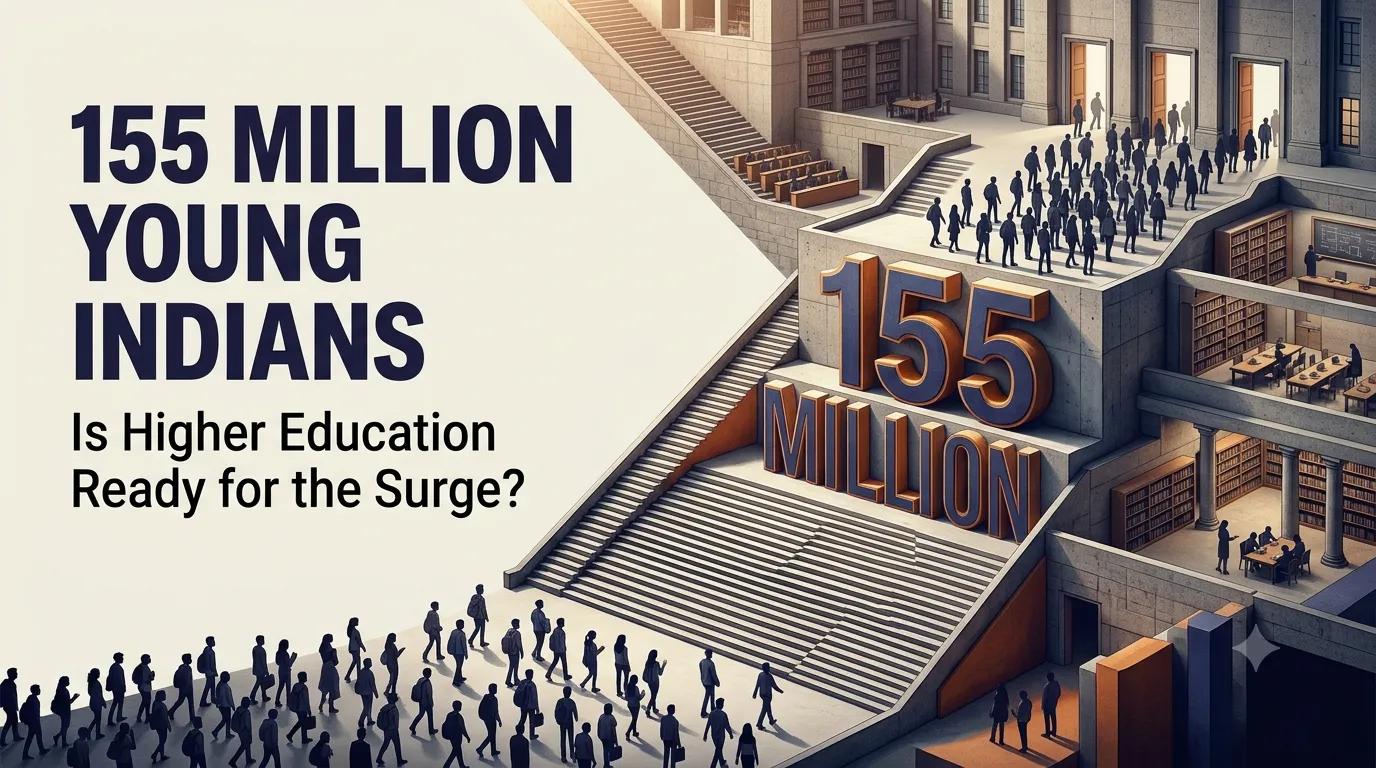
India's higher education challenge is not just about getting more students into colleges. It is about providing enough credible programmes, qualified faculty and learning opportunities for a population of nearly 155 million people aged 18-23. The scale of this demand is reflected in the market's growth: Makreo Research reports that India's higher education market is expanding at a 10% CAGR.
The sector is also changing how it delivers education. Foreign universities are establishing Indian campuses, UGC-governed online enrolments have reached 9.5 million, and NEP 2020 has opened new pathways for international collaboration. These developments are expanding access, but they also raise an important question: can India's higher education system grow without compromising academic quality and student outcomes?
THE BIG TAKEAWAY: India's opportunity lies not only in educating more young people, but also in offering credible, affordable and relevant higher education through multiple learning models.
155 Million Young Indians: How Big Is the Higher Education Demand?
India's young population creates a significant opportunity, but meeting its needs requires more than adding seats to existing colleges.
According to BusinessWorld's coverage cited by Makreo Research, India has nearly 155 million people in the 18-23 age group. This makes the country one of the largest higher education demand markets globally.
However, students do not all seek the same kind of education. Demand spans undergraduate and postgraduate degrees, doctoral programmes, diplomas and online certifications. Each category has different requirements in terms of fees, faculty, delivery methods and career outcomes.
Geography also influences how institutions can reach students:
-
Metropolitan cities: These remain important locations for foreign university campuses and premium academic programmes.
-
Tier-2 and Tier-3 cities: Online degrees, hybrid learning and affordable private higher education can help reach students beyond major urban centres.
-
Working professionals: Flexible online programmes and postgraduate upskilling options can support learners who want to continue studying alongside work.
This means India's higher education expansion cannot depend on physical campuses alone. Institutions need to consider different student groups, locations and learning preferences.
NEP 2020 Is Opening New Routes for Foreign Universities
Policy reforms are making it easier for eligible international universities to establish campuses and award recognised qualifications in India.
For a long time, students seeking an international degree often had to travel abroad. NEP 2020 and the UGC Foreign Higher Educational Institutions Regulations 2023 have created a formal route for eligible foreign universities to establish campuses in India.
The regulations allow qualifying institutions, including universities meeting the specified global or subject rankings criteria, to set up Indian campuses and offer programmes with UGC approval. They also provide academic autonomy and degree-awarding authority within the regulatory framework.
The UGC Recognition and Equivalence Regulations 2025 further address an important student concern: whether a qualification from an approved foreign campus in India will be recognised. These regulations establish equivalence with corresponding Indian qualifications, supporting the value of such degrees for employment and further studies.
For students, this can make international education more accessible without requiring them to relocate overseas. For Indian institutions, it introduces new competition and opportunities for collaboration.
Foreign Universities Are Moving from Plans to Indian Campuses
The presence of operational foreign campuses shows that international higher education is becoming a more visible part of India's education landscape.
As of April 2026, three foreign universities were fully operational in India.
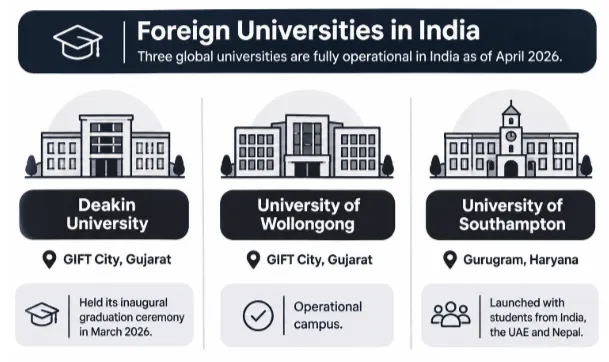
Several other universities have received UGC approval or Letters of Intent, with campus launches and admissions planned during 2026 and beyond. These include the University of Liverpool in Bengaluru, the University of Aberdeen and the University of Bristol in Mumbai, the University of York in Mumbai, and Illinois Institute of Technology in Mumbai.
The cost of studying at these campuses is another important part of their appeal. Makreo Research highlights two examples:
-
Studying at the University of Southampton's Gurugram campus costs approximately 60-70% less than attending its UK home campus.
-
Illinois Institute of Technology's Mumbai campus fees are approximately one-third of the fees at its Chicago campus.
These examples show how international degrees in India could offer students access to foreign university qualifications at a lower cost than studying at the home campus.
However, opening campuses is only one part of meeting demand. Universities will also need to maintain academic quality, provide experienced faculty, build industry connections and support students through their programmes.
Can Online Degrees Help India Reach More Students?
Online higher education is becoming an important access channel for learners who cannot depend on traditional campus-based programmes.
India's higher education demand extends beyond major cities and students who can attend college full-time. Working professionals, young learners in smaller cities and students seeking flexibility also need access to recognised qualifications.
The scale of online education is already significant. Makreo Research reports that enrolments in UGC-governed online programmes reached 9.5 million, registering a 45% increase in a single year.
Greater acceptance of UGC-recognised online degrees has helped strengthen confidence in this mode of learning. Digital education also allows institutions to reach students without requiring them to build physical campuses in every location.
For students, online programmes can offer:
-
Access to higher education from locations beyond major university cities.
-
Flexibility to study alongside work or other responsibilities.
-
Opportunities to pursue undergraduate and postgraduate programmes.
-
Access to professional learning and upskilling options.
For institutions, however, online education requires more than making lectures available digitally. Programme delivery, assessments, student support, learning outcomes and employability need careful attention.
Online degrees can therefore help expand access, but their value will depend on the quality and credibility of the programmes being offered.
Exploring flexible undergraduate options? Check out the Online BCA Degree offered through PW Online Degree.
Is India Ready to Become a Global Education Destination?
India's higher education market is increasingly being viewed as both a source of international students and a potential destination for learners from other countries.
Makreo Research highlights the changing global student mobility landscape. International student numbers are projected to reach 8.5 million by 2030, while the combined market share of the traditional four major destinations is expected to decline as students explore other options.
India could benefit from this shift through its affordability, English-language education, policy reforms and growing foreign university presence. Inbound student growth could also support campus diversity, research partnerships and international academic connections.
India's academic visibility is another positive signal. The Ministry of Education's coverage of QS World University Rankings 2026 reported 54 Indian universities in the rankings, making India the fourth most represented country globally that year.
As more universities and online programmes enter the market, clear communication will become especially important. Students need to understand whether a programme is approved, what qualification it awards, what it costs and what academic or career pathways it offers.
To develop skills in emerging technologies, programmes such as the IIT Patna Professional Certificate Programme in AI and ML offer another route to explore specialised learning.
Key Takeaways
-
India has nearly 155 million people aged 18-23, creating a major higher education demand pool.
-
The higher education market is growing at a 10% CAGR, according to Makreo Research.
-
NEP 2020 and UGC regulations have created pathways for eligible foreign universities to establish campuses in India.
-
Three foreign universities were fully operational in India as of April 2026.
-
UGC-governed online enrolments reached 9.5 million, recording a 45% single-year increase.
-
AI and hybrid learning could expand access and improve delivery, provided institutions demonstrate measurable learning outcomes.
-
Recognition, affordability, faculty quality and placement outcomes will influence India's ability to attract international students.
India has the demographic scale to become one of the world's most important higher education markets. Foreign university campuses, online degrees and technology-led learning are already expanding the ways students can access education. However, the real test will be whether institutions can turn this growing demand into credible qualifications, quality learning experiences and better student outcomes. India's readiness will ultimately depend not just on how many students it can enrol, but on the value of the education it provides.