Applied AI Skills Demand Surges 51% as Employers Shift Beyond Basic AI Use
 Avisha Das3 Nov, 2026

Knowing how to write a prompt may have helped you stand out when AI tools first entered the workplace. But that advantage is changing. Workday’s October 2026 Global Workforce Report found that demand for basic AI skills fell 25% after peaking in January 2026. In contrast, demand for hands-on skills such as building AI tools, automating workflows and AI engineering climbed 51% between September 2025 and July 2026.
This shift points to a bigger change in what employers expect from their workforce. AI is no longer just a tool employees are expected to use; it is becoming part of how organisations redesign jobs and get work done. For students and young professionals, the question is no longer simply whether you know how to use AI, but whether you can apply it to solve problems and create value.
THE BIG TAKEAWAY: Basic AI familiarity can help you get started, but the growing demand is for people who can put AI to work. Building, integrating and applying AI systems may become increasingly important as organisations move from experimentation to practical use.
The AI Skills Employers Want Are Changing Faster Than You Think
The workplace is moving from asking employees to use AI to expecting them to build and apply it.
Workday analysed skills data from job requisitions across more than 550 employers using Workday Recruiting. The findings reveal a clear change in the skills companies are seeking.
Between September 2025 and July 2026, demand for hands-on AI skills increased by 51%, while demand for basic AI skills fell 25% after reaching a peak in January 2026.
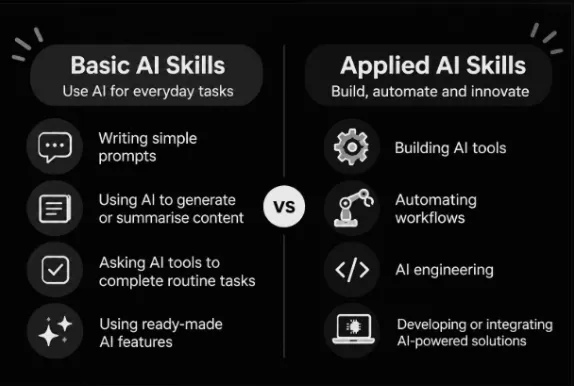
This does not mean that prompting or everyday AI use has become irrelevant. These skills can still help you work more efficiently. However, they may no longer be enough to distinguish you in a job market where employers increasingly want people who can take AI beyond basic tasks.
Key takeaway: Treat basic AI tools as a starting point. The next step is learning how to build, adapt and apply AI solutions to actual work.
AI Is Rewriting Jobs, Not Simply Removing Them
The rise in applied AI demand is part of a wider workplace shift, where organisations expect employees to work differently rather than necessarily reduce their teams.
Workday's report found that 40% of business leaders expect AI to help them get more out of their existing employees. Only 28% expect AI to reduce headcount.
This suggests that many organisations see AI as a way to increase productivity and change how existing roles function. Employees may be expected to take on new responsibilities, work with AI-powered systems or handle tasks that require more judgement and problem-solving.
Consider how this could affect different kinds of work:
-
Marketing: Instead of only using AI to generate content, professionals may need to work with AI-powered campaign tools, analyse customer behaviour and improve campaign workflows.
-
Finance: AI can support activities such as fraud detection, credit assessment and risk analysis. Professionals who understand both financial processes and AI applications can work across these areas.
-
Manufacturing and supply chains: AI-powered systems can support process automation, operational monitoring and decision-making.
-
Technology: Demand for people who can develop AI tools, work with machine learning models and integrate AI into software may grow as organisations adopt more advanced systems.
These are examples of how applied AI can be used across industries, rather than a list of specific job forecasts from the report.
The report's central message is that job responsibilities are changing. As AI takes on more routine work, employees may need to focus more on interpreting outputs, solving unfamiliar problems and ensuring that AI systems work effectively.
Key takeaway: Your career preparation should account for how AI may change the tasks within your chosen field, not just which jobs it may affect.
Explore how AI is being applied to industrial operations, manufacturing and supply chains through PW's Advanced Certificate Programme in AI-Driven Supply Chain and Industry 4.0.
The Skills Gap: Workers Know What They Need, But Are They Getting the Support?
Knowing which skills matter is only one part of the challenge. Workers also need opportunities to develop them.
Workday's September 2026 survey of 6,001 employees and business leaders found a gap between the skills employees believe they need and the support they receive from their employers.
79% of workers said they know which skills they need to succeed, but only 66% said their employer helps them develop those skills.
That is a 13-percentage-point gap between awareness and workplace support.
The findings also reveal that many workers are willing to learn. Around 65% said they were confident they could develop new skills when asked to do so. However, confidence alone may not be enough if employees lack access to relevant training, practical learning opportunities or support from their organisations.
The challenge becomes more significant as AI adoption accelerates. In Workday's August 2026 AI@Work Pulse survey, 62% of employees who used AI for nearly all their work believed it would make their current skills less valuable. Yet more than three-quarters of these heavy AI users expected AI to create new career opportunities.
This creates an interesting contrast: workers can see both the risk of their existing skills losing value and the possibility of new opportunities emerging.
What does this mean for you?
-
Identify which tasks in your chosen field are already being influenced by AI.
-
Look beyond basic tool familiarity and explore the technical skills behind AI applications.
-
Practise using AI to solve problems rather than relying only on ready-made outputs.
-
Look for learning opportunities that combine concepts with projects and practical applications.
Key takeaway: The ability to learn and adapt matters, but you need to turn that willingness into demonstrable skills.
Build your foundation in AI and machine learning with PW's IIT Patna AI & ML Certification Programme, which includes hands-on projects using Python, TensorFlow and PyTorch.
The Opportunity Is Not Limited to AI and Technology Jobs
You do not have to work in a dedicated AI role to benefit from the growing demand for applied AI skills.
AI is being used across functions that already exist in different industries. This means professionals can combine their domain knowledge with AI capabilities instead of treating AI as an entirely separate career path.
For example:
-
In finance: AI can support fraud analytics, credit scoring, risk assessment and robo-advisory services.
-
In digital marketing: Generative AI can assist with content workflows, customer engagement and campaign execution.
-
In supply chain management: AI can support forecasting, operational planning and automation.
-
In robotics: AI can help intelligent systems interpret information, respond to their surroundings and perform tasks.
This combination of domain knowledge and AI capability can help you develop a more specific professional skill set. A finance graduate who understands AI-driven risk analysis, for instance, brings a different combination of knowledge than someone who only knows how to use a general-purpose AI chatbot.
The same applies to marketing, operations, engineering and other fields. Understanding the industry problem is just as important as knowing which AI technology to use.
Want to explore AI applications in financial services? Consider PW's IIT Roorkee AI-Driven FinTech Programme (PGCPF), which focuses on areas such as fraud analytics, credit scoring and risk analytics.
If You Want to Stay Relevant, Start Building Proof of What You Can Do
As AI skills become more common in job applications, being able to demonstrate your abilities can help you stand out.
Workday's report also highlights a challenging job market. Internal moves declined at 57% of employers, while promotion rates remained essentially flat. At the same time, the median number of applicants for each filled position rose to 69, compared with 58 a year earlier.
The report does not establish that AI alone caused these changes. However, it shows that employees are facing fewer opportunities to move internally and greater competition when applying for jobs.
In this environment, simply listing AI tools on your resume may not communicate the depth of your skills. You can make your learning more tangible by building projects that show how you apply AI.
Here are a few ways to start:
-
Choose a problem: Identify a repetitive task or challenge in an area you understand, such as organising information, analysing data or improving a workflow.
-
Select the right tools: Explore whether programming, machine learning, generative AI or automation can help address it.
-
Build a small solution: Start with a simple prototype rather than trying to create a complex application immediately.
-
Test the outcome: Check whether your solution works, where it falls short and what could be improved.
-
Document your work: Explain the problem, your approach, the tools you used and the result. This gives you something concrete to discuss in interviews or professional conversations.
You can also use projects to discover which parts of AI interest you most. You may find that you enjoy working with data, developing applications, automating business processes or applying AI to a particular industry.
Key Takeaways
-
Applied AI demand is rising: Workday reported a 51% increase in demand for hands-on AI skills between September 2025 and July 2026.
-
Basic AI skills are not enough on their own: Demand for basic AI skills fell 25% after peaking in January 2026.
-
Jobs are changing: 40% of business leaders expect AI to help them get more out of existing employees, while 28% expect it to reduce headcount.
-
A skills gap remains: 79% of workers know which skills they need, but only 66% receive employer support to develop them.
-
AI skills extend across industries: Finance, marketing, manufacturing, supply chains and technology all offer opportunities to apply AI.
-
Practical work matters: Projects can help you demonstrate how you use AI to solve real problems.
The rise in applied AI skills demand signals a change in what employers may expect from the workforce. Knowing how to use AI tools is useful, but the ability to build applications, automate processes and apply AI to industry-specific challenges can take your skills further.
You do not need to master every AI technology at once. Start with the area that interests you, build the relevant technical and domain knowledge, and put it into practice through projects. As AI continues to change how work gets done, your ability to learn, adapt and create useful solutions can become an important part of your career.


Have questions about your prep?
Our experts can answer all your questions