







India Adds 33 Allied Healthcare Degrees and Updates 21 Others
 Avisha Das31 Oct, 2026


India is aiming to add one lakh allied and healthcare professionals over the next five years, as outlined in the Union Budget 2026–27 vision. But expanding the workforce is only one part of the challenge. The country also needs consistent education standards, clearly defined qualifications and practical training to prepare professionals for their roles.
In a move towards this goal, the University Grants Commission (UGC) has notified 33 new allied and healthcare degrees and revised 21 existing ones under the National Commission for Allied and Healthcare Professions (NCAHP) framework. The changes cover undergraduate and postgraduate programmes across fields such as physiotherapy, occupational therapy, medical laboratory sciences, optometry and radiology. They also define degree nomenclature, course duration and entry qualifications, bringing these programmes under the One Nation, One Curriculum approach.
THE BIG TAKEAWAY: The change is not simply about adding more degree options. It aims to bring greater consistency to allied healthcare education across India, giving you clearer information about qualifications and academic pathways.
UGC's Latest Notification Marks a Major Shift in Allied Healthcare Education
The UGC's fifth amendment to its Specification of Degrees notification introduces 33 new degrees and revises 21 others.
The amendment was notified on 27 August 2026 through Notification No. F.21-12/2026(CPP-II), UIN 3/2026, and published in the Gazette on 31 August 2026. The notification was issued under Section 22(3) of the UGC Act, 1956.
It covers undergraduate and postgraduate qualifications across several allied and healthcare disciplines. The changes specify important academic details, including:
-
Degree nomenclature: The names and abbreviations to be used for the qualifications.
-
Course duration: The prescribed duration for the relevant programmes, including revisions for selected courses.
-
Entry qualifications: The academic requirements you must meet to enter specific programmes.
-
Specialisations: More clearly defined postgraduate degree options in selected disciplines.
The National Commission for Allied and Healthcare Professions (NCAHP) has also highlighted the importance of uniformity in course duration, degree nomenclature and entry qualifications under its One Nation, One Curriculum approach.
Key takeaway: The amendment sets out clearer academic specifications for the notified degrees. You should still check the requirements of your chosen programme before applying.
Looking to build practical skills in data analysis and technology? Explore the BCA with Data Analytics programme and learn how data can support informed decision-making across industries.
Which Allied Healthcare Professions Are Included in the UGC's New Framework?
The notification covers a wide range of allied and healthcare disciplines rather than focusing on a single professional field.
-
Physiotherapy
-
Occupational Therapy
-
Optometry
-
Medical Laboratory Sciences
-
Emergency Medical Technology
-
Anaesthesia and Operation Theatre Technology
-
Nutrition and Dietetics
-
Psychology
-
Medical and Social Psychiatric Social Work
-
Medical Radiology, Imaging and Therapeutic Technology
-
Physician Associate
-
Respiratory Technology
-
Dialysis Therapy Technology
-
Health Information Management
The notification also specifies postgraduate specialisations in selected fields. The numbers include:
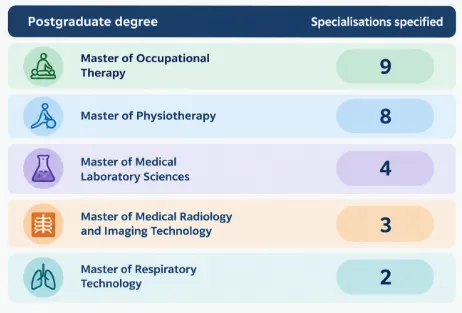
These specialisations give you a clearer picture of the areas in which postgraduate study may be available. However, the notification's summary does not provide the complete list of all 33 new and 21 updated degree titles. You should refer to the relevant Gazette notification for programme-specific details.
Key takeaway: The changes cover several clinical, diagnostic, therapeutic and support-related disciplines. The exact degree title and specialisation options will depend on the programme.
Can One Curriculum Make Allied Healthcare Degrees More Comparable Across India?
The One Nation, One Curriculum approach aims to reduce differences in how allied healthcare qualifications are named and defined across institutions.
The NCAHP framework seeks greater consistency in course duration, entry qualifications and degree nomenclature. This can help you understand what a qualification represents when comparing programmes offered by different institutions.
The changes also aim to bring Indian degree-level qualifications closer to globally accepted nomenclature. This may support greater clarity around professional qualifications, mobility and international recognition. However, these are intended benefits, not guaranteed outcomes for every graduate.
For you, the practical points to examine include:
-
Whether the degree title matches the nomenclature specified for the programme.
-
Whether the course duration follows the notified requirements.
-
Whether the entry qualifications match their academic background.
-
Whether the institution follows the applicable NCAHP curriculum and regulatory requirements.
Key takeaway: Common academic specifications can make qualifications easier to understand and compare, but you must still verify programme recognition, eligibility and institutional compliance.
Interested in the management side of healthcare? Enrol in the Online BBA Degree to build a foundation in business, administration and management.
Clinical Training Takes Centre Stage in the Revised Allied Healthcare Curricula
Alongside degree updates, the NCAHP has released competency-based curricula that place emphasis on practical clinical training.
The NCAHP has released 18 competency-based curricula covering 28 professions. These curricula focus on the knowledge and practical competencies required in different allied and healthcare roles.
An important part of this approach is hands-on clinical training. The curricula emphasise internships of adequate duration at hospitals or associated facilities where professionals practise. This gives practical exposure an important place alongside academic learning.
The Commission has also directed states, Union Territories and other stakeholders to implement the released curricula mandatorily from the 2026–27 academic year.
A few implementation details are worth noting:
-
The directive applies to the released competency-based curricula.
-
Institutions and relevant stakeholders are expected to follow the applicable curricula from the 2026–27 academic year.
-
States and Union Territories have been directed to ensure implementation.
-
Institutions may also commence the Diploma in Medical Laboratory Technology (DMLT) programme.
-
The remaining curricula are being finalised for implementation in subsequent academic years.
You should check with their preferred institution to understand how the applicable curriculum, clinical training and internship requirements will be delivered.
Key takeaway: The curriculum changes place greater emphasis on professional competencies and clinical exposure. You should look beyond classroom subjects and check the practical training arrangements offered by an institution.
Where Robotics and AI Enter the Allied Healthcare Conversation
The updated qualifications define professional academic pathways, while developments in technology are creating additional areas of learning across healthcare and related industries.
Technology such as AI, machine learning and robotics is being applied in different sectors, including areas connected with medical equipment, diagnostics and operational processes. However, learning these technologies does not qualify someone to practise as a physiotherapist, radiology professional, medical laboratory scientist or another regulated allied healthcare professional.
If you already have, or plan to pursue, the required healthcare qualification may explore technology education separately if it aligns with their interests and career goals.
For example:
-
The AI-Driven Robotics, Design, Intelligence and Automation programme introduces learners to an interdisciplinary technology area that includes robotics and automation.
These batches and programmes are supplementary options. They should not be treated as substitutes for an NCAHP-aligned degree, clinical training, registration or any other professional requirement applicable to an allied healthcare role.
Key takeaway: Technology skills may complement a person's broader learning interests, but the required allied healthcare qualification and clinical competencies remain essential for professional practice.
What Should You Check Before Choosing an Allied Healthcare Degree?
A degree title alone is not enough to decide whether a programme is right for you. You should examine the academic and practical requirements of the specific qualification you intend to pursue.
Before applying, check:
-
Degree nomenclature: Does the programme use the applicable degree title and abbreviation?
-
Eligibility: Do your previous subjects and qualifications meet the prescribed entry requirements?
-
Course duration: Does the programme follow the notified duration?
-
Curriculum: Does the institution follow the applicable competency-based curriculum?
-
Clinical exposure: What internships, hospital training or practical learning opportunities are included?
-
Institutional compliance: Has the institution provided clear information about the relevant regulatory requirements?
The UGC notification and the applicable NCAHP curriculum can help you understand the academic requirements. It is also important to contact the institution directly for current admission details and programme-specific information.
Key takeaway: Compare the qualification, eligibility, curriculum and clinical training arrangements before making an admission decision. Do not rely on the degree name alone.
Key Takeaways.
-
33 new degrees and 21 updated degrees: The UGC has notified changes to degree nomenclature, duration and entry qualifications.
-
Multiple disciplines covered: The changes span fields such as physiotherapy, occupational therapy, optometry, medical laboratory sciences and radiology.
-
Postgraduate specialisations: The notification specifies specialisation options across selected master's degrees.
-
18 curricula covering 28 professions: The NCAHP has released competency-based curricula with an emphasis on practical clinical training.
-
Implementation from 2026–27: States, Union Territories and relevant stakeholders have been directed to implement the released curricula from this academic year.
-
Further curricula are pending: The remaining curricula are being finalised for subsequent academic years.
The introduction of 33 new allied healthcare degrees and updates to 21 others marks an important step towards greater consistency in allied and healthcare education in India. The accompanying competency-based curricula also place emphasis on practical clinical training, with implementation of the released curricula directed from the 2026–27 academic year.
For you, the next step is to understand how these changes apply to your chosen discipline. Checking the notified degree details, entry requirements, course duration and clinical training arrangements can help you make a more informed decision about your education and future professional pathway.


Have questions about your prep?
Our experts can answer all your questions

Get Free Counselling Today
and Clear up all your Doubts
 Live & recorded classes available at easeDashboard for progress trackingLakhs of practice questions


