Can India Become the Next Global Hub for International Students?
 Avisha Das4 Nov, 2026

India's higher education landscape is beginning to attract a different kind of global attention. Foreign universities are no longer just exploring the possibility of entering the country. Deakin University, the University of Wollongong and the University of Southampton have already established a presence, marking an important step in India's efforts to bring international education closer to home.
Makreo Research's India Higher Education Market 2026: NEP 2020, Foreign University Campuses, and Online Degrees Reshape a 155-Million-Student Opportunity highlights this shift. With regulatory reforms, international university partnerships and more flexible learning options, India is building the foundations to become a stronger destination for global education.
THE BIG TAKEAWAY: India has the student base, policy direction and expanding education options to strengthen its position in international higher education. However, becoming a global student hub will also depend on the quality, recognition, affordability and outcomes of the education it offers.
India Is Moving Beyond Being a Country That Sends Students Abroad
India's higher education opportunity is expanding from outbound student mobility to attracting learners from other countries.
For years, Indian students looking for international education primarily considered destinations such as the US, UK, Canada and Australia. Domestic institutions largely competed within state, city and entrance-examination ecosystems.
That picture is changing. Foreign universities are establishing campuses in India, online degrees are gaining acceptance, and students can explore international qualifications without necessarily relocating overseas.
Makreo Research identifies several factors supporting this shift:
-
A large student population: Nearly 155 million people in the 18-23 age group create a substantial higher education demand base.
-
Private institution expansion: Growing institutional capacity is adding to the range of available programmes.
-
Digital education: Online and hybrid learning are extending access beyond traditional campuses.
-
Foreign university collaborations: International institutions are exploring campus-based and partnership models in India.
-
Policy reforms: NEP 2020 and UGC regulations are supporting the internationalisation of higher education.
India's opportunity is also spread across different student segments. Metropolitan cities are attracting foreign campuses and premium programmes, while Tier-2 and Tier-3 cities are becoming important for online degrees, hybrid learning and affordable private education.
This creates the possibility of serving domestic learners while attracting students who want access to international qualifications and English-language education at different price points.
Key takeaway: India's role in global education is expanding. It is increasingly positioning itself as both a country of origin for international students and a destination for learners from abroad.
Foreign Universities Are Bringing Global Education Closer to Home
The entry of international universities is one of the clearest signs of India's changing position in the global education market.
The UGC Foreign Higher Educational Institutions Regulations 2023 created a formal pathway for eligible foreign universities to establish campuses in India, offer programmes and award qualifications with UGC approval.
The regulations allow eligible globally recognised institutions, including those ranked among the top 500 globally or by subject, to establish branch campuses. This moves international education beyond informal collaborations and twinning arrangements towards a campus model with academic autonomy and degree-awarding authority.
The UGC Recognition and Equivalence Regulations 2025 further strengthened the position of approved foreign campuses by confirming that their degrees are equivalent to corresponding Indian qualifications.
This is important for students considering international education because recognition can affect employability, higher studies, government job eligibility, PSU roles and the long-term value of a qualification.
Which Foreign Universities Have Started Establishing Campuses in India?
As of April 2026, three foreign universities were fully operational in India:
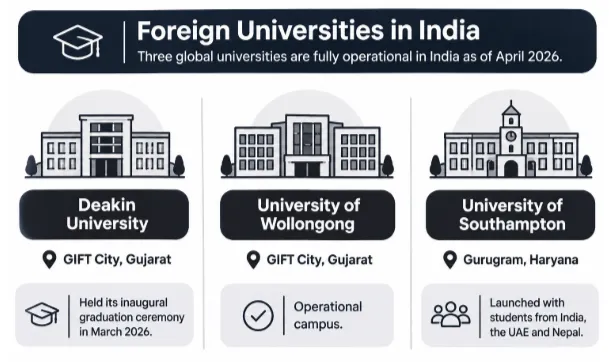
The next wave of foreign university entry includes institutions across Bengaluru, Mumbai, Delhi NCR and GIFT City.
Some notable developments highlighted in Makreo Research's market overview include:
-
University of Liverpool, Bengaluru: Admissions opened for August 2026 across Business Management, Accounting and Finance, Computer Science, Biomedical Sciences and Game Design.
-
University of Aberdeen, Mumbai: Programmes include Business Management, Computing Science, Data Science, Economics, postgraduate Artificial Intelligence and MBA.
-
University of Bristol, Mumbai: Its programme areas include Data Science, Economics, Finance and Investment, Immersive Arts, and Financial Technology.
-
University of York, Mumbai: Undergraduate and postgraduate programmes were planned for the 2026/27 academic year.
-
Birkbeck, University of London, Bengaluru: Launched in April 2026 with programmes in Business Management, Business Analytics and International Business Management.
-
Illinois Institute of Technology, Mumbai: The first US university to receive UGC approval, with an inaugural cohort of approximately 300 students.
-
University of New South Wales, Bengaluru: Its planned programme areas include Business, Computer Science and Data Science.
-
Queen's University Belfast, GIFT City: The first Russell Group university to open in India.
-
Coventry University, GIFT City: Approved for the GIFT City zone, with programmes in International Business Management and Business and Finance.
Victoria University (Melbourne) has also received UGC approval, with its Delhi NCR campus expected in 2027.
Key takeaway: Foreign university campuses are making international qualifications more accessible within India. Their long-term appeal will depend on academic quality, recognition, faculty, industry connections and student outcomes.
Explore international and technology-focused learning opportunities through PW's IIT Patna AI & ML Certification Programme, which includes practical projects using Python, TensorFlow and PyTorch.
Can India Offer an International Degree Experience at a Lower Cost?
Affordability is another factor that could make India more attractive to students considering international education.
Studying at a foreign university's Indian campus can cost considerably less than attending its home campus overseas.
Makreo Research highlights two examples:
-
University of Southampton, Gurugram: Studying at the Indian campus costs approximately 60-70% less than attending its UK home campus.
-
Illinois Institute of Technology, Mumbai: Fees are approximately one-third of the rates at its Chicago campus.
The appeal is not limited to lower fees. Approved foreign campuses in India offer qualifications with the same academic standing as their respective home institutions. Under the UGC Recognition and Equivalence Regulations 2025, these degrees also receive recognition equivalent to corresponding Indian qualifications.
For students, this creates another option when comparing the cost of overseas education with the possibility of studying at an international university within India.
It also gives foreign institutions an opportunity to reach students who are interested in global academic exposure but may find studying abroad financially challenging.
However, affordability alone cannot determine whether a campus becomes a preferred international destination. Students will also consider the quality of teaching, campus experience, industry integration, placement outcomes and available academic support.
Key takeaway: Lower costs can make international education more accessible, but the value of a foreign campus will ultimately depend on the quality and recognition of the qualification it provides.
Online Degrees Are Expanding India's Reach Beyond Physical Campuses
India's international education ambitions are not limited to foreign university campuses; online learning is also widening access to higher education.
According to Makreo Research's market overview, enrolments in UGC-governed online programmes reached 9.5 million, marking a 45% single-year increase.
Online higher education is increasingly serving working professionals, young learners outside metropolitan cities and students who need greater flexibility in their studies.
The growth is supported by improved acceptance of UGC-recognised online degrees, digital education platforms and institutional online programmes. These developments allow learners to access higher education without being restricted by the location of a physical campus.
For international students, online and hybrid programmes can also create additional ways to access Indian institutions and qualifications.
The distinction between learning formats remains important. Universities need to decide which programmes can be delivered fully online, which require blended learning and where physical internships or assessments are necessary.
Students comparing these options should understand the differences between regular and distance degrees, including their learning modes, flexibility, interaction and recognition requirements.
Key takeaway: Online education gives India another route to reach learners beyond its physical campuses. Its growth will depend on credible qualifications, learner support and demonstrable learning outcomes.
Explore flexible undergraduate learning options through PW's Online BCA Degree.
AI and Hybrid Learning Could Strengthen India's Global Education Proposition
AI-led learning and hybrid education are emerging as important parts of India's higher education development.
Makreo Research identifies AI-led learning, adaptive assessments, job-linked microcredentials, language localisation and analytics-driven student support as growing themes across universities and EdTech platforms.
These applications can influence how institutions deliver education and support students. For example:
-
Personalised learning paths can help adapt learning experiences to individual requirements.
-
Adaptive assessments can support different levels of learning and evaluation.
-
Language localisation can make educational content accessible to learners across language backgrounds.
-
Analytics-driven student support can help institutions understand student engagement and learning progress.
-
Job-linked microcredentials can offer focused learning in specific skill areas.
Hybrid learning is another important development. Students may value the flexibility of online modules while also seeking campus interaction, peer learning, laboratories, internships and placement support.
This creates room for programmes that combine digital access with the academic and social experience of physical institutions.
However, AI adoption will need to demonstrate measurable educational value. Institutions will be expected to show whether these tools improve completion rates, placement readiness, faculty productivity and student engagement. Data privacy and learning quality will also remain important considerations.
Key takeaway: AI and hybrid learning can strengthen India's education offerings, but their value will depend on the quality of learning and support they deliver.
Explore management-focused AI learning through PW's IIM Kashipur Executive Development Programme in AI and ML, covering AI concepts, machine learning and business applications.
India's Global Education Ambition Will Depend on More Than University Rankings
Foreign university entry and online education are creating opportunities, but academic quality and student trust will influence how far India can grow as a global education destination.
International students evaluate more than the availability of a university or programme. They also consider whether the qualification is recognised, whether the institution offers a valuable learning experience and whether the education justifies the cost.
Makreo Research highlights several factors that will shape competition in India's higher education market:
-
Academic recognition: Clear approval and degree-equivalence rules can help students understand the value of their qualifications.
-
Faculty quality: Experienced faculty and academic depth contribute to the credibility of an institution.
-
Industry integration: Employer partnerships and practical learning can connect academic programmes with professional opportunities.
-
Placement outcomes: Career support and graduate outcomes influence how students assess institutions.
-
Research opportunities: Research depth and academic collaborations can strengthen international visibility.
-
Affordability: Competitive fees can make Indian campuses attractive to students comparing destinations.
-
Campus experience: Student interaction, facilities and academic support also contribute to the overall experience.
India's global academic visibility is another relevant factor. The Ministry of Education's coverage of QS World University Rankings 2026 reported 54 Indian universities in the rankings, making India the fourth most represented country globally that year.
However, rankings are only one part of the trust equation. Students also look at alumni outcomes, practical learning, international exposure, faculty quality and affordability.
As more foreign campuses and online degrees enter the market, institutions will need to communicate their approval status, programme details, fees, placement support and progression pathways clearly. This will help students distinguish recognised and credible programmes from offerings that may not provide the same academic value.
Key Takeaways
-
India has a large higher education base: Nearly 155 million people are in the 18-23 age group, supporting substantial student demand.
-
The market is expanding: India's higher education market is growing at a 10% CAGR.
-
Foreign universities are entering India: International campuses in cities such as Bengaluru, Mumbai, Gurugram and GIFT City are widening student choices.
-
Affordability is a competitive factor: Some foreign university campuses in India cost significantly less than their home campuses.
-
Online education is gaining acceptance: UGC-governed online programme enrolments reached 9.5 million, with a 45% single-year increase.
-
AI and hybrid learning are changing education delivery: Personalised learning, adaptive assessments and digital student support are becoming important areas of development.
-
Quality will determine long-term growth: Recognition, faculty, industry integration, research and student outcomes will influence India's global education position.
India is gradually moving beyond its traditional role as a major source of international students. Foreign university campuses, online degrees, regulatory reforms and AI-led education are creating more ways for international learners to access its higher education system.
The opportunity is significant, but becoming a global student hub will require more than attracting foreign institutions. India will need to build international confidence through recognised qualifications, strong academic standards, affordable programmes and a valuable student experience. These factors will determine whether its growing higher education market can translate into a lasting position in global education.