






D.Pharm Complete Guide: Course, Eligibility, Fees, Salary & Career After 12th
D.Pharm is a 2-year diploma course after Class 12 (PCM/PCB). Subjects like pharmaceutical sciences, drug regulations, patient care, and pharmacy law are covered in D.Pharm along with a mandatory internship. After completing the course candidates get legal qualification to register as a licensed pharmacist in India.
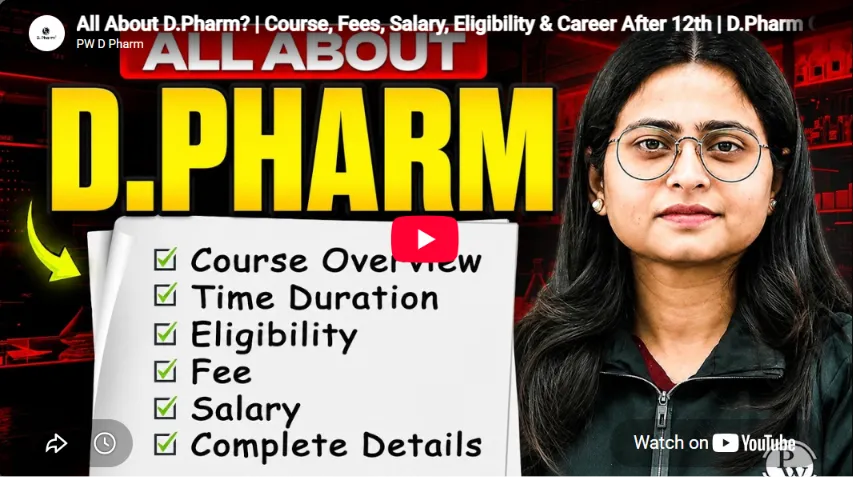
D.Pharm (Diploma in Pharmacy) is a 2-year diploma course for students who have completed Class 12 with PCM or PCB. It covers pharmaceutical sciences, drug regulations, patient care, pharmacy law, and practical training, followed by a mandatory internship. Admissions are merit-based or through state-level entrance exams, and NEET is not required.
After completing D.Pharm and obtaining a pharmacist license, graduates can work in hospitals, retail pharmacies, pharmaceutical companies, and government healthcare sectors. Annual salaries typically start from ₹1.5–3.5 LPA, with better prospects through experience or higher studies like B.Pharm via lateral entry. The course also offers opportunities for entrepreneurship, including opening a medical store.
What Is D.Pharm?
D.Pharm, or Diploma in Pharmacy, is a foundational course for students who dream of working in the healthcare sector. This diploma is directly linked to the study of drugs and medicines. It is an undergraduate program designed according to the needs of the pharmaceutical industry and hospital setups.
The course runs for two years, with annual examinations instead of semester-wise exams. During this time, students learn about dosage regulations, inventory control, patient counselling, and pharmacy legislation. This makes it a strong starting point for anyone who wants to build a career in medicines, hospitals, or the pharma industry without spending too many years in college.
D.Pharm Eligibility Criteria After 12th
Before applying, students must check the eligibility rules for this course.
-
Students must have passed Class 12 with PCM (Physics, Chemistry, Mathematics) or PCB (Physics, Chemistry, Biology).
-
Commerce and Arts stream students are not eligible for admission.
-
A minimum of 45% to 50% aggregate marks in the science stream is generally required.
-
The minimum age for admission is 17 years; there is no upper age limit.
-
Some institutes and universities may set their own additional eligibility criteria, so it is important to check with the specific college.
D.Pharm Course Duration and Structure
The duration of this diploma is 2 years, divided into First Year and Second Year, with annual exams for each year. Along with theory, students must also complete practical training in labs, since the syllabus is designed to build both conceptual and hands-on skills.
After completing the two years, students must also finish a mandatory internship of around 500 hours, including about 3 months of practical training in a hospital or approved healthcare setup. This internship can be completed in either a government or private hospital.
D.Pharm Syllabus: Subject-Wise Breakdown
The syllabus for this diploma is regulated by the Pharmacy Council of India (PCI), which means the same curriculum is followed across the entire country.
| Year | Subjects |
| First Year (5 Subjects) | Pharmaceutics, Pharmaceutical Chemistry, Pharmacognosy, Human Anatomy and Physiology (HAP), Social Pharmacy |
| Second Year (6 Subjects) | Pharmacology, Community Pharmacy and Management, Biochemistry and Clinical Pathology, Pharmacy Law and Ethics, Hospital and Clinical Pharmacy, Pharmacotherapeutics |
This structured syllabus ensures students first build a strong base in human biology and basic pharmacy concepts in Year 1, then move to drug action, hospital operations, and legal aspects in Year 2.
D.Pharm Admission Process
Admission into this course can happen in more than one way, depending on the state and institute.
-
Direct/merit-based admission: Many colleges admit students directly based on Class 12 marks.
-
State-level entrance exams: Several states conduct their own entrance tests for diploma admission, such as JEECUP (Uttar Pradesh), MHT CET (Maharashtra), and Karnataka CET.
-
Without NEET: Unlike some other medical courses, admission does not require students to qualify NEET.
D.Pharm Fees Structure
The fees for this diploma depend heavily on whether a student joins a government or private institute.
| College Type | Approximate Fees (Per Year) |
| Government College | ₹5,000 – ₹30,000 |
| Private Institute | ₹40,000 – ₹1,50,000 |
These figures are approximate and can vary based on the specific college, state, and facilities offered.
Benefits of Doing D.Pharm
Completing this diploma opens up several practical benefits for students.
-
Students become eligible for a pharmacist license after completing the course and required internship hours, allowing registration with the State Pharmacy Council.
-
Once registered, students can work as a licensed pharmacist in hospitals, clinics, or retail setups.
-
Graduates can also open their own retail or wholesale medical store, making entrepreneurship a realistic option.
-
The diploma also creates a base for further studies in pharmacy, including B.Pharm and beyond.
Career Options After D.Pharm: Government and Private Jobs
After completing the course and registering with the State Pharmacy Council, students have wide career options in both government and private sectors.
| Sector | Career Options |
| Government | State Pharmacist posts, Defence (Army, Navy, Air Force), NHM, DSSSB, UP Subordinate Services, RRB, ESIC, AYUSH Pharmacist, PSUs, SSC (for eligible posts) |
| Private | Hospital Pharmacist, Nursing Home Pharmacist, Production Assistant, Quality Assurance (QA/QC), Medical Coding (with certification), Healthcare BPOs, Health Insurance Companies, Retail Pharmacist, Medical Representative (MR), GMP Documentation, Inventory Management, Online Pharmacy Executive |
A valid pharmacist license is mandatory for most pharmacist-related government and private roles.
D.Pharm Salary After Diploma
Salary after this diploma depends on the job role, sector, and years of experience.
| Job Role | Approximate Annual Salary |
| Freshers (Entry Level) | ₹1.5 – ₹3.5 LPA |
| Hospital/Retail Pharmacist | ₹2 – ₹3.5 LPA |
| Medical Representative (MR) | ₹3 – ₹5 LPA (plus incentives) |
| Government Pharmacist (State-Level) | ₹3 – ₹4.5 LPA |
| Production/Quality Assistant | ₹2.5 – ₹4 LPA |
Salary generally increases with experience, and the growth also depends on the organization a student joins after completing the diploma.
Higher Education Options After D.Pharm
Many students use this diploma as a stepping stone toward higher studies rather than stopping at the diploma level. Students can pursue a B.Pharm degree through lateral entry, which allows them to skip the first year and directly join the second year of the bachelor's program. A similar lateral entry option is also available for students who wish to pursue Pharm D after completing the diploma.
After B.Pharm, students can go on to complete a Master's degree and even a PhD, depending on their long-term career goals. Building strong communication skills and taking up relevant certification courses alongside the diploma can further improve job prospects in both government and private sectors.
Get Preparation Support from PW for D.Pharm
Physics Wallah offers structured preparation support for pharmacy students through its dedicated Pharma channel, expert faculty, and organized study material.
| Feature | Details |
| Course | D.Pharm & Pharma Preparation Batches |
| Mode | Live + Recorded Classes |
| Study Material | Notes, PDFs & Practice Questions |
| Practice | Mock Tests, DPPs & Previous Year Questions |
Students can explore the latest preparation batches on the official Physics Wallah Pharma page and read more about the course on the D.Pharm detailed guide.
D.Pharm Complete Guide FAQs
What is the full form of D.Pharm?
What is the D.Pharm eligibility after 12th?
Is NEET required for D.Pharm admission?
What is the D.Pharm fees for government and private colleges?




Get Free Counselling Today
and Clear up all your Doubts
 Live & recorded classes available at easeDashboard for progress trackingLakhs of practice questions

