







How to Start GPAT Preparation in 1st Year B.Pharm?
Starting GPAT preparation early is crucial for B.Pharm first-year students aiming for higher studies. GPAT qualification offers a ₹12,400 monthly scholarship and admission to top M.Pharm institutions. The exam is MCQ-based with negative marking. Focus on core first-semester subjects like General Pharmacy, HAP, Pharmacognosy, and Inorganic & Analytical Chemistry, understanding concepts, and practicing previous year questions.
 Neha Tanna5 May, 2026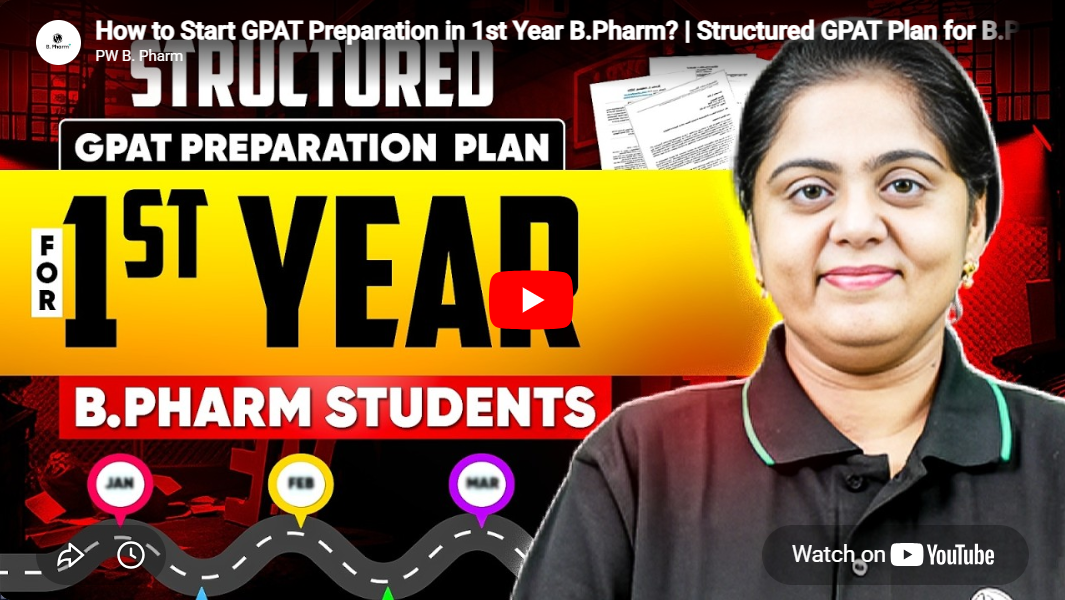
Starting GPAT preparation in the first year of B.Pharm can give students a powerful head start towards higher studies like M.Pharm. The Graduate Pharmacy Aptitude Test (GPAT) is closely aligned with the B.Pharm syllabus, which means students can begin preparing from their very first semester without needing any separate study plan.
By understanding the exam pattern, scholarship benefits, and important first-semester subjects such as General Pharmacy, HAP, Pharmacognosy, and Inorganic & Analytical Chemistry, students can gradually build strong concepts while continuing their regular coursework. Early preparation not only improves confidence but also increases the chances of qualifying GPAT and securing admission to top pharmacy institutes with financial support.
GPAT Examination Details
GPAT syllabus is primarily based on the B.Pharm curriculum. A thorough study of the B.Pharm syllabus, starting from the first semester, is crucial.
-
Score Validity: The GPAT score remains valid for three years.
-
Scholarship: A monthly stipend of ₹12,400 is provided to GPAT qualifiers.
-
Exam Pattern: The examination is Multiple Choice Question (MCQ)-based, consisting of 125 questions.
-
Each correct answer awards four marks.
-
There is negative marking: one mark is deducted for each incorrect answer.
-
The total marks for the paper are 500.
Understanding these details is fundamental before commencing GPAT preparation.
GPAT Preparation Plan for B.Pharm First-Year Students
For B.Pharm first-year students, beginning GPAT preparation early is highly beneficial. With the evolving syllabus and new students, it is essential to clarify various aspects of the GPAT examination.
A clear understanding of what GPAT is, which body conducts it, the fellowship amount, its validity, and how to target preparation from the first semester is key to qualification. Students from competitive exam backgrounds can readily qualify by maintaining their preparation level and focusing on important subjects from the first semester. The GPAT examination is not overly difficult with structured planning.
To summarize an effective GPAT preparation strategy for B.Pharm first-year students:
-
Target Setting: Clearly define the goal of pursuing higher studies and aiming for GPAT qualification.
-
Preparation Strategy:
-
Focus on the four important subjects identified from the first semester.
-
Prioritize understanding concepts rather than memorization.
-
Continuously practice Previous Year Questions (PYQs) alongside your regular studies.
This strategic approach will significantly help in preparing for the seven to eight questions typically appearing in GPAT from the first-semester syllabus.
GPAT-Relevant Topics from First Semester Subjects
Here's a breakdown of crucial topics within each relevant first-semester subject:
-
General Pharmacy (BP 102T)
-
Key topics include the Profession of Pharmacy, History, Pharmacopoeias, and Calculations.
-
Pharmaceutical Calculations, especially Posology, is a very important topic for GPAT.
-
Topics like Prescriptions and Dosage Forms (Solid, Liquid, Semi-Solid) also require thorough preparation.
-
Practicing MCQs alongside studying these topics is highly recommended.
-
Human Anatomy, Physiology, and Pathology (HAP) (BP 104T)
-
HAP is a very important topic for GPAT.
-
Syllabus covers: Introduction to Human Body, Integumentary System, Wound Healing, Basic Mechanism of Inflammation and Repair, Peripheral Nervous System, Cardiovascular System.
-
The Cardiovascular System (CVS) is the most important topic, followed by the Peripheral Nervous System (PNS). These two areas are crucial for the GPAT examination.
-
Introduction to Pharmacognosy (BP 105T)
-
Important syllabus topics include: History and Fundamentals of Pharmacognosy, Classification of Drugs, Cultivation of Drugs, Quality Control of Drugs, Metabolites of Plant Origin, and Phytotherapeutic Agents.
-
Phytotherapeutic Agents are an important area of focus.
-
Other critical topics are Traditional Systems of Medicine, Primary and Secondary Metabolites, and specific aspects of Quality Control. These units demand greater attention.
-
Inorganic and Analytical Chemistry (BP 106T)
-
This is a merged subject.
-
The topic of Errors is very important.
-
From Impurities, questions on Limit Tests are frequently asked.
-
Acid-Base Buffer Systems and Acid-Base Titrations are highly important.
-
Other potential topics include Complexometry, Redox Titrations, and Radiopharmaceuticals.
-
Students should focus on these topics during their first semester for GPAT preparation.
Career Targets After B.Pharm
B.Pharm first-year students should define their career goals early. While options like Job Opportunities, International Opportunities, and Entrepreneurship exist, this discussion specifically focuses on Higher Studies, particularly pursuing M.Pharm. GPAT qualification also supports admission to better institutions for other paths like Pharm MBA.
M.Pharm: GPAT vs. Non-GPAT
M.Pharm can be pursued either by qualifying GPAT or as a non-GPAT candidate. Qualifying GPAT offers distinct advantages:
Advantages of GPAT Qualification
-
Scholarship: GPAT qualifiers receive a scholarship of ₹12,400 per month. This fellowship is provided for two years or the M.Pharm course duration.
-
Admission to Better Institutes: GPAT qualification opens doors to top-tier institutions such as NIPERs (Mohali, Hyderabad, etc.), Panjab University, and IIT BHU. Studying at these institutions provides superior facilities and enhanced placement opportunities.
These benefits highlight the value of qualifying GPAT for higher studies.
How to Start GPAT Preparation in 1st Year B.Pharm? FAQs
Why should a B.Pharm first-year student start GPAT preparation early?
What are the main benefits of qualifying GPAT for M.Pharm aspirants?
Who conducts the GPAT examination, and what is its validity?



Have questions about your prep?
Our experts can answer all your questions
 Live & recorded classes available at easeDashboard for progress trackingLakhs of practice questions

