NIPER JEE Exam Pattern 2026, Exam Mode, Duration, Marking Scheme
NIPER JEE Exam Pattern 2026 is detailed here. The National Institute of Pharmaceutical Education and Research (NIPER) conducts the NIPER JEE annually, It is a Computer-based Test (CBT) with 200 Multiple Choice Questions (MCQs) to be completed in 2 hours. Correct answers award 0.5 marks, while incorrect ones have negative marking.



NIPER JEE Exam Pattern 2026: The National Institute of Pharmaceutical Education and Research (NIPER) conducts the NIPER JEE annually, an examination for admission to various postgraduate courses like M.Pharm, M.S. (Pharm.), M. Tech. (Pharma), MBA (Pharma), and Ph.D. (Pharmaceutical and Biological Sciences) across NIPER institutions. It is a Computer-based Test (CBT) with 200 Multiple Choice Questions (MCQs) to be completed in 2 hours. Correct answers award 0.5 marks, while incorrect ones deduct 0.125 marks. The NIPER JEE Exam Pattern 2026, detailing the mode, language, marking scheme, and duration, will be released with the official information brochure on niperguwahati.ac.in. Understanding this pattern is crucial for all aspiring candidates.
NIPER JEE Exam Pattern 2026 Highlights
The NIPER JEE is a significant postgraduate entrance examination. It evaluates candidates for various pharmacy-related courses across multiple NIPER campuses. Here are the key highlights of the NIPER JEE 2026.
| NIPER JEE Exam Pattern 2026 Highlights | |
|---|---|
| Particular | Details |
| Full Name | National Institute of Pharmaceutical Education and Research Joint Entrance Exam (NIPER JEE) |
| Conducting Body | National Institute of Pharmaceutical Education and Research |
| Exam Level | Post Graduate |
| Course offered | Master of Technology (MTech) in Pharmacy, Master of Business Administration (MBA) Pharmacy, Master of Pharmacy (MPharm), Master of Science (MS) in Pharmacy, Doctor of Philosophy (Ph.D.) |
| Medium of Exam | English |
| Mode of Exam | Computer-based Test (CBT) |
| Type of Questions | Multiple Choice Questions (MCQs) |
| Total number of questions asked | 200 questions in Master's entrance exam |
NIPER JEE Masters Exam Pattern
For candidates appearing for Master's programs, understanding the specific NIPER JEE Exam Pattern 2026 is essential. This section outlines the structure of the examination for Master's degree admissions.
-
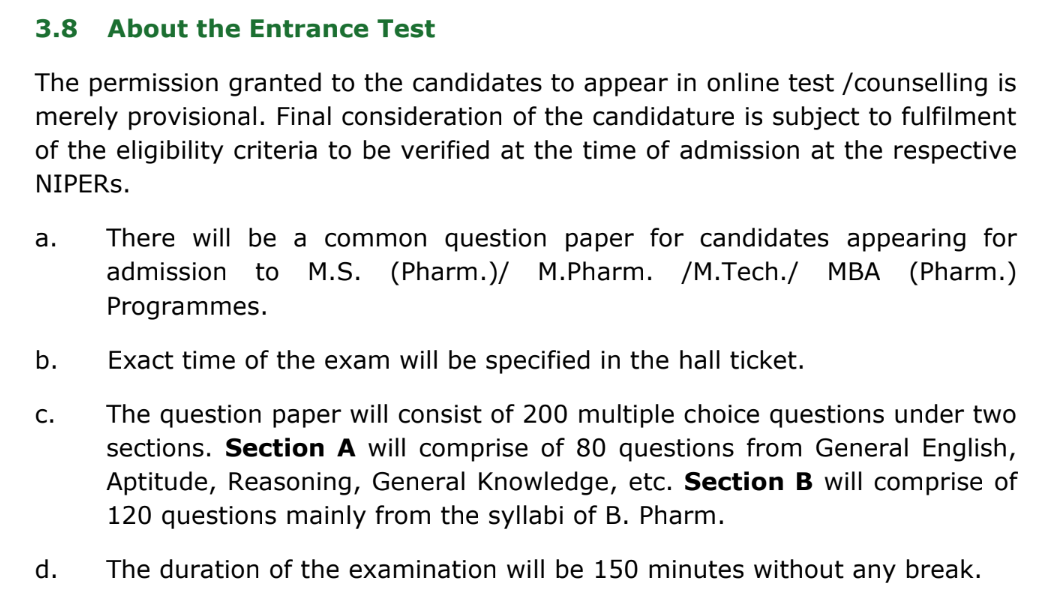
Mode of an exam: The NIPER JEE 2026 exam will be conducted in computer-based mode (CBT).
-
Exam duration: Candidates will have to answer the questions in the NIPER JEE 2026 exam in two hours.
-
Medium of the exam: The medium of the exam will be English.
-
Total number of questions: NIPER JEE 2026 will consist of 200 questions.
-
Questions type: Multiple Choice Questions (MCQs) will be asked in the NIPER JEE 2026 exam.
-
Syllabus Basis: Questions will be asked from the B.Pharm and PG degrees in the relevant fields along with general aptitude questions.
-
NIPER exam 2026 total marks: 100
NIPER JEE PhD. Exam Pattern
For NIPER JEE PhD, the exam is usually computer-based, in English, and lasts 2 hours. The paper has 200 MCQs and carries 200 marks, with +1 for each correct answer and -0.25 for each wrong answer.
For PhD candidates, the paper is split into 170 subject-based questions from Chemical Sciences, Biological Sciences, Pharmaceutical Sciences, and Medical Devices, plus 30 questions from General Aptitude, Reasoning, and General English. This makes the exam a mix of domain knowledge and basic aptitude
NIPER JEE 2026 Marking Scheme
The marking scheme is a critical component of the NIPER JEE Exam Pattern 2026. Knowing how marks are awarded and deducted helps candidates strategize their attempts during the exam. An accurate understanding ensures effective exam preparation.
-
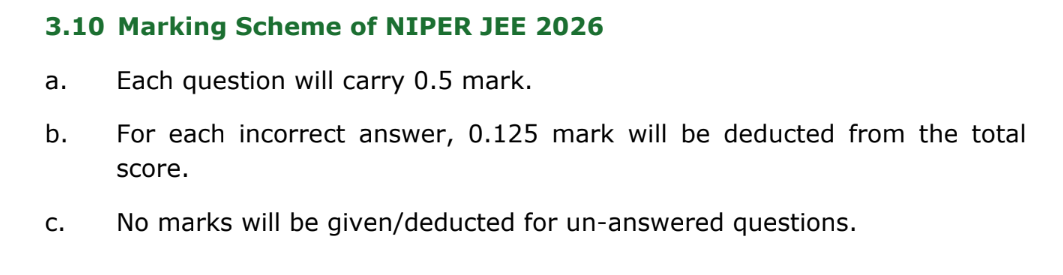
According to the marking scheme of the NIPER JEE exam pattern 2026, every correct answer will be awarded with 0.5 mark.
-
Every incorrect answer will lead to the deduction of 0.125 marks.
-
No mark is deducted for an unanswered question.
NIPER JEE 2026 Syllabus
The NIPER JEE 2026 syllabus primarily covers the qualifying examination's curriculum. It integrates general pharmaceutical sciences and aptitude sections to assess candidates comprehensively.
-
The curriculum of NIPER JEE mainly consists of the syllabus of the qualifying examination.
-
It covers course design, general pharmaceutical sciences, and general aptitude.
-
For PhD courses: Questions will be from MS (Pharm.), MPharm, and MSc (relevant discipline).
-
For MPharm/MS courses: Questions related to BPharm and MSc (relevant discipline) will be asked for master's degree admission.
-
Pharmacy science: General pharmaceutical science questions.
-
Aptitude: General aptitude questions.
-
There is no specific weightage for the sections; the question paper contains 200 questions, and no specific number of questions are asked from each subject area.
NIPER JEE Exam Pattern 2026 FAQs
What is the NIPER JEE Exam Pattern 2026?
How many questions are in the NIPER JEE Master's entrance exam?
What is the marking scheme for NIPER JEE 2026?


Have questions about your prep?
Our experts can answer all your questions