







Best Ways to Practise Challenging Maths Problems at Home

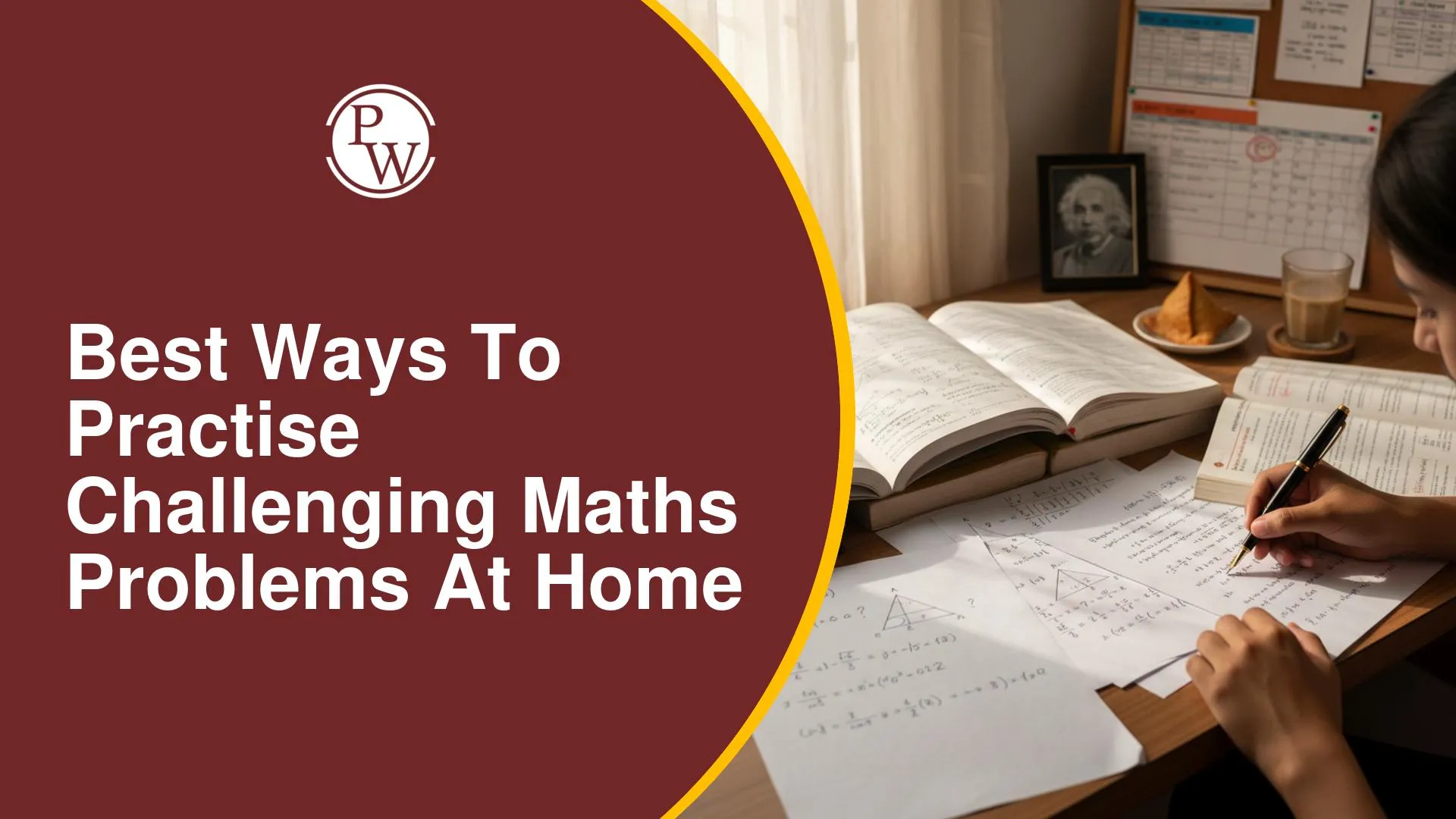
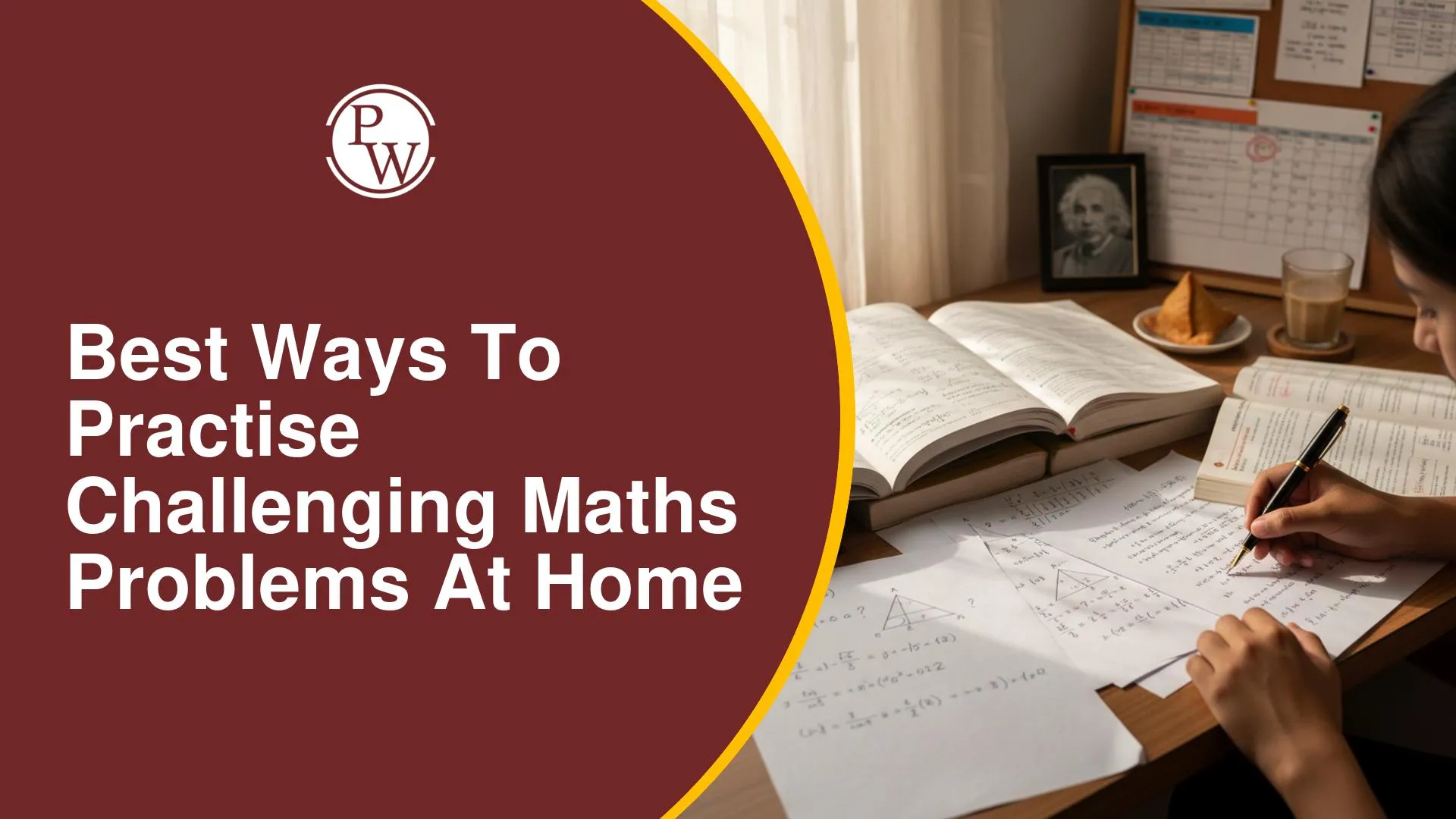
Challenging Maths problems can help students go beyond memorising formulas and learn how to think logically. For Classes 6–10, regular practice with unfamiliar questions can improve Maths problem-solving skills, conceptual clarity and confidence.
The key is not to solve hundreds of questions every day. Students need the right mix of concept revision, application-based questions, Maths puzzles and challenging problems. A structured approach, such as the learning model followed by PW Prodigy, can help students gradually move from basic concepts to advanced problem-solving and develop stronger mathematical thinking.
Effective Ways to Practise Difficult Maths Problems at Home
Below are the best ways to practise challenging Maths problems at home, including concept clarity, regular practice, Maths puzzles, logical reasoning, and Olympiad-style questions.
1. Start With Concept Clarity
Before solving challenging questions, students should understand the basic concept behind the topic. A strong foundation makes it easier to identify which formula, rule or method should be used.
Instead of simply memorising a formula, ask questions such as:
-
Why does this formula work?
-
Where can I apply it?
-
Can I solve the problem using another method?
-
What happens if the values in the question change?
For example, while learning algebra, students should understand why an algebraic identity works rather than only memorising its expansion.
This type of conceptual Maths learning can make unfamiliar questions easier to approach.
2. Move From Easy to Challenging Problems
Students do not need to start with the hardest question. A gradual increase in difficulty can make practice more effective.
Follow this progression:
Concept → Basic Question → Application → Multi-step Problem → Challenging Problem → Olympiad-style Problem
Start with a few questions that test the basic idea. Then move to questions that require students to combine two or more concepts.
This approach is also useful for students interested in Olympiad Maths practice because Olympiad-style questions often require deeper reasoning rather than direct formula application.
PW Prodigy follows a concept-focused approach designed to help students build their understanding and take on progressively challenging academic problems.
3. Give Yourself Time to Think
One of the most important best ways to practise challenging Maths problems at home is to avoid looking at the solution too quickly.
When a question looks difficult, give yourself some time to think. Try to understand what the problem is asking before choosing a method.
Students can follow these steps:
-
Read the question carefully.
-
Write down the information given.
-
Identify what needs to be found.
-
Break the problem into smaller parts.
-
Try one approach.
-
If it does not work, try another method.
-
Check the answer once you finish.
Even when the first attempt is unsuccessful, the thinking process itself is useful. It builds independence and teaches students how to handle unfamiliar questions.
4. Make Problem-Solving Interactive
Maths practice does not always have to involve worksheets and textbook exercises. Adding variety can make challenging problems more interesting.
Parents can introduce:
-
Number and pattern puzzles
-
Geometry challenges
-
Logic-based questions
-
Mental Maths games
-
Real-life Maths situations
-
Strategy-based puzzles
-
Timed problem-solving challenges
For example, students can be asked to find different ways to reach the same numerical answer or identify a pattern in a sequence.
These activities encourage logical reasoning in Maths and help students look at problems from different angles.
5. Learn From Every Mistake
Getting an answer wrong is not necessarily a bad thing. The important part is understanding why the answer was wrong.
After completing a challenging question, students should ask:
-
Did I misunderstand the question?
-
Did I use the wrong formula?
-
Was there a calculation error?
-
Did I miss an important piece of information?
-
Is there another way to solve the problem?
Maintaining a small mistake notebook can be helpful. Write down the question, the mistake made and the correct approach.
Over time, this can help students identify repeated errors and improve their Maths problem-solving skills.
6. Add a Daily or Weekly Challenge
Students can make challenging Maths practice a regular part of their home routine.
Instead of solving a large number of difficult questions every day, set aside time for one meaningful challenge.
For example:
Monday: Algebra challenge
Tuesday: Geometry problem
Wednesday: Number-based puzzle
Thursday: Logical reasoning question
Friday: Mixed-concept problem
Saturday: Olympiad-style challenge
Sunday: Review mistakes
Parents can also organise a weekly “challenge day” where students solve a problem without immediate help.
This routine can gradually improve confidence and encourage students to enjoy mathematical thinking.
Read More: Top Talent Exams for Students in India: Olympiads and More
7. Connect Maths With Real-Life Situations
One of the easiest ways to understand why Maths matters is to connect it with everyday situations.
Students can practise Maths through:
-
Calculating discounts while shopping
-
Comparing prices
-
Working out travel time
-
Measuring areas at home
-
Calculating ingredients in recipes
-
Creating simple budgets
-
Understanding graphs and data
For example, a student learning percentages can calculate the final price of an item after applying a discount.
Real-life examples show students that Maths is not limited to textbooks and examinations.
8. Practise Explaining Your Solution
Solving a problem is only one part of mathematical learning. Students should also practise explaining how they reached the answer.
After solving a difficult question, try explaining:
What was given → What was required → Which concept was used → Why that method was selected → How the answer was calculated
If a student can explain the solution clearly, it usually shows that they understand the reasoning behind it.
This habit becomes particularly useful for students building a Maths foundation for JEE, where conceptual understanding and problem-solving are important.
9. Use Different Types of Difficult Questions
Students should not practise only one type of challenging question. A balanced routine can include different areas of Maths.
|
Use Different Types of Difficult Questions |
|
|
Area |
Example Practice |
|
Algebra |
Equations and identities |
|
Geometry |
Shapes, angles and constructions |
|
Number Theory |
Factors, divisibility and number patterns |
|
Arithmetic |
Ratios, percentages and applications |
|
Logical Reasoning |
Patterns and deduction |
|
Data Handling |
Graphs and interpretation |
Exposure to different question types helps students become flexible problem-solvers instead of depending on one familiar method.
How PW Prodigy Can Support Mathematical Thinking
For students who enjoy challenging questions or want to develop their academic foundation early, structured learning can provide a useful progression.
PW Prodigy focuses on nurturing students who want to go beyond routine school-level learning. Its learning pathways include Foundation, IIT-JEE and Olympiad-focused preparation, giving students opportunities to work on concepts, reasoning and more challenging problems.
For Classes 6–10, this type of structured practice can complement school learning by encouraging students to question concepts, solve unfamiliar problems and develop independent thinking.
The goal should not be to make every question difficult. Instead, students should gradually become comfortable with questions that require them to think, experiment and try more than one approach.
Read More: How Olympiad Practice Helps Later With JEE and NEET
Common Mistakes to Avoid While Practising Maths at Home
Students can make their practice more effective by avoiding a few common habits:
-
Looking at the solution immediately
-
Memorising formulas without understanding them
-
Solving only easy questions
-
Ignoring mistakes after checking the answer
-
Focusing only on speed
-
Practising without a regular schedule
-
Avoiding questions that seem unfamiliar
Parents should also avoid putting pressure on children to solve a fixed number of difficult questions every day. The quality of thinking is more important than the number of questions completed.
Practising challenging Maths problems at home is more effective when students focus on understanding concepts, trying different approaches and learning from mistakes. Regular practice with Maths puzzles, application-based questions and progressively difficult problems can strengthen problem-solving and mathematical thinking.
The goal is not to solve the maximum number of questions but to become more confident in approaching unfamiliar problems. A consistent and thoughtful practice routine can help students build stronger Maths skills for school studies and future academic challenges.
Best Ways to Practise Challenging Maths Problems at Home FAQs
What are the best ways to practise challenging Maths problems at home?
How can students improve their Maths problem-solving skills?
How much time should I spend practising challenging Maths problems each day?
Are Maths puzzles useful for improving mathematical thinking?






Get Free Counselling Today
and Clear up all your Doubts
 Live & recorded classes available at easeDashboard for progress trackingLakhs of practice questions

