



What Is a Key Feature of Generative AI?
 Mishika Gupta20 Nov, 2026

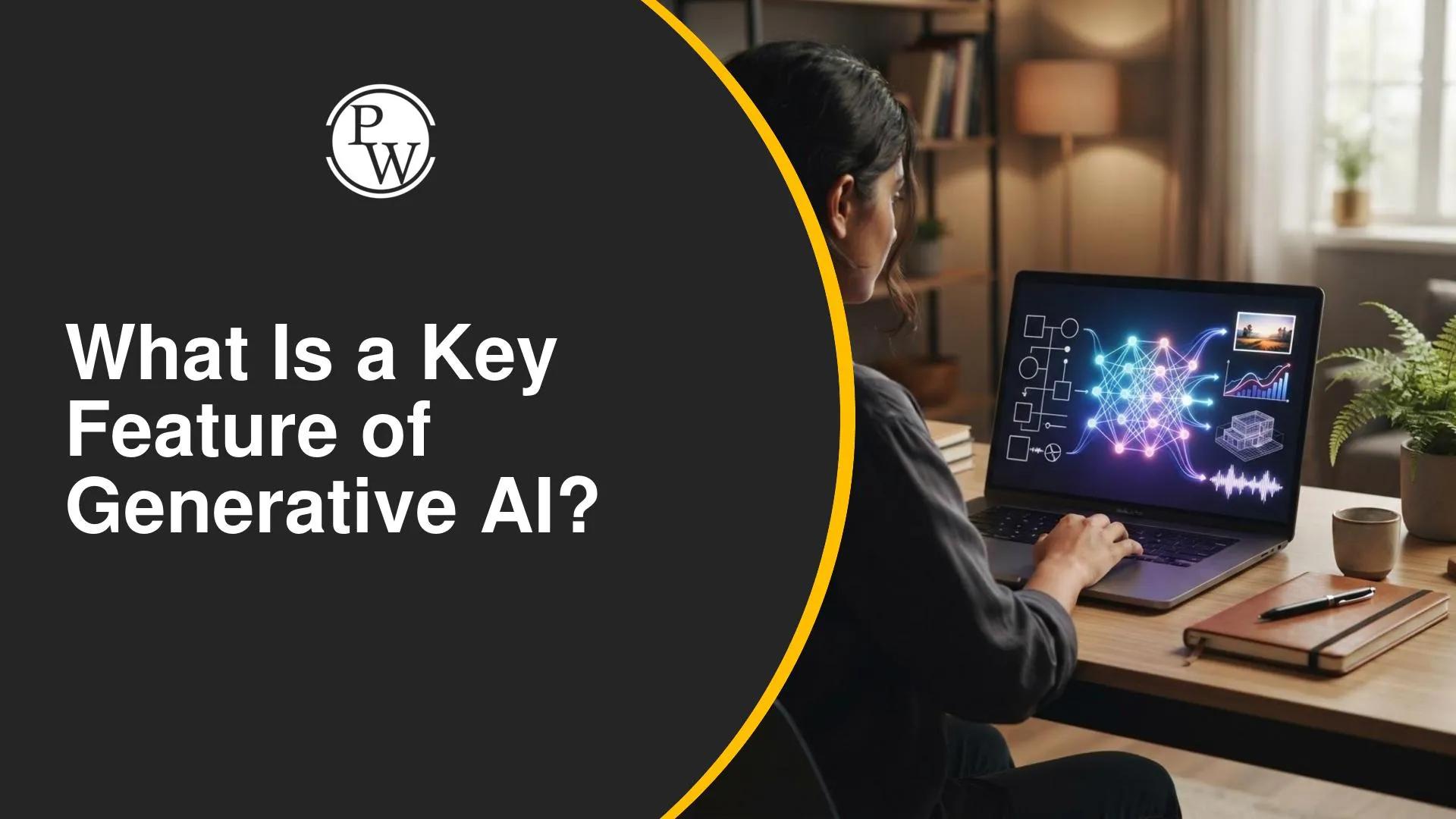
The key feature of generative AI is its ability to create new content. It learns patterns and relationships from large amounts of training data rather than simply identifying existing information or predicting outcomes.
Using these learned patterns, generative AI can produce different types of content, including text, images, audio, video and computer code.
It can also respond to user prompts to generate content based on specific instructions, making it useful for tasks such as drafting emails, creating visuals, summarising information and writing code.
Why Is Content Generation the Defining Feature of Generative AI?
The defining characteristic of generative AI is content creation. It learns the patterns, relationships and characteristics present in its training data and uses them to produce new outputs in response to a prompt or other input.
For example, you can ask an AI tool to draft a professional email, create an illustration or write a Python programme. The model processes your instructions and generates an output based on its learned patterns.
Generative AI stands out because it can produce new content, including text, images, audio, video and code, using patterns learned during training.
According to the National Institute of Standards and Technology, generative AI models use the structure and characteristics of input data to generate derived synthetic content. Similarly, Microsoft explains that generating new content is the key feature that distinguishes this technology.
How Does Generative AI Create New Content?
Generative AI does not simply search the internet and copy an existing response. It uses patterns learned during training to produce outputs based on the instructions and context it receives.
Generative AI turns learned patterns and user instructions into new outputs through a process of training, prompt processing and content generation.
The process generally involves four stages:
-
Training on data: The model is trained using large datasets that may contain text, images, audio, video or computer code.
-
Learning patterns: During training, it identifies statistical relationships, structures and characteristics within the available data. For example, a language model learns how words and tokens relate to one another.
-
Processing prompts: A user provides an instruction, question or other supported input. The model uses this information and its available context to shape the response.
-
Generating content: The model produces an output, such as a written explanation, image, code snippet, audio clip or video, depending on its capabilities.
For instance, when you enter a prompt asking for a short explanation of machine learning, a generative AI tool uses its learned language patterns to create a relevant response.
Everyday Examples That Explain Generative AI
You may have already encountered generative AI while using writing assistants, image generators or coding tools. These applications demonstrate how the same core capability can produce different types of content.
Here are three simple examples:
|
User Input or Prompt |
Possible AI-Generated Output |
Type of Generation |
|
"Write a short email requesting leave." |
A customised email draft with a subject line and message |
Text generation |
|
"Create an illustration of a solar system." |
A digital illustration showing planets and their positions |
Image generation |
|
"Write Python code to sort a list." |
A code snippet with an explanation of how it works |
Code generation |
From drafting emails to generating images and writing code, generative AI makes content creation possible across different digital tasks.
The same content-generation capability has practical applications across industries, including digital marketing, where AI-powered tools support content creation and campaign execution.
Ready to take your digital marketing campaigns to the next level with AI? Discover how AI content tools in digital marketing can help you create engaging content and streamline your marketing efforts.
Generative AI vs Traditional AI: What Is the Difference?
Traditional AI often predicts, classifies or recommends, whereas generative AI is primarily designed to produce new content from learned patterns.
Generative AI and traditional AI use data for different purposes. Traditional or predictive AI typically classifies information, identifies patterns and predicts outcomes, while generative AI creates new content using learned patterns and context.
|
Aspect |
Traditional or Predictive AI |
Generative AI |
|
Primary purpose |
Classifies information, detects patterns or predicts outcomes |
Creates new content based on learned patterns and context |
|
Typical output |
Labels, scores, predictions or recommendations |
Text, images, audio, video or computer code |
|
Example |
Predicting whether a financial transaction may be fraudulent |
Generating an explanation of how fraud detection works |
|
Common applications |
Fraud detection, forecasting and recommendation systems |
Content creation, image generation and code assistance |
For example, a predictive AI system may analyse transaction details and assign a fraud-risk score. A generative AI tool can create a written explanation of how a fraud detection system works.
This distinction is not absolute. Generative AI models can also perform analytical and classification tasks, while traditional AI systems support a range of applications.
Other Important Capabilities of Generative AI
Although content generation is its defining feature, generative AI offers several additional capabilities that make it useful across different applications.
Some important capabilities include:
-
Prompt-based generation: You can guide the output by providing instructions, questions, examples and relevant context. Clearer prompts can help produce more relevant responses.
-
Multimodal capabilities: Some generative AI models can process or generate different data formats, including text, images, audio and video. However, not every model supports all these formats.
-
Content transformation: Generative AI can summarise, translate, rewrite, edit or reorganise existing content according to your requirements.
-
Contextual responses: Certain models use conversation history or supplied information to make their responses more relevant to the ongoing interaction. This does not necessarily mean they permanently learn from every conversation.
Curious about the AI skills shaping today's digital marketing roles? Discover the AI skills every digital marketer should learn and understand how AI is transforming marketing activities.
Prompt-based interaction, multimodal processing and content transformation extend generative AI beyond creating content from a single instruction.
What Are the Limitations of Generative AI?
Generative AI can produce useful content quickly, but its outputs are not always accurate or reliable. The technology has limitations that you should understand before using it for academic, professional or personal tasks.
Generative AI can accelerate content creation, but accuracy, privacy, originality and human review remain important considerations.
Some important concerns include:
-
Incorrect information: Generative AI can produce convincing but inaccurate responses, commonly described as hallucinations. A fluent answer does not necessarily mean the information is correct.
-
Bias in generated content: Outputs may reflect biases, gaps or limitations present in the training data.
-
Privacy concerns: Sharing confidential, personal or sensitive information with an AI tool may create data protection risks. You should understand the tool's privacy policies before submitting such information.
-
Need for human verification: Generated responses should be reviewed, particularly when used for academic work, financial decisions, legal matters or other high-impact applications.
-
Originality concerns: Generated content is not guaranteed to be entirely original or completely different from material in its training data.
According to Google Cloud's generative AI glossary, grounding can help connect generated responses to relevant information, but it does not eliminate every possibility of error.
How Can You Build Skills in Generative AI?
Understanding how generative AI works is a useful starting point if you want to apply the technology in practical settings. You can gradually develop your knowledge through programming, data analysis, machine learning and hands-on projects.
Here are some learning areas to consider:
-
Understand generative AI fundamentals: Learn how models are trained, how prompts influence outputs and how different generative AI applications work. The Data Science With Generative AI Course can help you develop knowledge across data science and generative AI concepts.
-
Develop AI engineering knowledge: Explore how generative AI models and applications are developed and integrated into software systems through a Gen AI Engineering Course.
-
Learn data analysis: Understand how data is collected, interpreted and used to generate insights with a Data Analytics With AI Course.
-
Apply AI in software development: Build programming and application development skills while understanding how AI can support coding workflows through Full Stack Development with AI.
Learning generative AI involves more than using prompts; developing data, programming and practical application skills can help you understand the technology in greater depth.
Your learning path can depend on whether you are interested in data science, AI engineering, analytics or software development. Practising with suitable tools and projects can help you understand how generative AI concepts translate into real-world applications.
What Does the Future of Generative AI Look Like?
Generative AI is expanding across content creation, software development, education, data analysis and digital business. Its ability to produce different types of content makes it useful for tasks that previously required considerable manual effort.
The defining strength of generative AI is content creation, but its long-term value depends on how accurately, responsibly and effectively people apply it.
However, its growing use also makes responsible implementation important. Accuracy checks, data privacy, transparency and human oversight will continue to influence how organisations and individuals use these tools.
Looking to apply generative AI in real-world projects? Build practical skills with the Data Science With Generative AI Course and gain hands-on experience