Data Readiness, Governance and Domain Expertise Become Key to Scaling AI Projects in India
 Avisha Das6 Nov, 2026

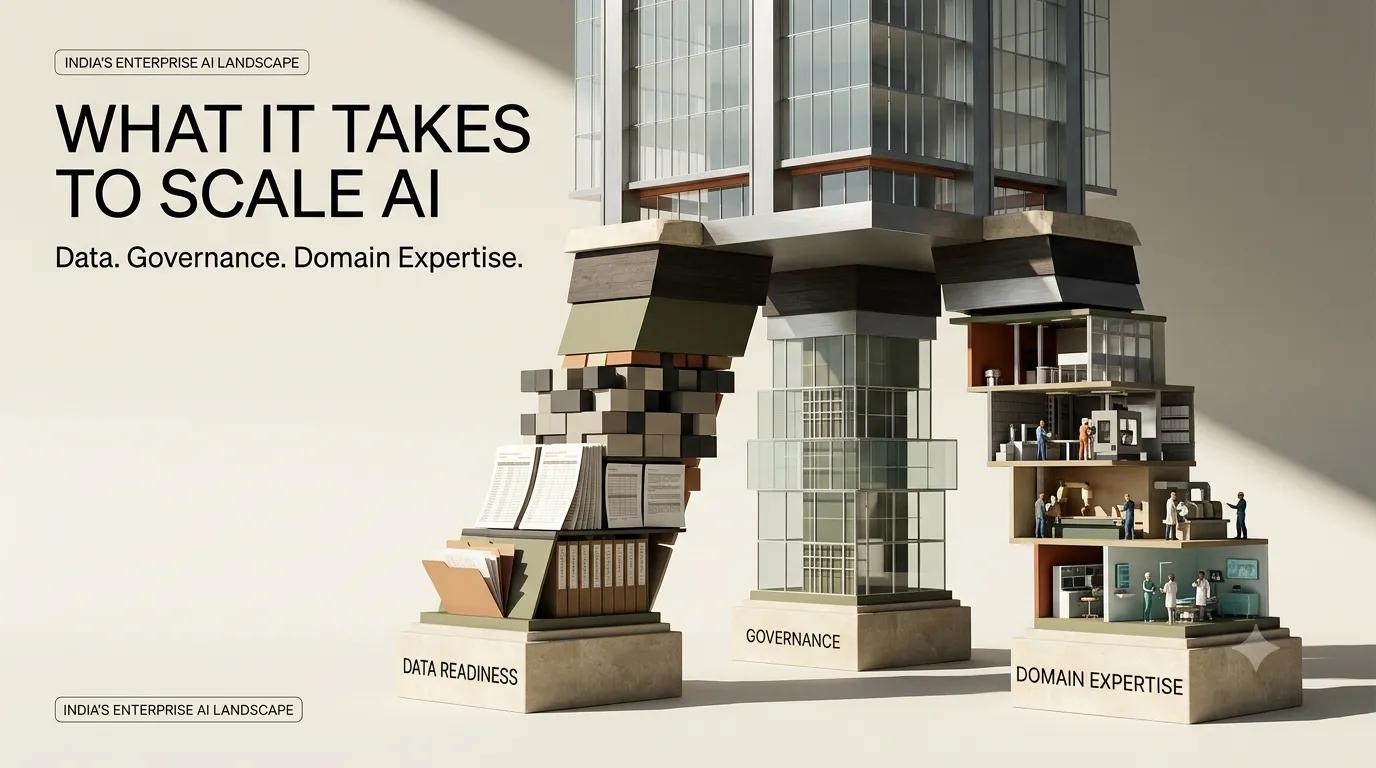
India's AI investments are growing, but getting projects beyond the pilot stage remains a challenge. According to industry experts, fewer than 10% of enterprises are truly AI-ready in terms of their data, governance and internal processes. This means that adopting AI is not just about having access to the technology or hiring people who understand it. Companies also need the right foundations to put AI systems to work at scale.
A report by The Economic Times, citing staffing firms and industry leaders, highlights three factors shaping enterprise AI adoption: data readiness, governance and professionals with the right mix of AI expertise and domain knowledge. While talent shortages remain a concern, the report points out that organisational readiness can be a separate barrier to moving AI projects from experimentation to production.
THE BIG TAKEAWAY: Scaling AI requires more than technical expertise. With less than 10% of enterprises considered truly AI-ready, companies must also address data readiness, governance and process requirements. At the same time, employers are looking for professionals who can connect AI capabilities with specific business and industry needs.
Why Are Fewer Than 10% of Indian Enterprises Ready to Scale AI?
Data readiness, governance and internal processes are preventing many organisations from taking AI projects beyond the pilot stage.
According to Pareekh Jain, CEO of market research firm EIIRTrend, less than 10% of enterprises are truly AI-ready from a data, governance and process perspective.
Jain noted that companies are facing difficulties taking AI projects from pilot to production, but these challenges are not always caused by a lack of AI talent. Many organisations are still working through the data readiness and governance requirements needed for large-scale AI deployment.
The report identifies three areas where enterprise readiness remains a concern:
-
Data readiness: Organisations are still grappling with the data requirements involved in large-scale AI deployment.
-
Governance: Companies need to address governance requirements before scaling AI projects.
-
Internal processes: Organisational processes also influence whether AI projects can move from pilot stages to production.
These challenges can exist even when a company has access to AI professionals and is investing in the technology. As a result, hiring more AI talent alone may not resolve every obstacle to enterprise-wide adoption.
Explore the Data Science With Generative AI Course by PW Skills to learn about data science, machine learning, deep learning, NLP and Generative AI.
Key Takeaway: Fewer than 10% of enterprises are considered truly AI-ready by the expert cited in the report. Data readiness, governance and internal processes remain important requirements for moving AI projects into production.
Why Do Companies Need Professionals With Both AI and Domain Expertise?
Employers are looking beyond general AI familiarity and seeking professionals who can combine technical capabilities with an understanding of their business domains.
The report highlights that finding AI talent is not only about the number of available professionals. Companies also need candidates who understand how AI expertise applies to specific business and industry requirements.
Neeti Sharma, CEO of TeamLease Digital, said employers are struggling to find professionals with the right mix of AI expertise and domain knowledge.
This requirement is becoming more relevant as companies across sectors increase their AI investments. The report identifies demand across:
-
Information technology services
-
Global Capability Centres (GCCs)
-
Banking
-
Healthcare
-
Manufacturing
According to TeamLease Digital, GCCs account for more than 60% of AI-related hiring demand. Hiring is also increasingly concentrated in mid- and senior-level professionals.
The staffing firm estimates that talent gaps in specialised AI and GenAI roles can exceed 50%. Companies are also increasing investments in internal reskilling programmes to develop AI capabilities within their existing workforce.
Explore the Data Analytics With AI Course by PW Skills to study data analysis, Python, SQL, Power BI and AI applications in analytics.
Key Takeaway: Employers need more than professionals with general AI exposure. The ability to combine AI expertise with domain knowledge is an important hiring requirement, particularly as AI adoption expands across industries.
How Are AI Talent Shortages Adding to Enterprise Adoption Challenges?
The shortage of production-ready AI professionals is creating another hurdle for companies trying to scale their AI projects.
India could face a shortage of more than 1 million AI professionals by 2027, according to staffing firms and experts cited in the report. Some estimates put demand at 2.3 million AI professionals, against an available talent pool of around 1.2 million.
The shortage is particularly severe in specialised production and deployment roles.
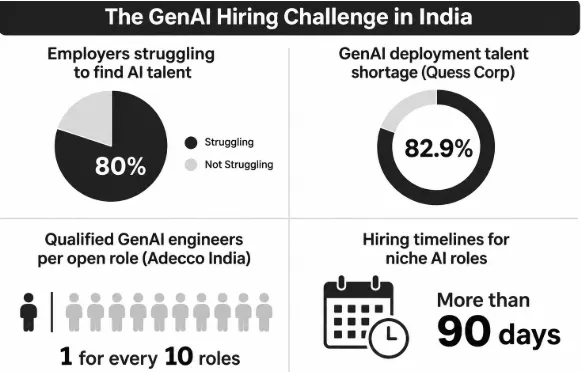
The talent gap is also influencing compensation. Core AI professionals are commanding salary premiums of 30–40%, while specialised GenAI engineers, AI architects and domain-focused AI professionals can attract premiums of 50% or more.
The report also notes that companies are increasing investments in reskilling to build AI capabilities internally. However, a slowdown in hiring and training by major IT services firms could create a talent bottleneck over time.
Explore the Gen AI Engineering Course by PW Skills to learn about RAG systems, autonomous agents, LLMOps and production AI application development.
Key Takeaway: Talent shortages add to the difficulty of scaling AI projects. Around 80% of employers report challenges finding the AI professionals they need, while specialised GenAI roles face particularly high shortages.
What Are Companies Doing to Build AI Capabilities Internally?
Reskilling programmes are becoming one way for companies to develop AI capabilities within their existing workforce.
As demand for specialised AI professionals rises, companies are stepping up investments in internal reskilling programmes. TeamLease Digital highlights this approach alongside the growing concentration of hiring in mid- and senior-level roles.
The report also points to a potential concern: a slowdown in hiring and training by major IT services firms could create a talent bottleneck over time.
Building AI capabilities internally can help organisations develop the expertise they need, while addressing the shortage of specialised professionals remains an important part of their hiring efforts.
Explore the Full Stack Development with AI Course by PW Skills, which combines software development learning with AI-related capabilities.
Key Takeaways
-
Enterprise AI readiness remains limited: Less than 10% of enterprises are considered truly AI-ready from a data, governance and process perspective.
-
Data and governance affect deployment: Organisations are still working through the requirements needed to move AI projects from pilot stages to production.
-
Domain knowledge matters in AI hiring: Employers are looking for professionals who combine AI expertise with an understanding of business and industry requirements.
-
GCCs drive a significant share of AI hiring: They account for more than 60% of AI-related hiring demand, according to TeamLease Digital.
-
Reskilling is gaining importance: Companies are investing in internal programmes to develop AI capabilities, although a slowdown in hiring and training could create talent bottlenecks.
India’s AI hiring challenge is no longer just about finding people who understand AI; it is about finding professionals who can take AI projects from experimentation to enterprise-level deployment. With talent shortages, long hiring timelines, and gaps in data readiness and governance, companies need a mix of technical expertise and business-domain knowledge to scale their AI initiatives. Building these capabilities through specialised hiring and internal upskilling will be essential as AI adoption moves beyond pilot projects.