CBSE Class 12 Maths Board Exam 2026: Step Marking Strategy Explained

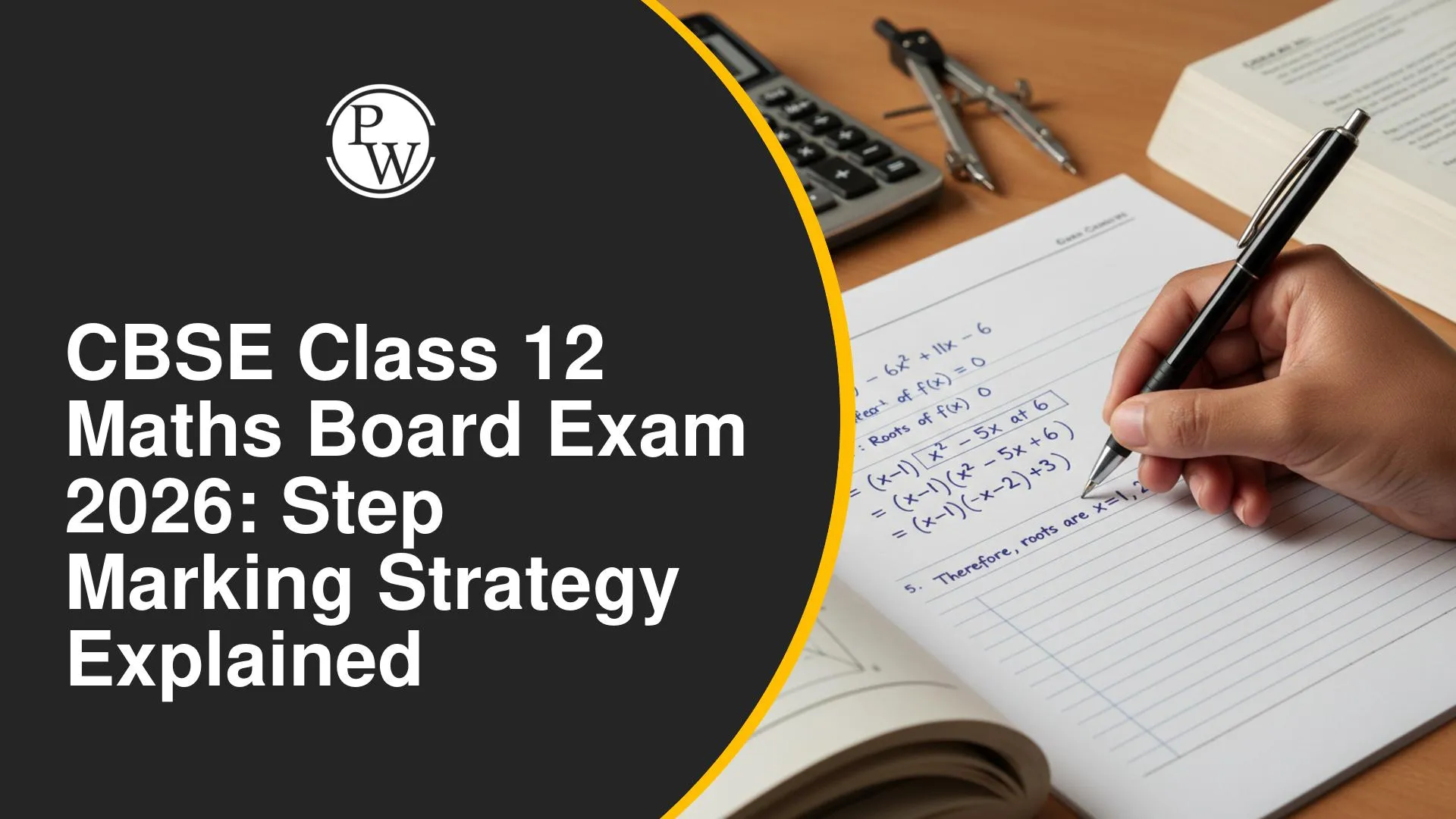
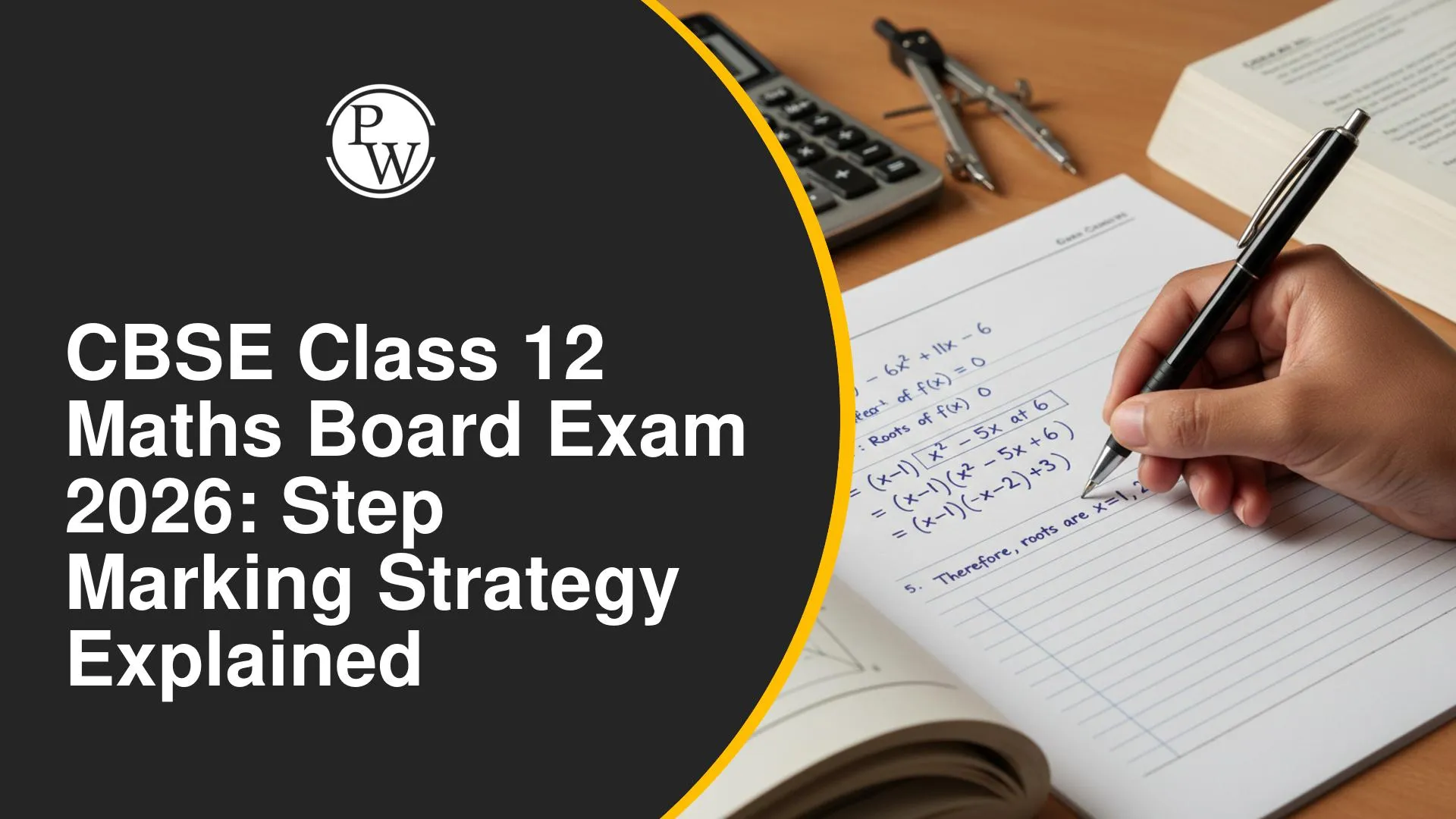
CBSE Class 12 Maths Board Exam 2026 will be conducted on 9 March 2026 by the Central Board of Secondary Education. With the exam date approaching, students must now focus not just on completing the syllabus but also on understanding the step marking strategy used in the CBSE Class 12 Maths Board Exam 2026.
If you want to score 90+ in the CBSE Class 12 Maths Board Exam 2026, mastering the official step-wise marking scheme is essential.
CBSE Class 12 Maths Board Exam 2026 – Exam Date & Pattern
The CBSE Class 12 Maths Board Exam 2026 will be conducted on 9 March 2026 as per the schedule released by the Central Board of Secondary Education. Students must understand the exam structure and marking pattern to perform confidently on the final day.
|
CBSE Class 12 Maths Board Exam 2026 – Exam Date & Pattern |
|
|
Particulars |
Details |
|
Exam Date |
9 March 2026 |
|
Exam Time |
10:30 AM – 1:30 PM |
|
Duration |
3 Hours |
|
Total Theory Marks |
80 Marks |
|
Internal Assessment |
20 Marks |
|
Question Types |
MCQs, Short Answer, Long Answer (4–6 marks), Case Study-Based |
The CBSE Class 12 Maths Board Exam 2026 includes MCQs, short-answer questions, long-answer questions (4–6 marks), and case study-based questions. Long-answer questions are especially important because step marking plays a crucial role, allowing students to score partial marks even if the final answer is incorrect.
Sample Paper Format of CBSE Class 12 Maths Board Exam 2026

What Is Step Marking Scheme in CBSE Class 12 Maths Board Exam 2026?
In the CBSE Class 12 Maths Board Exam 2026, marks are awarded for each correct step , not just the final answer.
Examiners give marks for:
-
Writing the correct formula
-
Correct substitution
-
Logical step-by-step solution
-
Accurate calculations
-
Final answer presentation
This step-wise marking scheme ensures that even if a student makes a minor arithmetic error, they can still score partial marks in the CBSE Class 12 Maths Board Exam 2026.
Unit-Wise Weightage for CBSE Class 12 Maths Board Exam 2026
Understanding weightage helps in smart preparation before the CBSE Class 12 Maths Board Exam 2026 on 9 March.
|
Unit-Wise Weightage for CBSE Class 12 Maths Board Exam 2026 |
|
|
Unit |
Marks (Approx.) |
|
Relations & Functions |
8 |
|
Calculus |
35 |
|
Algebra |
10 |
|
Vectors & 3D Geometry |
14 |
|
Probability |
13 |
Calculus carries the highest weightage (35 marks) in the CBSE Class 12 Maths Board Exam 2026, so ensure you practice differentiation, integration, and application-based problems thoroughly.
How Step Marking Works in 6-Mark Questions?
In the CBSE Class 12 Maths Board Exam 2026, a typical 6-mark question may be divided as:
-
1 mark – Correct formula
-
1–2 marks – Proper substitution
-
2 marks – Correct method or derivation
-
1 mark – Final accurate answer
Even if your final answer is incorrect but your method is correct, you can still score 4–5 marks in the CBSE Class 12 Maths Board Exam 2026.
Last-Minute Strategy Before 9 March 2026
With the CBSE Class 12 Maths Board Exam 2026 scheduled for 9 March, follow these smart strategies:
-
Revise All Formulas Daily: Keep a formula notebook.
-
Practice Previous Year Questions: Focus on step presentation.
-
Attempt Full-Length Mock Tests: Simulate 3-hour exam conditions.
-
Improve Presentation: Write clearly and box final answers.
-
Do Not Leave Questions Blank: Even partial steps fetch marks in the CBSE Class 12 Maths Board Exam 2026.
Common Mistakes That Reduce Marks
Avoid these errors in the CBSE Class 12 Maths Board Exam 2026 to prevent unnecessary mark loss.
-
Writing only final answers
-
Skipping intermediate steps
-
Not showing working clearly
-
Calculation errors due to rushing
-
Poor handwriting
Will There Be Grace Marks in CBSE Class 12 Maths Board Exam 2026?
The Central Board of Secondary Education may award grace marks in rare situations such as:
-
Question paper difficulty
-
Printing errors
-
Technical issues
However, students should not rely on grace marks for the CBSE Class 12 Maths Board Exam 2026 on 9 March.
With the CBSE Class 12 Maths Board Exam 2026 on 9 March, this is the time to focus on clarity, accuracy, and presentation. The step marking strategy can help you maximise your score even if you make minor mistakes.
Prepare smartly, write every step clearly, and use the marking scheme to your advantage in the CBSE Class 12 Maths Board Exam 2026.