PW Class 6 Social Science Notes Chapter 11: Grassroots Democracy – Part 2 Local Government in Rural Areas

Understanding how villages are governed helps you see how decisions about everyday needs are made at the local level. In rural India, the Panchayati Raj system gives people an opportunity to participate in local decision-making through different levels of government, from the village to the district.
Physics Wallah Class 6 Social Science Notes bring together the key ideas from Grassroots Democracy – Part 2 Local Government in Rural Areas. You can revise the Panchayati Raj system, the three-tier structure, the Gram Panchayat and Gram Sabha, the roles of the Panchayat Secretary and Patwari, the functions of local bodies, and the Child-Friendly Panchayat Initiative.
What is Panchayati Raj
Panchayati Raj is the system of local self-government in rural India. It allows people at the village level to participate directly in decision-making.
How Does the Three-Tier System of Panchayati Raj Work?
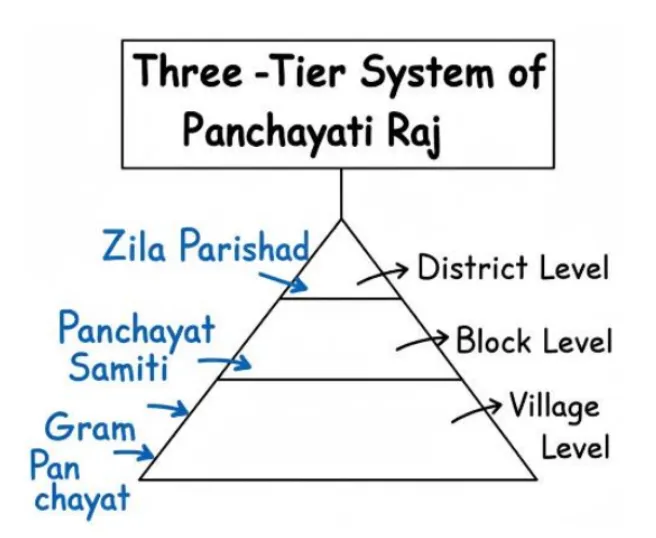
The Panchayati Raj system operates through three levels of local government, with each level handling responsibilities at the village, block, or district level.
-
District Level: Zila Parishad
The Zila Parishad functions at the district level.
-
Block Level: Panchayat Samiti
The Panchayat Samiti works at the block level.
-
Village Level: Gram Panchayat
The Gram Panchayat works at the village level.
What Happens at the Gram Panchayat Level?
The Gram Panchayat is the local government body closest to people living in rural areas.
-
Its members are directly elected by the Gram Sabha.
-
Villages are divided into wards.
-
The Gram Panchayat elects a head known as the Sarpanch or Pradhan.
Panchayat Secretary (Sachiv)
The Panchayat Secretary, also known as the Sachiv, performs administrative work.
The responsibilities include:
-
Calling meetings
-
Maintaining records
Patwari
The Patwari maintains the villagers' land records.
Reservation for Women
In the Panchayat, one-third of the seats are reserved for women.
What Is the Gram Sabha?
The Gram Sabha is also called the “Village Parliament.”
It is a group of adults from a village who are enrolled as voters. The members are 18 years old or above.
The Gram Sabha is the most powerful body of local government.
What Are the Functions of a Gram Panchayat?
The Gram Panchayat looks after several important areas related to village life, including:
-
Cleanliness
-
Sanitation
-
Hospitals
-
Running Anganwadi Centres
-
Village records
-
Maintenance of village roads
-
Supply of drinking water
-
Schools
What Does the Panchayat Samiti Do?
The Panchayat Samiti works at the block level and performs several functions.
-
It works for a group of villages.
-
It prepares development plans.
-
It provides funds to Gram Panchayats.
-
It coordinates between the village and district levels.
What Is the Hierarchy of Panchayati Raj?
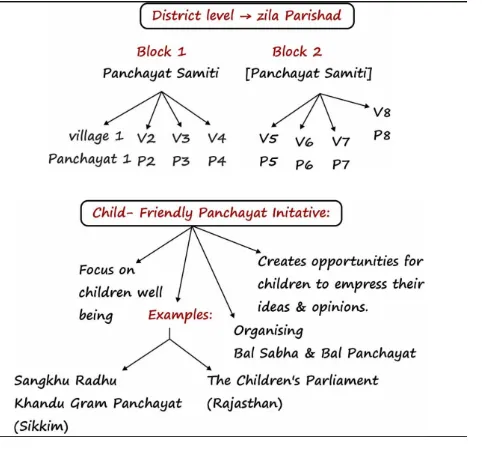
The structure of the Panchayati Raj system can be understood through its three levels.
-
District level → Zila Parishad
-
Block 1 → Panchayat Samiti
-
Village 1 (P1)
-
V2 (P2)
-
V3 (P3)
-
V4 (P4)
-
Block 2 → Panchayat Samiti
-
V5 (P5)
-
V6 (P6)
-
V7 (P7)
-
V8 (P8)
This hierarchy connects village-level bodies with the block and district levels.
What Is the Child-Friendly Panchayat Initiative?
The Child-Friendly Panchayat Initiative focuses on the well-being of children.
It creates opportunities for children to express their ideas and opinions. The initiative includes activities such as organising:
-
Bal Sabha
-
Bal Panchayat
Examples
-
Sangkhu Radhu Khandu Gram Panchayat, Sikkim
-
The Children's Parliament, Rajasthan
 CBSE Class 6 Social Science Chapter 11 Notes PDF
Download the Grassroots Democracy – Part 2 Local Government in Rural Areas notes PDF to revise the Panchayati Raj system, village-level bodies, their functions, and the Child-Friendly Panchayat Initiative.
CBSE Class 6 Social Science Notes Chapter 11 PDF
Download and Read without Internet
What Do Physics Wallah Notes Cover in Grassroots Democracy – Part 2?
Physics Wallah notes bring the chapter's key concepts together for focused revision.
-
Panchayati Raj: Revisit the meaning of rural local self-government and direct participation in decision-making.
-
Three-tier system: Remember the roles of the Zila Parishad, Panchayat Samiti, and Gram Panchayat.
-
Gram Panchayat: Revise wards, elections, the Sarpanch or Pradhan, and the responsibilities of the Panchayat Secretary and Patwari.
-
Gram Sabha: Recall who forms the Gram Sabha and why it is known as the “Village Parliament”.
-
Local functions: Review the responsibilities of the Gram Panchayat and Panchayat Samiti.
-
Child-friendly governance: Revisit Bal Sabha, Bal Panchayat, and the examples mentioned in the chapter.
The Panchayati Raj system brings local governance closer to people living in rural areas. Through the Gram Panchayat, Gram Sabha, Panchayat Samiti, and Zila Parishad, different responsibilities are managed across village, block, and district levels. The Child-Friendly Panchayat Initiative further gives children opportunities to share their ideas and opinions.
Related Resources