CBSE Class 7 The Story of Indian Agriculture Notes by PW


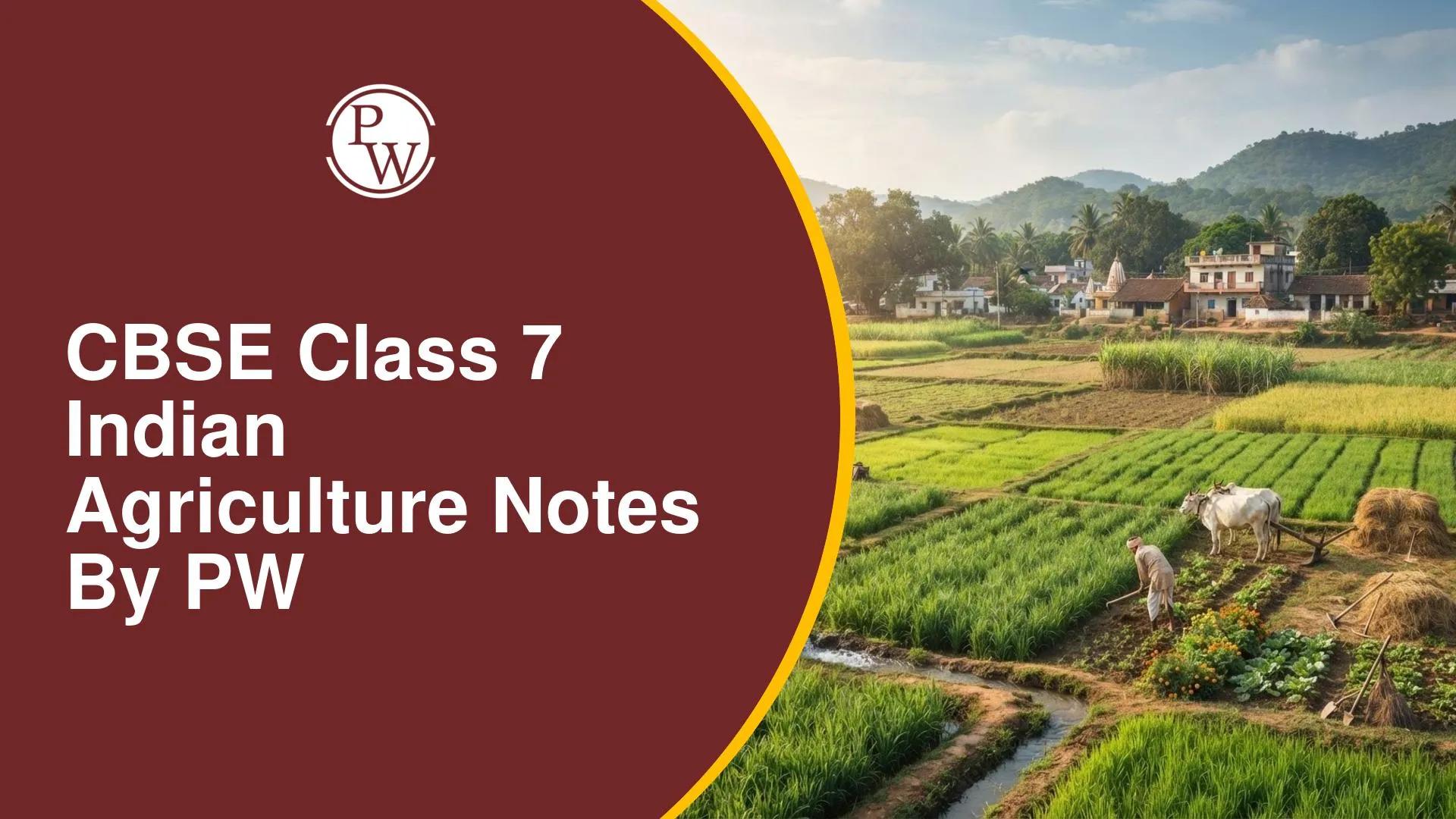
Agriculture plays an important role in India's economy, food production and rural employment. It includes growing crops, preparing soil and rearing animals. Farming practices differ across the country because regions have different climates, rainfall patterns, soil types and weather conditions.
Understanding the story of Indian agriculture involves exploring its history, agricultural seasons and the relationship between soil and crops. PW CBSE Class 7 Online Coaching 2026–27 supports students with concept-based learning, interactive live classes, dedicated faculty, 800+ Daily Practice Problems (DPPs), 150+ free daily quiz questions, regular revision and doubt-solving support.
Meaning and Scope of Agriculture
Agriculture is the practice of cultivating land, growing crops and rearing animals. It involves several activities, including:
-
Preparing the soil for cultivation.
-
Cultivating fields and sowing seeds.
-
Growing and harvesting crops.
-
Rearing animals such as cows and goats.
The word agriculture comes from two Latin words:
-
Agri: Field
-
Culture: Cultivation or growing
Therefore, agriculture refers to the cultivation of fields and the rearing of animals.
Memory Tip: Remember Agri = Field and Culture = Cultivation to understand the meaning of agriculture.
Importance of Agriculture in India
Agriculture contributes to India's economy and provides raw materials for several industries. It supplies food, clothing fibres, rubber and other materials used in everyday life.
Agriculture contributes approximately 18% of India's goods and services, while around 46% of the population is engaged in agricultural activities.
Some everyday products obtained through agriculture include:
-
Cotton: Used to manufacture clothes.
-
Food crops: Provide food grains, fruits and vegetables.
-
Rubber: Obtained from rubber cultivation and used in products such as footwear.
Women's Role in Agriculture
Women make an important contribution to agricultural activities. Although farming is commonly associated with men, women participate in several stages of agricultural work.
More than 75% of agricultural workers are women. Their activities may include preparing food for field workers, carrying it to the fields, working alongside family members and managing household responsibilities after returning home.
Their contribution supports agricultural production and rural livelihoods.
Agricultural Diversity in India
India has different climatic conditions, rainfall patterns and soil types across its regions. As a result, farmers cultivate different crops according to local conditions.
|
Region |
Important Crop |
|
Kashmir |
Saffron |
|
Punjab |
Wheat |
|
Kerala |
Rice |
|
Assam |
Tea |
|
Karnataka |
Coffee |
For example, Kerala receives substantial rainfall and has conditions suitable for rice cultivation, which requires considerable water. In contrast, areas of Rajasthan receive less rainfall, making crops such as millet and sorghum more suitable.
|
Regional Condition |
Suitable Crop Examples |
|
High rainfall |
Rice |
|
Low rainfall |
Millet and sorghum |
|
Different climatic regions |
Wheat, saffron, tea, coffee and rice |
This regional diversity shows how climate, rainfall and soil influence agricultural practices in India.
Find it difficult to answer textbook questions? Use PW Class 7 NCERT Solutions for revision.
Agriculture in Ancient India
Agriculture has existed in India since ancient times. Evidence of farming has been found from the Indus Valley Civilization and earlier periods, while references to agricultural activities also appear in the Vedas.
Archaeological findings provide information about the crops cultivated by early communities:
-
Rice was cultivated near the Ganga region around 7000 BCE.
-
Barley and millets were found at Mehrgarh.
-
The Harappan Civilization cultivated barley, wheat, rice, millets, vegetables, oilseeds, pulses and fibre-producing crops.
-
Fruits such as grapes, dates, jackfruit, mango, mulberry and black plum were also cultivated.
These findings show that ancient communities practised different forms of cultivation and developed agricultural knowledge over time.
Intercropping in Ancient India
Intercropping is the practice of growing more than one crop in the same field. Archaeological evidence suggests that this practice existed at Kalibangan around 2800 BCE.
|
Concept |
Explanation |
|
Intercropping |
Growing multiple crops in the same field |
|
Historical evidence |
Practised at Kalibangan around 2800 BCE |
|
Common misconception |
Intercropping is sometimes considered only a modern farming practice |
Memory Tip: Connect Kalibangan with Intercropping to remember the historical evidence.
Animal Rearing in Ancient India
Animal rearing was an important part of agriculture during the Indus Valley or Sindhu-Saraswati Civilization, approximately 3000–500 BCE.
Animals were kept for milk, labour, manure and other agricultural purposes. Cows, goats, dogs and pigs were among the animals reared during this period.
Agriculture in Ancient Texts
Ancient Indian texts contain references to farming, soil preparation, plant cultivation and other agricultural practices.
|
Ancient Text |
Associated Agricultural Knowledge |
|
Kautilya's Arthashastra |
Seed selection, sowing, soil preparation, farming practices and farmers' income |
|
Surapala's Vrikshayurveda |
Information related to agriculture and plants |
|
Varahamihira's Brihat Samhita |
Grafting method |
Grafting Method
Grafting is a method of joining parts of two different plants to develop a plant with desirable characteristics. It combines useful features from selected plants.
The basic process involves:
-
Selecting two plants with different desirable characteristics.
-
Cutting suitable portions from both plants.
-
Joining the selected portions.
-
Allowing the joined parts to grow as a plant with combined characteristics.
For example, one plant may have sweet fruits, while another may have resistance to certain pests. Grafting can be used to combine desirable features.
|
Plant One |
Plant Two |
Intended Result |
|
One desirable characteristic |
Another desirable characteristic |
A plant combining both features |
Memory Tip: Remember Varahamihira → Brihat Samhita → Grafting. Also connect Kautilya → Arthashastra → Agriculture and Soil Preparation.
Historical Names of Agricultural Seasons
The three main agricultural seasons in India have historical names
|
Present Name |
Historical Name |
|
Kharif |
Kedara |
|
Rabi |
Khemana |
|
Zaid |
Grishmika |
These names help you connect present-day agricultural seasons with their historical references.
Want help with SST and other school subjects? Check out PW Class 7 Batches.
Climate, Seasons and Crops
India has several climatic regions. These include the Alpine climate of the Himalayas, temperate conditions in lower Himalayan areas, subtropical conditions in the Northern Plains and arid conditions in the Thar Desert.
Agricultural activities vary according to the climate, soil, rainfall and weather of each region. The Chinese traveller Hiuen Tsang also described variations in Indian agriculture based on climatic and soil conditions.
Agro-Climatic Zones of India
India is divided into 15 agro-climatic zones. Each zone has broadly similar climatic and soil conditions, which influence the crops that can be cultivated there.
Different zones support crops such as rice, wheat and tea, depending on their natural conditions.
This classification helps the government:
-
Plan agricultural development according to regional requirements.
-
Arrange water supply based on crop needs.
-
Support agricultural research suited to different regions.
Looking for more than chapter notes? Check PW Class 7 chapter-wise notes
Agricultural Seasons in India
India has three main agricultural seasons: Kharif, Rabi and Zaid. Each season has a different sowing and harvesting period and supports crops suited to its weather conditions.
Memory Tip: Remember the order as KRZ — Kharif, Rabi and Zaid.
Kharif Crops
Kharif crops are also known as monsoon crops because they are cultivated during the rainy season.
-
Sowing period: June–July
-
Harvesting period: September–October
-
Examples: Rice, maize, sorghum, millet, groundnut, sugarcane and cotton
These crops are generally grown during the southwest monsoon and require suitable rainfall. Rice is a common example because it needs considerable water for cultivation.
Memory Tip: Associate abundant water and monsoon conditions with rice cultivation.
Rabi Crops
Rabi crops are also called winter crops. They are sown during the cooler months and harvested in spring.
-
Sowing period: October–November
-
Harvesting period: March–April
-
Examples: Wheat, barley, peas, mustard and gram
These crops generally require cool weather during their growing period.
Zaid Crops
Zaid crops are cultivated between the Kharif and Rabi seasons. They allow farmers to use agricultural fields during the period between the two main cropping seasons.
-
Sowing period: March–April
-
Harvesting period: June–July
-
Examples: Watermelon, cucumber, muskmelon, fruits and vegetables
Soil: The Foundation of Cultivation
Soil is the upper layer of the Earth's crust in which plants and crops grow. It contains mineral particles and organic matter and may have different colours, including black, red and yellow.
For example, black soil is found in parts of Maharashtra and Madhya Pradesh, while red soil occurs in regions such as Rajasthan.
Soil fertility influences agricultural productivity. Fertile soil generally supports better crop growth, while infertile soil may limit plant development.
Formation of Soil
Soil forms through a natural process called weathering. During this process, rocks break down into smaller particles over time.
The process can be understood through these stages:
-
A parent rock is exposed to natural conditions such as rainfall and changes in temperature.
-
The rock gradually breaks into smaller pieces.
-
Continued weathering produces finer particles.
-
These particles, along with organic matter, contribute to soil formation.
Weathering means the breaking down and disintegration of rocks.
Memory Tip: Remember the sequence: Parent Rock → Weathering → Fine Particles → Soil.
Humus
Humus is dark organic matter formed through the decomposition of dead plants and animals. It is commonly found in the upper layer of soil.
Fallen leaves and other organic materials decompose over time and contribute to humus formation. Humus adds nutrients to the soil and improves its fertility, supporting plant growth.
Soil-Crop Linkages
Different soil types have different characteristics, fertility levels and water-retention properties. These differences influence which crops can grow in a particular region.
Alluvial Soil
Alluvial soil forms when rivers carry materials such as clay, sand, gravel and minerals from mountains and deposit them in nearby areas.
It is highly fertile and supports several crops, including rice, wheat, maize, sugarcane and jute. It is commonly found in Uttar Pradesh and the Northern Plains.
Black Soil
Black soil develops through the weathering of volcanic rocks. It is associated with regions where ancient lava flows cooled and gradually broke down into soil.
It is found in Maharashtra, Gujarat, Madhya Pradesh and parts of the Deccan region. Common crops grown in black soil include cotton, wheat, jowar, sugarcane and tobacco.
Memory Tip: Connect black lava with black soil to remember its formation.
Red Soil
Red soil develops through the weathering of ancient rocks. Its red colour is mainly associated with the presence of iron.
It is found in regions such as Odisha, Tamil Nadu and Karnataka. Its fertility is generally considered average. Rice, ragi, groundnut and vegetables are among the crops grown in this soil.
Memory Tip: Remember Old Rocks → Red Soil and connect its colour with iron.
Laterite Soil
Laterite soil forms in regions where rocks undergo weathering under heavy rainfall. It may appear red because it contains iron and aluminium oxides.
This soil generally has low fertility. Tea, coffee, rubber and cashew are among the crops associated with laterite soil.
Desert Soil
Desert soil is sandy and is commonly found in Rajasthan. It generally has low fertility and limited moisture-retention capacity.
Bajra and groundnut are among the crops grown in areas with desert soil.
Mountain Soil
Mountain soil is found in the Himalayas and other mountainous regions. It is generally thin and has limited depth.
Tea is among the crops cultivated in suitable mountain soil conditions.
Major Soil Types and Suitable Crops
|
Soil Type |
Formation or Characteristic |
Fertility |
Crop Examples |
|
Alluvial |
Formed from river deposits |
Highest among the types discussed |
Rice, wheat, maize, sugarcane, jute |
|
Black |
Develops through weathering of volcanic rocks |
Fertile |
Cotton, wheat, jowar, sugarcane |
|
Red |
Develops from ancient rocks; contains iron |
Average |
Rice, ragi, groundnut |
|
Laterite |
Forms through rock weathering under heavy rainfall |
Low |
Tea, coffee, rubber, cashew |
|
Desert |
Sandy soil |
Very low |
Bajra, groundnut |
|
Mountain |
Thin soil found in mountainous regions |
Not specified |
Tea |
Understanding the relationship between soil characteristics and crops helps explain why agricultural patterns differ across Indian regions.
Indian agriculture reflects the country's varied climate, soil conditions and farming traditions. From ancient practices such as intercropping and grafting to the three main agricultural seasons—Kharif, Rabi and Zaid—farming has developed through generations of knowledge and experience. Different soil types, including alluvial, black, red, laterite, desert and mountain soil, also influence the crops cultivated across regions.
You can revise these concepts through examples, tables and regular practice. PW CBSE Class 7 Online Coaching 2026–27 supports learning with interactive live classes, dedicated faculty, 800+ DPPs, 150+ free daily quiz questions, performance evaluation, revision and doubt-solving support.
FAQs
1. What is agriculture?
2. What are the three main agricultural seasons in India?
3. What are Kharif crops?
4. What are Rabi crops?