CBSE Class 8 Maths Notes Chapter 5 – Number Play
 Neha Tanna27 Aug, 2024
Number Play is one of the most interesting topics in CBSE Class 8 Mathematics. In CBSE Class 8 Maths Ganita Prakash Chapter 5 Notes, students explore how numbers behave through divisibility rules, digit-reversal tricks, letter-based puzzles, magic squares, and special number patterns such as palindromes, Armstrong numbers, and the Fibonacci sequence.
These Number Play Class 8 Notes simplify the chapter into short and easy-to-understand points along with solved examples. Students can use these notes for quick revision before class tests, unit tests, and annual examinations.
Whether you are revising divisibility rules or trying to recall a number trick, this Class 8 Number Play Chapter 5 Notes guide provides all the key information in a concise format.
CBSE Class 8 Maths Chapter 5 Notes Overview
Below is a quick overview of CBSE Class 8 Maths Chapter 5 Number Play, including key details such as the chapter name, subject, board, and note format to help students understand the scope of these revision notes.
1. Introduction to Number Play
2. Numbers Tell us Things
Numbers aren't just for counting; they can represent relationships and
follow specific rules.
• Even numbers: Can be grouped in pairs with no leftovers.
Example:
2, 4, 6, 8, 10...

• Odd numbers: Always leave one unpaired object.
Example: 1, 3, 5,
7, 9...

4. Reversing Digits and Number Tricks
If a 2-digit number is xy (x = tens digit, y = units digit):
• Original number = 10x + y
• Reversed number = 10y + x
Example:
Original = 54 → 10 × 5 + 4 = 54,
Reversed = 45 → 10 × 4 + 5 = 45
Tip: Difference between a 2-digit number and its reverse is always
divisible by 9.
5. Letters for Digits – Alphametics
An alphametic or cryptarithm is a puzzle where letters replace digits in
an arithmetic problem.
Rules:
• Each letter represents one unique digit.
• Same letter → same digit throughout the problem.
• Different letters → different digits.
• The idea is to figure out which digit (from 0 to 9) each letter stands for
so that the math equation makes sense.
That means:
• Armstrong Number: Sum of cubes of digits equals number
(153 → 13+53+33=153)
• Perfect Number: Sum of divisors equals number
(28 → 1+2+4+7+14=28)
Pattern Observation: Square numbers ending in certain digits have
predictable endings.
CBSE Class 8 Maths Chapter 5 Notes PDF Download Link
Students can download the Complete CBSE Class 8 Maths Chapter 5 Number Play Notes PDF to revise all the important concepts and patterns covered in the chapter in a clear and easy-to-understand format.
|
CBSE Class 8 Maths Chapter 5 Notes |
|
|
Number Play Notes PDF |
The PDF summarises key ideas, mathematical tricks, number patterns, divisibility concepts, and problem-solving techniques discussed in the Ganita Prakash textbook.
What's Covered in CBSE Class 8 Maths Notes Chapter 5
This chapter explains how to play with numbers using rules of divisibility, reversing digits, letter puzzles (alphametics), and other number tricks, with a focus on recognising patterns and properties of numbers to solve problems quickly.
Introduction to Number Play: An overview of how the chapter uses divisibility rules, digit reversal, alphametics, and other tricks to help students spot number patterns faster.
Numbers Tell Us Things: Numbers aren't just for counting — they represent relationships and follow specific rules.
-
Even numbers can be grouped in pairs with no leftovers, e.g., 2, 4, 6, 8, 10.
-
Odd numbers always leave one object unpaired, e.g., 1, 3, 5, 7, 9.
Divisibility Rules: A set of simple rules to check whether a number is divisible by 2 to 11 without doing long division.
|
No. |
Divisibility Rule |
Example |
|
1 |
Last digit is 0, 2, 4, 6, or 8 |
124 - ends in 4 - divisible by 2 |
|
2 |
The sum of the digits is divisible by 3 |
153 - 1+5+3 = 9 - divisible by 3 |
|
3 |
Last two digits form a number divisible by 4 |
212 - 12 ÷ 4 = 3 - divisible by 4 |
|
4 |
Last digit is 0 or 5 |
235 - ends in 5 - divisible by 5 |
|
5 |
Number is divisible by both 2 and 3 |
120 - even and digit sum = 3 - divisible by 6 |
|
6 |
Last three digits form a number divisible by 8 |
416 - 416 ÷ 8 = 52 - divisible by 8 |
|
7 |
Sum of digits is divisible by 9 |
729 - 7+2+9 = 18 - divisible by 9 |
|
8 |
Last digit is 0 |
150 - ends in 0 - divisible by 10 |
|
9 |
Difference of the sum of alternate digits is divisible by 11 |
121 - (1+1) − 2 = 0 - divisible by 11 |
Reversing Digits and Number Tricks: For a 2-digit number xy (x = tens digit, y = units digit):
-
Original number = 10x + y
-
Reversed number = 10y + x
Example: Original = 54 - 10×5 + 4 = 54, Reversed = 45 - 10×4 + 5 = 45. Tip: The difference between a 2-digit number and its reverse is always divisible by 9.
Letters for Digits – Alphametics: An alphametic (or cryptarithm) is a puzzle where letters replace digits in an arithmetic problem.
-
Each letter represents one unique digit.
-
The same letter always represents the same digit throughout the problem.
-
Different letters represent different digits.
-
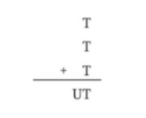
The goal is to find which digit (0–9) each letter represents so that the equation works out correctly. For example, adding T + T + T is the same as 3 × T, and the result is written as the 2-digit number UT, where U is the tens digit and T is the ones digit again.
Secret Number Games: Number tricks that always lead to a fixed result, proved using algebra. Example trick: Multiply a number by 2, add 8, divide by 2, then subtract the original number — the result is always 4. Proof: Let the number be x - (2x + 8)/2 − x = 4.
Magic Squares: A magic square is an arrangement of numbers in a square grid so that the sums of each row, column, and diagonal are equal. Magic Constant Formula for an n × n square: M = n(n² + 1)/2. Example: A 3×3 magic square with magic constant 15 —
|
8 |
1 |
6 |
|
3 |
5 |
7 |
|
4 |
9 |
2 |
Number Puzzles and Patterns: Special categories of numbers with unique properties:
-
Palindrome: A number that reads the same backward as forward, e.g., 121.
-
Armstrong Number: A number equal to the sum of the cubes of its digits, e.g., 153 - 1³ + 5³ + 3³ = 153.
-
Perfect Number: A number equal to the sum of its divisors (excluding itself), e.g., 28 - 1+2+4+7+14 = 28.
-
Pattern Observation: Square numbers ending in certain digits follow predictable ending patterns.
Nature's Favorite Sequence – The Virahāṅka-Fibonacci Numbers: A special pattern: 1, 2, 3, 5, 8, 13, 21, 34, … where each number (after the first two) is the sum of the previous two numbers (1+2=3, 2+3=5, 3+5=8, 5+8=13, and so on). This is also called the Fibonacci sequence and appears throughout nature, plants, music, and art.
Important Formulae Recap:
-
Sum of first n natural numbers = n(n+1)/2
-
Sum of first n odd numbers = n²
-
Sum of first n even numbers = n(n+1)
Benefits of Using CBSE Class 8 Maths Notes Chapter 5
These Number Play notes are designed to make revision fast and effective by summarizing all key concepts in a simple format. They help students easily understand number patterns, divisibility rules, and logical tricks from Ganita Prakash, making exam preparation smoother and more organized.
-
Helps in quick revision before exams and tests
-
Covers important divisibility rules and number-based tricks at one place
-
Presents concepts in a clear and easy point-wise format
-
Improves understanding of patterns like alphametics, magic squares, and number sequences
-
Useful for school exams, class tests, and annual examinations
-
Simplifies all key ideas from Ganita Prakash Chapter 5 for better retention
CBSE Class 8 Maths Notes Chapter 5 FAQs
What is Number Play in CBSE Class 8 Maths?
What are the important topics in CBSE Class 8 Maths Ganita Prakash Chapter 5 Notes?
What is the divisibility rule for 9?
What is an Armstrong number?


Have questions about your prep?
Our experts can answer all your questions