Human Eye and the Colourful World Mind Map for Class 10 Science Board Exam 2026
Human Eye and the Colourful World mind map explains how the human eye uses a convex lens to form images on the retina, the role of power of accommodation, correction of vision defects using lenses, and key light phenomena such as dispersion, atmospheric refraction, and scattering, which explain effects like twinkling of stars and the blue colour of the sky.

Human Eye and the Colourful World: With the Class 10 Science board exam 2026 approaching on 25th Feb 2026, students are now in the most important phase of revision. Human Eye and the Colourful World is a high-weightage, concept-based chapter, frequently asked through diagrams, ray diagrams, reasoning questions, numericals, and natural phenomenon explanations.
To support fast and effective last-minute revision. This Human Eye and the Colourful World in 34 Minutes Mind Map Series for Class 10th explanation connects concepts like the structure of the eye, accommodation, defects of vision, dispersion, scattering, and atmospheric refraction in a clear and organised manner, helping students revise confidently.
Human Eye and the Colourful World Mind Map Series for Class 10
Many students find this chapter, Human Eye and the Colourful World, difficult because it combines biology (eye) with physics (light). A structured mind map approach helps simplify definitions, ray diagrams, and cause–and–effect relationships required in the Science 10th class board exam 2026 answers.
This mind map video simplifies the Human Eye and the Colourful World chapter through a connected approach, ensuring a clear understanding and smooth exam revision.
Human Eye and the Colourful World Introduction
The human eye is a remarkably sensitive sense organ that enables us to perceive the world and its vibrant colours. Understanding its intricate structure and how each component functions is crucial to appreciating the complexity of vision. This involves the coordinated effort of various parts to capture and process light, ultimately forming a clear image that is then interpreted by the brain.
The Human Eye
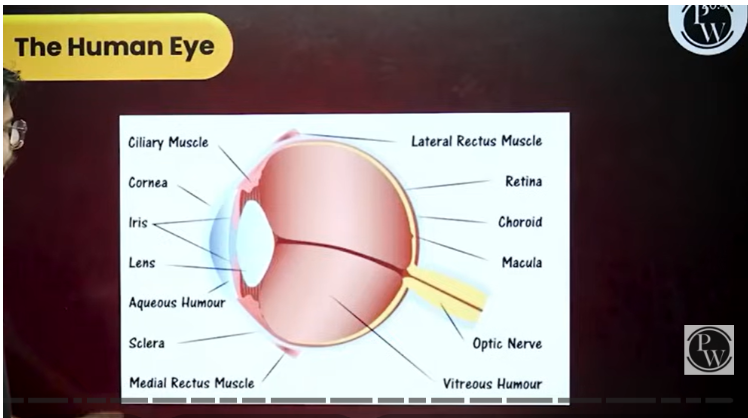
The human eye is a valuable and sensitive sense organ that enables us to see the world and its colours. A cross-sectional view reveals its key components and their functions.
Structure and Function of the Eye's Components
-
Cornea: The transparent, spherical outer membrane at the front of the eye. It protects the eye and is responsible for most of the refraction of light entering the eye, thereby assisting the lens.
-
Aqueous Humour: A water-like fluid located between the cornea and the lens. It maintains the pressure balance between the inside and outside of the eye. This is an internal fluid and should not be confused with tears.
-
Iris & Pupil:
-
Iris: The coloured diaphragm located between the cornea and the lens. The colour of the eye is determined by the colour of the iris. Its primary function is to control the size of the pupil.
-
Pupil: The hole in the centre of the iris through which light enters the eye. The iris adjusts the pupil's size to regulate the amount of light entering—dilating (widening) in low light to let more light in and constricting in bright light to protect the eye.
-
Eye Lens: A convex lens whose function is to focus light to form a real, inverted image on the retina.
-
Ciliary Muscles: These muscles hold the eye lens in position. They contract and relax to change the thickness and curvature of the lens, which in turn adjusts its focal length and power.
-
Vitreous Humour: A jelly-like substance that fills the large space behind the eye lens. It helps to maintain the spherical shape of the eyeball.
-
Retina: The light-sensitive screen at the back of the eye where the image is formed.
-
Optic Nerve: A bundle of nerves that transmits the visual information from the retina to the brain in the form of electrical signals.
Power of Accommodation
The Power of Accommodation is the ability of the eye lens to adjust its focal length to see both distant and near objects clearly. This adjustment is performed by the ciliary muscles, which change the lens's shape. The relationship between power (P) and focal length (f) is inverse (P ∝ 1/f).
Exam Tip: Viewing distant objects causes less strain than viewing near objects.
Comparative Structure: Muscle State and Vision
|
Vision Focus |
Ciliary Muscles State |
Lens Shape |
Focal Length |
Lens Power
|
|---|---|---|---|---|
|
Distant Objects |
Relaxed |
Thin |
Increases (Long) |
Decreases (Low) |
|
Near Objects |
Contracted |
Thick |
Decreases (Short) |
Increases (High) |
-
Viewing distant objects is less strenuous on the eye muscles.
-
Viewing near objects requires more tension in the eye muscles.
Far Point and Near Point
-
Far Point: The farthest point up to which the eye can see objects clearly. For a normal, healthy eye, the far point is at infinity.
-
Near Point: The closest point at which the eye can see objects clearly without strain. For a normal, healthy eye, the near point is about 25 cm from the eye. (Memory Tip: The near point is also known as L.D.D.V. - Least Distance of Distinct Vision).
2 Min Quick Recap
This recap helps students quickly revise the structure and working of the human eye, focusing on key facts frequently asked in Class 10 Science board exams.
-
Eye lens is convex; image formed on retina is real and inverted
-
Ciliary muscles adjust lens for near and distant vision (power of accommodation)
-
Near point = 25 cm, far point = infinity
Defects of Vision and Their Correction
Defects of Vision and Their Correction explains common eye problems like myopia, hypermetropia, presbyopia, cataract, and astigmatism, along with the methods used to correct them.
1. Myopia (Near-sightedness or Short-sightedness)
-
Condition: A person can see nearby objects clearly but finds it difficult to see distant objects, which appear blurry.
-
Image Formation: The image is formed in front of the retina.
-
Causes:
-
Excessive curvature of the eye lens (lens is too thick/powerful).
-
Elongation of the eyeball.
-
Correction: A Concave Lens of appropriate power is used to diverge the light rays before they reach the eye lens, allowing the image to form correctly on the retina.
2. Hypermetropia (Far-sightedness or Long-sightedness)
-
Condition: A person can see distant objects clearly but finds it difficult to see nearby objects, which appear blurry.
-
Image Formation: The image is formed behind the retina.
-
Causes:
-
Decrease in the power of the eye lens (focal length is too long).
-
Shortening of the eyeball.
-
Correction: A Convex Lens of appropriate power is used. This external lens provides additional converging power to assist the eye's weakened lens, helping to form the image on the retina.
3. Presbyopia
-
Condition: An age-related defect where the eye's power of accommodation decreases. It typically manifests as hypermetropia (difficulty with near vision) but can sometimes involve both near and distant vision problems.
-
Cause: Gradual weakening of the ciliary muscles and diminishing flexibility of the eye lens due to aging.
-
Correction: Bifocal lenses are often used. These lenses have two parts: the upper portion is a concave lens (for distant vision) and the lower portion is a convex lens (for near vision).
4. Cataract
-
Condition: The natural lens of the eye becomes progressively milky and cloudy, leading to blurred or lost vision.
-
Cause: The formation of a protein membrane over the lens, often associated with old age.
-
Correction: The cloudy lens is surgically removed and replaced with an artificial lens.
5. Astigmatism
-
Condition: A person cannot simultaneously focus on both horizontal and vertical lines, resulting in distorted or blurred vision. This can cause difficulty judging depth.
-
Cause: An irregular, non-spherical shape of the cornea or the eye lens.
-
Correction: Cylindrical lenses are used to correct the irregular curvature.
2-Minute Quick Recap
This recap helps students quickly remember key facts about the human eye, common vision defects, corrective lenses, and image formation for fast and accurate exam revision.
-
Eye Lens: Convex
-
Near Point: 25 cm
-
Myopia: Concave lens
-
Hypermetropia: Convex lens
-
Presbyopia: Bifocal lens
-
Image on Retina: Real and inverted
The Prism
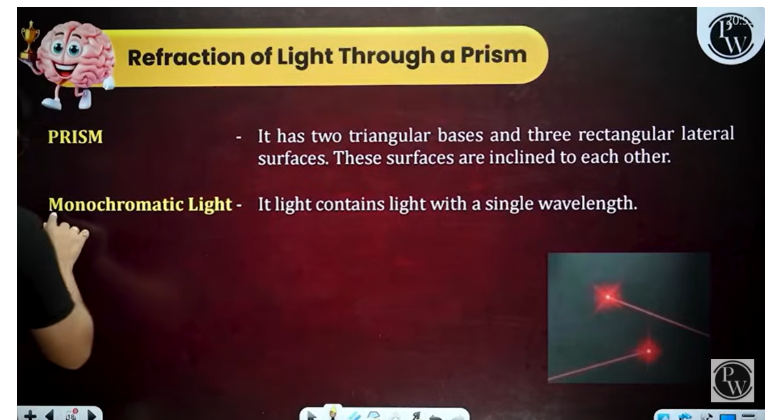
A triangular prism has two triangular bases and three rectangular lateral surfaces. When monochromatic light (light of a single colour/wavelength) passes through it, it undergoes refraction.
-
Path of Light: The incident ray bends towards the normal upon entering the denser prism, becoming the refracted ray. Upon exiting into the rarer medium, it bends away from the normal, becoming the emergent ray.
-
Key Angles:
-
Angle of Incidence (i)
-
Angle of Refraction (r)
-
Angle of Emergence (e)
-
Angle of the Prism (A): The angle between the two refracting surfaces.
-
Angle of Deviation (D or δ): This is the angle between the extended incident ray and the emergent ray. It measures how much the light ray has deviated from its original path.
Dispersion of Light
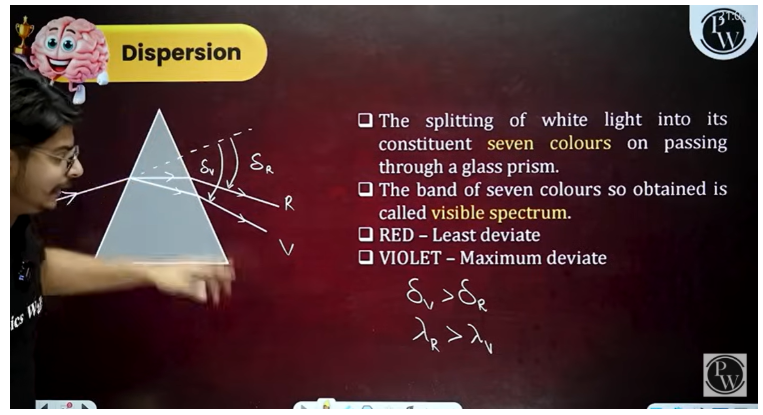
Dispersion is the phenomenon of the splitting of white light into its constituent seven colours (a spectrum) when it passes through a transparent medium like a glass prism. The band of seven colours is known as VIBGYOR (Violet, Indigo, Blue, Green, Yellow, Orange, Red).
-
Cause: Different colours of light have different wavelengths. When they pass through the prism, they bend at slightly different angles.
-
Relationship between Wavelength and Deviation: Deviation is inversely related to wavelength.
-
Red light has the longest wavelength and deviates the least.
-
Violet light has the shortest wavelength and deviates the most.
Memory Tip: VIBGYOR = Violet deviates most, Red deviates least
Recombination of the Spectrum
Sir Isaac Newton demonstrated that if a second, identical prism is placed in an inverted position next to the first one, the spectrum of colours produced by the first prism will recombine to form white light again. This experiment conclusively proved that sunlight (white light) is composed of seven colours.
The Rainbow
A rainbow is a natural spectrum formed in the sky after a rain shower.
-
Conditions: It appears when the sun is shining and there are water droplets suspended in the atmosphere. The rainbow is always formed in the direction opposite to the sun.
-
Mechanism: The tiny water droplets act as small prisms. The formation of a rainbow involves three main optical phenomena:
-
Dispersion of sunlight as it enters the water droplet.
-
Internal Reflection of the dispersed light inside the droplet.
-
Refraction as the light exits the droplet towards the observer's eye.
Atmospheric Refraction
The bending of light as it passes through the Earth's atmosphere is known as atmospheric refraction.
-
Cause: The Earth's atmosphere is not uniform. It consists of layers of air with different optical densities. Light from space (a vacuum, rarer medium) enters the atmosphere (denser medium) and continuously bends.
Applications of Atmospheric Refraction
-
Twinkling of Stars:
-
Starlight bends as it passes through the constantly changing layers of the atmosphere. This causes the apparent position of the star to fluctuate continuously.
-
The amount of starlight reaching the eye also varies. This continuous shifting of the star's apparent position and brightness is perceived as twinkling.
-
The apparent position of a star is always slightly higher in the sky than its actual position.
-
Advanced Sunrise and Delayed Sunset:
-
Due to atmospheric refraction, the sun becomes visible about 2 minutes before it actually rises above the horizon (Advanced Sunrise).
-
Similarly, the sun remains visible for about 2 minutes after it has actually set below the horizon (Delayed Sunset).
-
This phenomenon occurs because light from the sun (when it's below the horizon) is bent by the atmosphere towards the observer, creating an apparent image of the sun above the horizon.
-
This effect adds a total of approximately 4 minutes to the perceived length of the day.
Scattering of Light
Scattering is the process in which light is absorbed and then re-emitted in various directions by particles in the medium it is passing through (e.g., dust, atoms, molecules in the atmosphere).
-
Rayleigh's Law of Scattering: The intensity of scattered light is inversely proportional to the fourth power of its wavelength (I ∝ 1/λ⁴).
-
Key Principle: Shorter wavelengths (like blue and violet) are scattered much more strongly than longer wavelengths (like red and orange).
-
Particle Size Effect:
-
Small particles (like air molecules) are effective at scattering short-wavelength light.
-
Large particles (like water droplets or dust) scatter longer-wavelength light.
Applications of Scattering
-
Tyndall Effect: This is the scattering of a beam of light by a medium containing small suspended particles (a colloid). The scattering makes the path of the light beam visible.
-
Why the Sky Appears Blue:
-
The fine particles in the Earth's atmosphere (molecules of air) are much smaller than the wavelength of visible light.
-
These particles scatter the shorter-wavelength blue light much more effectively than the longer-wavelength red light.
-
This scattered blue light enters our eyes from all directions, making the sky appear blue.
Smart Revision Tips for Class 10 Science Board Exam
This section highlights common errors in the Human Eye and the Colourful World chapter and guides students to avoid them for accurate answers and better scores in the Class 10 Science board exam.
-
Confusing concave and convex lens usage
-
Drawing incorrect ray diagrams
-
Forgetting near point value (25 cm)
-
Writing incomplete explanations for natural phenomena
Common Mistakes Students Make in Heredity and Evolution Chapter
This section focuses on practical revision habits that help students avoid frequent mistakes in the Heredity and Evolution chapter and improve accuracy and performance in the Class 10 Science board exam.
-
Revise diagrams daily
-
Practice ray diagrams neatly
-
Memorise defect–lens–image position table
-
Use short revision cycles (20–30 minutes)
-
Solve previous year questions
Human Eye and the Colourful World Mind Map FAQs
What is the primary function of the eye lens and how do ciliary muscles assist it?
Differentiate between Myopia and Hypermetropia.
Explain the phenomenon of dispersion of light.
Dispersion is the splitting of white light into its seven constituent colours (VIBGYOR) when it passes through a transparent medium like a prism. This occurs because different colours have different wavelengths and thus bend at slightly different angles when refracted.
How does atmospheric refraction cause stars to twinkle but not planets?
Atmospheric refraction causes starlight to bend continuously as it passes through varying atmospheric layers, making the star's apparent position and brightness fluctuate, which we perceive as twinkling. Planets, being much closer, appear as extended sources, so variations in light from different points of the planet average out, preventing noticeable twinkling.