


Metals and non-metals are an important part of the Class 10 Science syllabus. This topic is especially important for students preparing for the Class 10 Science Board Exam scheduled on February 25. It includes concepts that are frequently tested through definitions, reactions, and reasoning-based questions.
Understanding metals and non-metals also helps students relate scientific theory to real-life applications, such as the use of iron in construction, copper in electrical wiring, and non-metals like oxygen and carbon in everyday life and industrial processes. A mind map-based approach further helps in quick revision by presenting key concepts in a clear, connected, and easy-to-recall format, especially useful during exam preparation.
Class 10 Metal and Non-Metals Mind Map Series
Many students find the chapter Metals and Non-Metals lengthy due to multiple reactions, exceptions, and extraction processes. With the Class 10 Science Board Exam 2026 approaching, recalling the reactivity series, reaction conditions, and metallurgy steps becomes challenging during last-minute revision. This mind map series simplifies complex topics into connected visuals, helping students revise faster, retain concepts better, and avoid confusion in the final exam.
Class 10 Metals and Non-Metals PW Free Notes
PW Mind Maps are prepared strictly according to the NCERT syllabus and are highly useful for students preparing for the Class 10 Science Board Exam 2026. The notes include important definitions, reactions, tables, and exceptions commonly asked in exams. They support quick revision and help students recall key concepts effectively during the final days of preparation.
Download Class 10 Metals and Non-Metals Free Notes
Physical Properties of Metals and Non-Metals
Metals and non-metals differ significantly in their physical appearance and behavior. However, it is important to note specific exceptions that often appear in exams.
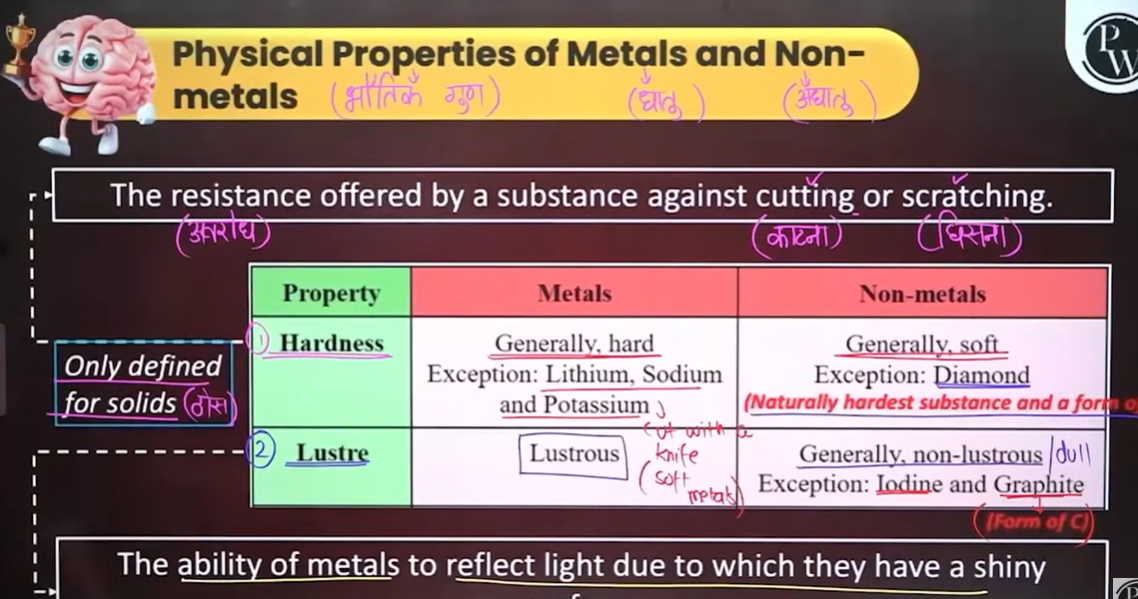
1. Hardness
Hardness is the resistance offered by a substance against being cut or scratched. This applies only to solids.
-
Metals: Metals are generally hard. Exceptions: Lithium (Li), Sodium (Na), and Potassium (K) are soft metals cuttable with a knife. Mercury (Hg) is liquid at room temperature.
-
Non-Metals: Non-metals are generally soft. Exception: Diamond, a form of carbon, is the hardest known substance.
2. Luster
Luster describes the shininess of a surface.
-
Metals: Metals possess metallic luster, reflecting light to appear shiny.
-
Non-Metals: Non-metals are generally non-lustrous and dull. Exceptions: Iodine and Graphite (carbon form) are lustrous.
3. Malleability
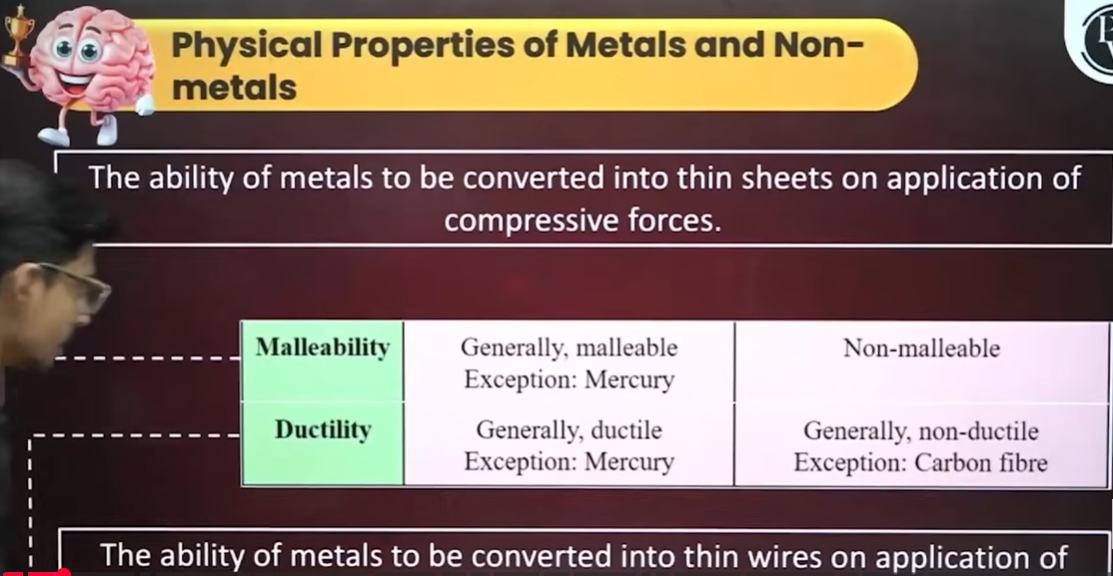
Malleability is the ability of a substance to be hammered into thin sheets.
-
Metals: Metals are generally malleable. Gold is the most malleable.
-
Non-Metals: Non-metals are non-malleable.
4. Ductility
Ductility is the ability of a substance to be drawn into thin wires.
-
Metals: Metals are generally ductile. Platinum is the most ductile, though Gold is often cited per NCERT.
-
Non-Metals: Non-metals are generally non-ductile. Exception: Carbon fibers exhibit ductility.
5. Sonority
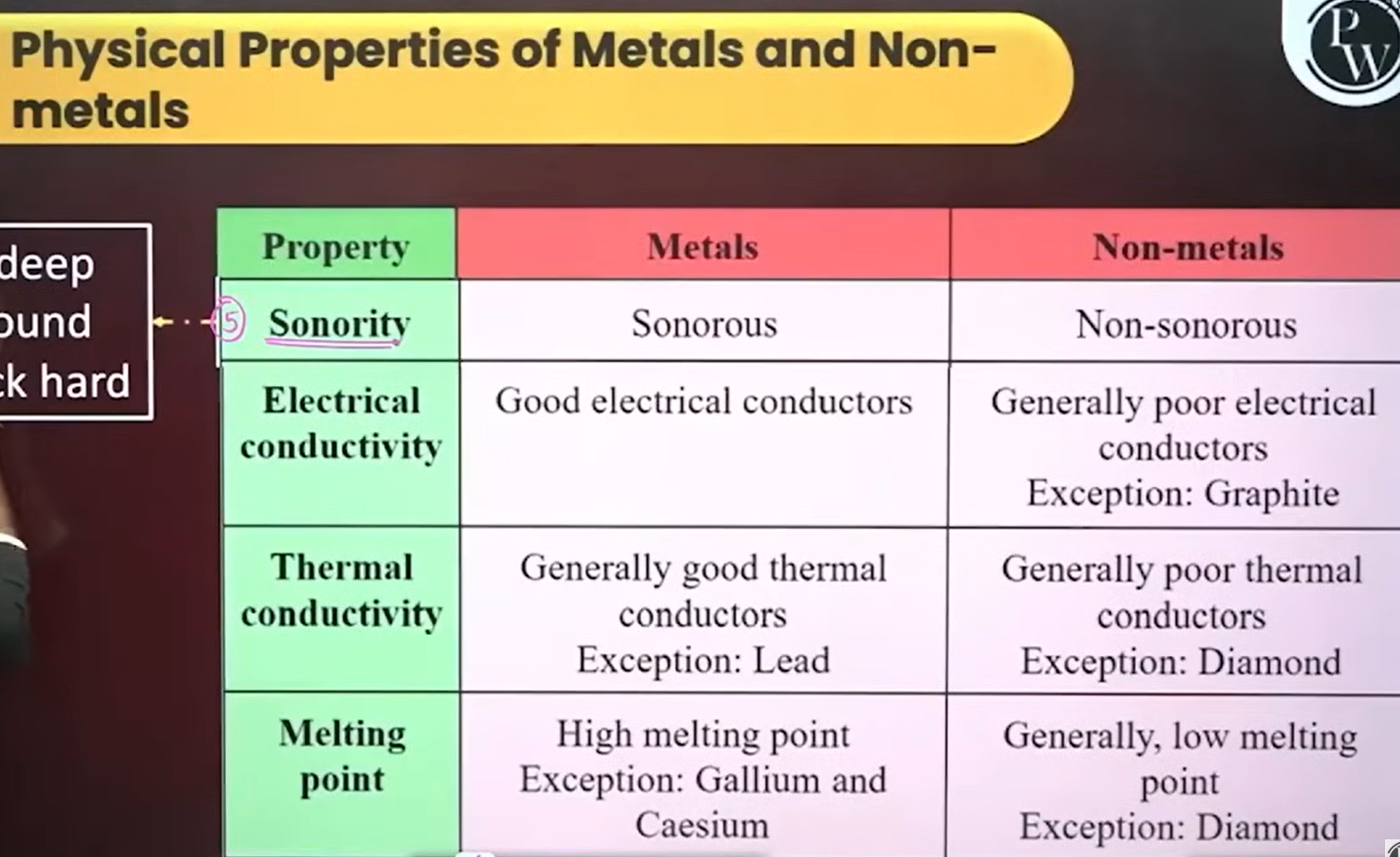
Sonority is the property of producing a deep, ringing sound when struck.
-
Metals: Metals are sonorous.
-
Non-Metals: Non-metals are non-sonorous.
6. Electrical Conductivity
-
Metals: Metals are good electrical conductors.
-
Non-Metals: Non-metals are generally poor electrical conductors. Exception: Graphite is a good conductor.
7. Thermal (Heat) Conductivity
-
Metals: Metals are good conductors of heat. Silver is the best. Exceptions: Lead (Pb) and Mercury (Hg) are poor heat conductors.
- Non-Metals: Non-metals are generally poor heat conductors. Exception: Diamond is the best conductor of heat among all materials.
8. Melting Point
The melting point is the temperature at which a substance changes from solid to liquid.
-
Metals: Metals generally have a high melting point. Exceptions: Gallium (Ga), Cesium (Cs), and Mercury (Hg) have very low melting points. Gallium (29.7°C) and Cesium (28.4°C) are solid at room temperature but melt on the human palm (37°C).
-
Non-Metals: Non-metals generally have a low melting point. Exceptions: Graphite and Diamond have very high melting points.
Summary of Superlative Properties
-
Most Malleable Metal: Gold
-
Most Ductile Metal: Platinum (or Gold per NCERT)
-
Best Conductor of Heat (Overall): Diamond (a non-metal)
-
Best Conductor of Heat (among Metals): Silver
-
Order of Electrical Conductivity: Silver > Copper > Gold > Aluminium.
Chemical Properties of Metals
The reactivity series was built by comparing how different metals react with oxygen, water, and acids.
1. Reaction of Metals with Oxygen
Metal + Oxygen → Metal Oxide
-
Example: 2Cu (shiny brown) + O₂ → 2CuO (black copper oxide)
Nature of Oxides
-
Metal Oxides: Are either Basic or Amphoteric. (Memory Tip: Remember MBA: Metal oxides are Basic or Amphoteric).
-
Basic Oxides: Behave as bases (e.g., Na₂O, K₂O).
-
Amphoteric Oxides: Behave as both acids and bases (e.g., Al₂O₃, ZnO).
-
Al₂O₃ + 6HCl → 2AlCl₃ + 3H₂O
-
Al₂O₃ + 2NaOH → 2NaAlO₂ + H₂O
-
Non-Metal Oxides: Are either Acidic (e.g., CO₂, SO₂) or Neutral (e.g., H₂O, CO).
Observationa
| Metal | Reaction at Room Temperature (25°C) | Reaction on Strong Heating in Air |
| K, Na | React vigorously, form oxides, and catch fire due to their exothermic nature. | Burn vigorously with characteristic flame (Lilac/Pale Purple for K, Golden for Na). |
| Ca, Mg, Al | Form a thin, protective oxide layer. | Burn with a bright white flame. |
| Zn, Fe, Pb | Form a protective oxide layer. | Zn burns with a blue flame. Powdered iron burns vigorously. Pb forms PbO but no flame. |
| Cu | No reaction. | On gentle heating, forms black Copper (II) Oxide (CuO). No flame. |
| Ag, Au, Pt | No reaction. | No reaction. |
Conclusion: Potassium (K) and Sodium (Na) are highly reactive and are stored in kerosene to prevent reaction with air and moisturel Evidence for Reactivity with Oxygen
2. Reaction of Metals with Water
A metal reacting at a lower temperature is more reactive.
-
A. With Cold Water: K, Na, Ca react.
-
Metal + Cold Water → Metal Hydroxide + Hydrogen (H₂) + Heat.
-
Potassium & Sodium: Highly exothermic; heat ignites H₂. Reaction with K is faster and more violent.
-
Calcium: Less violent; H₂ does not catch fire but bubbles stick to Ca, causing it to float.
-
Reactivity Conclusion: K > Na > Ca.
-
B. With Hot Water: Only Magnesium (Mg) reacts (K, Na, Ca also react more vigorously).
-
Mg + 2H₂O (hot) → Mg(OH)₂ + H₂ + Heat. H₂ bubbles stick to Mg, causing it to float.
-
C. With Steam: Al, Zn, Fe react.
-
Metal + H₂O (steam) → Metal Oxide + Hydrogen (H₂). H₂ does not catch fire.
Experimental Setup: Metal heated, steam (from water-soaked glass wool) passed over it. H₂ collected over water (insoluble, lighter than water).
3. Reaction of Metals with Dilute Acids
-
General Reaction: Metal + Dilute Acid → Salt + Hydrogen Gas. Occurs only if the metal is more reactive than hydrogen.
-
Observed Order of Reactivity: Using HCl, the speed of H₂ bubble formation shows: Mg > Al > Zn > Fe > Pb.
-
Metals that DO NOT React: Copper (Cu), Silver (Ag), Gold (Au), Platinum (Pt) are less reactive than hydrogen.
-
Special Case: Nitric Acid (HNO₃): A strong oxidizing agent, it oxidizes produced H₂ to H₂O, getting reduced to nitrogen oxides. Exceptions: Magnesium (Mg) and Manganese (Mn) react with very dilute HNO₃ to produce H₂.
4. Aqua Regia
A Latin term meaning "Royal Water." It is a freshly prepared mixture of concentrated Nitric Acid (HNO₃) and concentrated Hydrochloric Acid (HCl) in a 1:3 volume ratio. This highly corrosive, fuming liquid dissolves noble metals like Gold (Au) and Platinum (Pt).
5. Reaction of Metals with Salt Solutions of Other Metals
A more reactive metal displaces a less reactive metal from its salt solution.
-
Example: Cu + 2AgNO₃ (colorless) → Cu(NO₃)₂ (blue) + 2Ag (silvery-grey).
-
Conclusion: Copper is more reactive than silver and gold (Cu > Ag, Au). Silver is more reactive than gold (Ag > Au) because silver is found in both free and combined states, while gold is almost always found free.
-
Final Reactivity Conclusion: Cu > Ag > Au.
The Reactivity Series of Metals
The reactivity series arranges metals in order of decreasing reactivity. Hydrogen, a non-metal, is included as a reference point because it can lose an electron like a metal. Metals above hydrogen displace it from dilute acids, while those below hydrogen cannot. Reactivity Decreases ⟶
| Metal | Symbol |
|---|---|
| Potassium | K |
| Sodium | Na |
| Calcium | Ca |
| Magnesium | Mg |
| Aluminium | Al |
| Zinc | Zn |
| Iron | Fe |
| Lead | Pb |
| (Hydrogen) | (H) |
| Copper | Cu |
| Mercury | Hg |
| Silver | Ag |
| Gold | Au |
| Platinum | Pt |
-
(Memory Tip: A mnemonic to remember the series: Kudi Naal Car Maango Alto, Zisko Fir Lekar Hum Chale Mathura Saath Ghumne Pratik.)
Ionic Compounds (Electrovalent Compounds)
Ionic compounds form by the transfer of electrons between metals and non-metals.
-
Metals lose electrons to form cations (positively charged ions).
-
Non-metals gain electrons to form anions (negatively charged ions).
The electrostatic force between opposite charges forms the ionic bond.
Example: Formation of Sodium Chloride (NaCl)
-
Sodium (Na) (2, 8, 1) loses one electron to become Na⁺ (11 protons, 10 electrons).
-
Chlorine (Cl) (2, 8, 7) gains one electron to become Cl⁻ (17 protons, 18 electrons).
Na⁺ and Cl⁻ are held by strong electrostatic attraction.
Lewis Electron Dot Structures
Lewis structures use dots or crosses to represent valence electron transfer.
-
1. Formation of NaCl: Na (1 valence electron) transfers its electron to Cl (7 valence electrons). Resulting structure: [Na]⁺[Cl]⁻.
-
2. Formation of Magnesium Chloride (MgCl₂): Mg (2 valence electrons) loses two electrons to become Mg²⁺. Each Cl (7 valence electrons) gains one electron to become Cl⁻. One Mg atom reacts with two Cl atoms. Resulting compound: MgCl₂.
Properties of Ionic Compounds
| Property | Description & Reason |
|---|---|
| Physical Nature | Typically brittle solids. Pressure shifts lattice, causing like charges to align and repel, shattering the crystal. |
| Melting & Boiling Points | Very high. Large energy needed to overcome strong electrostatic attraction between ions. |
| Solubility | Generally soluble in water but insoluble in organic solvents. |
| Electrical Conductivity | - Solid State: Do not conduct electricity as ions are fixed and immobile.- Molten or Aqueous State: Conduct electricity as ions are free to move and act as charge carriers. |
Introduction to Metallurgy
Metallurgy is the science of extracting metals from their natural sources profitably and conveniently.
-
Minerals: Naturally occurring elements or compounds of metals.
-
Ores: Minerals from which metals can be extracted economically and conveniently. (All ores are minerals, but not all minerals are ores).
-
Gangue (or Matrix): Earthy impurities in an ore.
Metallurgy: Common Initial Steps
-
Crushing and Grinding of Ore: Converts large ore chunks into fine powder, increasing surface area.
-
Concentration of Ore (Enrichment): Removes gangue based on physical or chemical property differences between ore and impurities.
Roasting vs. Calcination
These processes convert sulfide and carbonate ores into metal oxides, which are easier to reduce.
| Feature | Roasting | Calcination |
|---|---|---|
| Purpose | Converts sulfide ores into metal oxides. | Converts carbonate ores into metal oxides. |
| Condition | Heating strongly in excess air (oxygen). | Heating strongly in a limited supply or the absence of air. |
| Temperature | Below the metal's melting point. | Below the metal's melting point. |
| General Reaction | Metal Sulfide + O₂ → Metal Oxide + SO₂ | Metal Carbonate → Metal Oxide + CO₂ |
Important Ores and their Formulas
| Metal | Ore Name(s) | Chemical Formula |
|---|---|---|
| Sodium (Na) | Rock Salt | NaCl |
| Aluminium (Al) | Bauxite | Al₂O₃·2H₂O |
| Zinc (Zn) | Zinc Blende, Calamine | ZnS, ZnCO₃ |
| Iron (Fe) | Hematite, Magnetite, Iron Pyrites, Siderite | Fe₂O₃, Fe₃O₄, FeS₂, FeCO₃ |
| Copper (Cu) | Copper Glance, Cuprite, Copper Pyrites | Cu₂S, Cu₂O, CuFeS₂ |
| Mercury (Hg) | Cinnabar | HgS |
| Lead (Pb) | Galena | PbS |
| Manganese (Mn) | Pyrolusite | MnO₂ |
Classification of Metals for Extraction
Metals are grouped by reactivity to determine extraction methods.
| Reactivity Level | Metals | Natural Occurrence |
|---|---|---|
| High Reactivity | K, Na, Ca, Mg, Al | Always in combined form (compounds). |
| Medium Reactivity | Zn, Fe, Pb | Always in combined form. |
| Low Reactivity | Cu, Hg, Ag | Found in both free (native) and combined forms. |
| Least Reactivity | Au, Pt | Always found in a free (native/pure) state. |
Extraction of Low Reactivity Metals
Examples: Cu, Hg.
-
Crushing & Grinding
-
Concentration of Ore
-
Roasting: Sulfide ore heated in air → metal oxide.
-
Reduction to Metal: Low reactivity metal oxides are unstable and reduce to metal by heating alone (auto-reduction).
-
Example for Copper: 2Cu₂O + Cu₂S → 6Cu + SO₂
-
Example for Mercury: 2HgO + HgS → 3Hg + SO₂ (or 2HgO → 2Hg + O₂)
-
Refining.
Extraction of Medium Reactivity Metals
Examples: Zn, Fe, Pb.
-
Crushing & Grinding
-
Concentration of Ore
-
Conversion to Oxide: Sulfide ores by Roasting, Carbonate ores by Calcination.
-
Reduction of Metal Oxide to Metal: Requires a reducing agent.
-
Smelting (by Carbon): Metal oxide heated with carbon (coke). Example: ZnO + C → Zn + CO.
-
Aluminothermy (by Aluminium): More reactive Aluminium reduces metal oxides. Highly exothermic. Example: MnO₂ + Al → Mn + Al₂O₃ + Heat.
-
Refining.
The Thermite Reaction
A highly exothermic displacement reaction involving a metal oxide and a powdered metal.
-
Example: Iron(III) oxide (Fe₂O₃) and Aluminium powder (Al).
-
Fe₂O₃ (s) + 2Al (s) → 2Fe (l) + Al₂O₃ (s) + Heat
-
This reaction produces enormous heat, melting the iron.
-
Application: Used for welding broken parts of heavy iron machinery and railway tracks.
This is a displacement, exothermic, and redox reaction.
Extraction of High Reactivity Metals
Examples: K, Na, Ca, Mg, Al.
-
Their stable oxides or chlorides cannot be reduced by common reducing agents like carbon or aluminium.
-
The only effective method is Electrolytic Reduction. An electric current is passed through the molten ore. The metal is deposited at the cathode, yielding pure metal.
Electrolytic Reduction of Molten NaCl
Illustrates the extraction of high-reactivity metals like Sodium.
-
Setup: Electrolytic tank, molten (fused) NaCl (electrolyte), inert electrodes.
-
(Memory Tip: To remember electrode processes: OIL RIG: Oxidation Is Loss (of electrons), Reduction Is Gain (of electrons). PANC: Positive is Anode, Negative is Cathode.)
-
Reactions:
-
At the Cathode (Negative Electrode): Reduction. Na⁺ ions gain electrons, reducing to liquid Sodium metal. Na⁺ + e⁻ → Na (l)
-
At the Anode (Positive Electrode): Oxidation. Cl⁻ ions lose electrons, oxidized to Chlorine gas. 2Cl⁻ → Cl₂ (g) + 2e⁻
-
Result: Sodium metal at the cathode, Chlorine gas at the anode.
Electrolytic Refining
A final purification step for metals like Copper, Zinc, Nickel, and Gold to achieve high purity.
Setup (for Copper):
-
Anode (Positive): Thick block of impure copper.
-
Cathode (Negative): Thin strip of pure copper.
-
Electrolyte: Acidified Copper Sulfate solution (CuSO₄).
-
Electrodes are active (participate in the reaction).
Process:
-
At the Anode (Impure Copper): Oxidation. Copper atoms from the impure anode lose electrons and dissolve as Cu²⁺ ions. The anode thins. Cu (impure) → Cu²⁺ (aq) + 2e⁻
-
At the Cathode (Pure Copper): Reduction. Cu²⁺ ions from the electrolyte gain electrons and deposit as pure copper metal. The cathode thickens. Cu²⁺ (aq) + 2e⁻ → Cu (pure)
Impure metal from the anode enters the solution as ions, and pure metal from the solution deposits onto the cathode. Soluble impurities remain in solution. Less reactive, insoluble impurities settle as anode mud.
Anode Mud
The less reactive metal impurities from the impure anode settle at the bottom of the electrolytic cell as a sludge called Anode Mud. This mud can contain valuable metals like Silver (Ag) and Gold (Au).
Corrosion
Corrosion is the surface deterioration of a metal. Metals naturally tend to revert to a more stable form by losing electrons (oxidizing), while atmospheric gases (like oxygen) gain electrons. This electron exchange forms stable compounds (metal oxides, sulfides, carbonates) on the metal surface.
Types of Corrosion
1. Rusting of Iron
Corrosion specific to iron.
-
Conditions: Requires both oxygen (O₂) and moisture (H₂O) (moist air).
-
Process: Silvery-grey iron reacts to form a reddish-brown flaky layer.
-
Chemical Identity: Hydrated ferric oxide (Fe₂O₃·xH₂O) (rust).
-
4Fe(s) + 3O₂(g) + xH₂O(l) → 2Fe₂O₃·xH₂O(s)
-
Rust is non-adherent and flaky, exposing fresh metal to further corrosion.
Experimental Proof of Conditions for Rusting
| Test Tube | Setup | Observation | Conclusion |
|---|---|---|---|
| A | Iron nails in regular water, open to air. | Rusting occurs. | Water and oxygen are both present. |
| B | Iron nails in boiled water (no dissolved O₂), with oil layer (prevents O₂ entry). | No rusting. | Oxygen is absent. |
| C | Iron nails in a sealed tube with anhydrous calcium chloride (absorbs moisture). | No rusting. | Moisture is absent. |
| This confirms that both oxygen and moisture are essential for rusting. |
2. Tarnishing of Copper
Copper reacts with moist air containing carbon dioxide (CO₂).
-
Result: Forms a green layer of basic copper carbonate (CuCO₃·Cu(OH)₂) on its surface, known as Patina.
-
Rust vs. Patina: Rust is flaky and non-adherent, allowing further corrosion. Patina is stable, adherent, and forms a protective layer preventing further corrosion of underlying copper.
3. Tarnishing of Silver
Silver reacts with hydrogen sulfide (H₂S) gas in the air.
-
Result: Forms a black layer of silver sulfide (Ag₂S).
-
2Ag(s) + H₂S(g) → Ag₂S(s) + H₂(g)
Prevention of Corrosion
1. Barrier Protection
Creates a physical barrier between metal and environment.
-
Method: Applying paint, oil, or grease.
-
Mechanism: Prevents air and moisture contact.
-
Limitation: Temporary; if coating is scratched, corrosion begins.
2. Sacrificial Protection (Galvanization)
An electrochemical method.
-
Method: Coating iron with a more reactive metal, usually zinc (Zn) (galvanization).
-
Mechanism: Zinc corrodes preferentially ("sacrificed"), protecting the iron underneath. Not permanent but more effective than barrier protection.
3. Alloying
Most effective and permanent solution.
-
Method: Creating an alloy (homogeneous mixture of metals/non-metals).
-
Example: Stainless Steel
-
Composition: Primarily Iron (Fe) with Chromium (Cr) and Nickel (Ni).
-
Role of elements: Chromium (Cr) provides corrosion resistance and prevents stains. Nickel (Ni) provides hardness. Stainless steel is hard, strong, and highly rust-resistant.
Common Alloys and Their Properties
| Alloy Name | Composition | Key Properties & Uses |
|---|---|---|
| Brass | Copper (Cu) (~80%) + Zinc (Zn) (~20%) | Malleable, strong, corrosion-resistant. Used for utensils and screws. |
| Bronze | Copper (Cu) (~90%) + Tin (Sn) (~10%) | Strong, corrosion-resistant. Used for coins, bells, and statues. |
| Steel | Iron (Fe) + Carbon (C) | Hard and has high tensile strength. Used in construction. |
| Solder | Lead (Pb) (50%) + Tin (Sn) (50%) | Very low melting point. Used for joining electrical wires. |
| Amalgam | Any Metal + Mercury (Hg) | An alloy where one component is always mercury. Dental Amalgam: Mercury with Silver/Gold for fillings. |
The chapter on Metals and Non-Metals helps students understand the properties of elements that are widely used in daily life and industry. By studying physical and chemical properties, reactivity series, extraction methods, corrosion, and alloys, students develop a strong foundation in chemistry. Understanding the exceptions and reasons behind different behaviours makes learning more meaningful and prepares students for higher-level studies in science.
Class 10 Metals and Non-Metals Mind Map FAQs
Why is Metals and Non-Metals important for the Class 10 Science board exam 2026?
Which topics from Metals and Non-Metals are most important for exams?
How should students revise this chapter effectively before exams?
Are exceptions in physical properties important for board exams?