Class 10 Control & Coordination Mind Map for Last Minute Revision
Control and Coordination mind map explains how living organisms regulate body activities and respond to stimuli. In humans, coordination is achieved through the nervous system for fast responses and the endocrine system for long-term regulation using hormones. The nervous system includes the brain, spinal cord, neurons, synapses, and reflex actions. In plants, coordination occurs through tropic and nastic movements regulated by plant hormones.

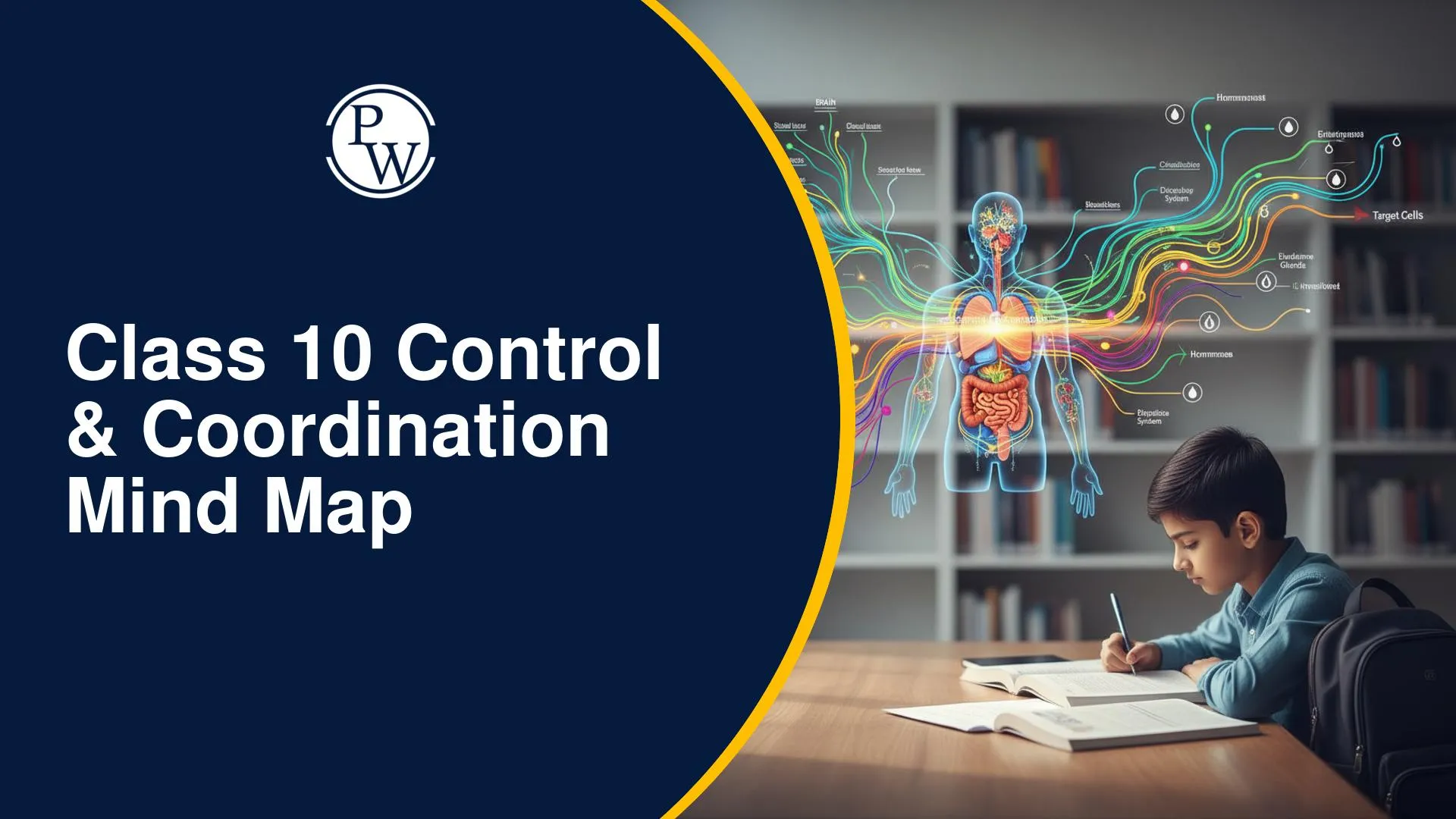
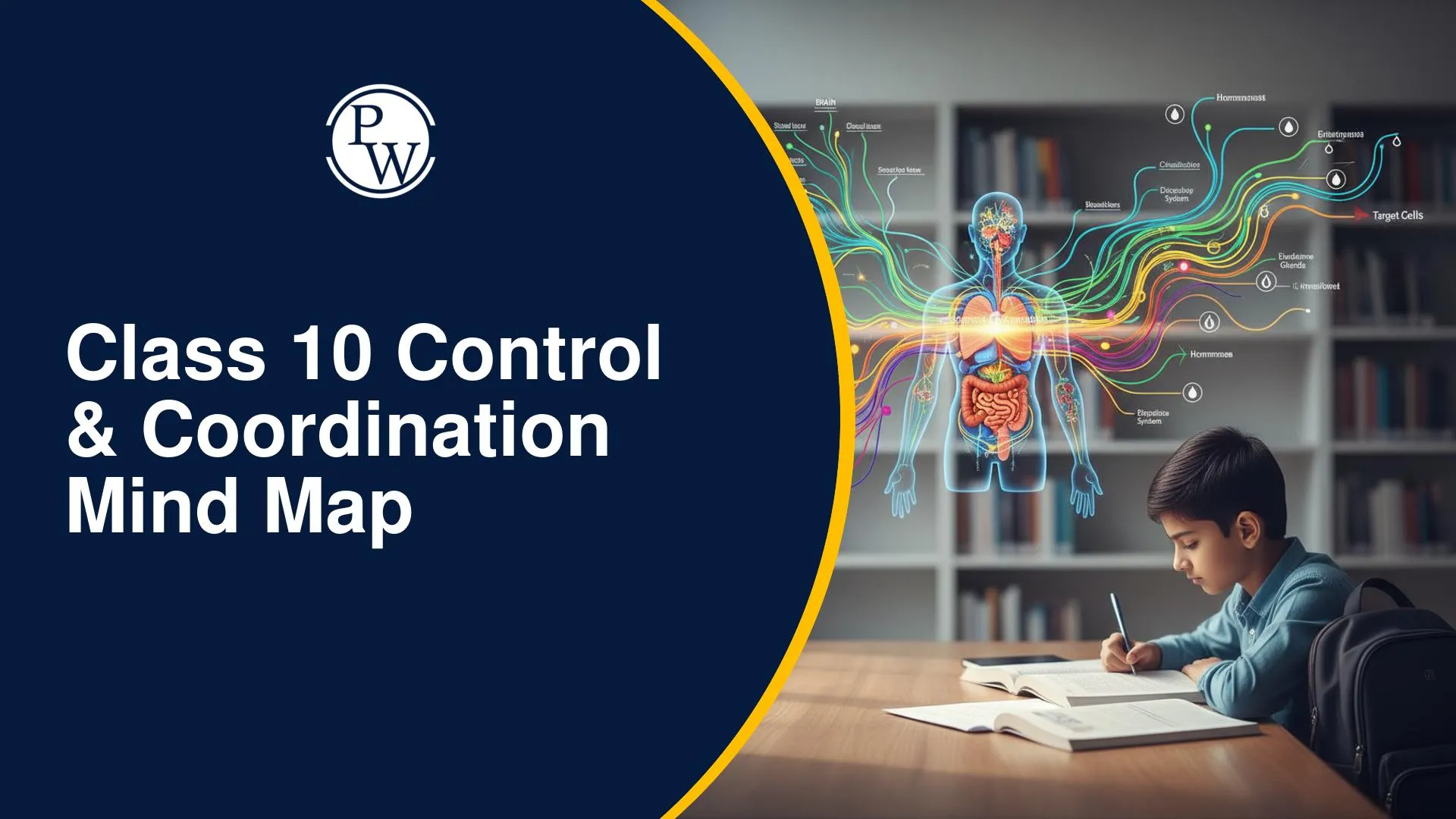
Control and Coordination: With the Class 10 Science board examination scheduled on 25 February 2026, students have now entered the most critical phase of revision. The chapter Control and Coordination is a fundamental and concept-rich unit of the Class 10 Science syllabus and is frequently tested in board examinations through definitions, diagram-based questions, reasoning answers, and application-oriented problems.
To support quick, effective, and last-minute revision, this mind map–based explanation, developed from video content, has been designed to help students systematically organise and interlink important concepts. It enables students to clearly understand topics such as the nervous system, neurons, reflex actions, structure and functions of the brain, endocrine glands, hormones, and coordination in plants.
Control & Coordination Mind Map Series
Every living organism possesses intricate systems to control its body and coordinate various parts for a proper response to stimuli. This process of Control and Coordination ensures that different body parts work together systematically. In animals, particularly humans, this is managed by the nervous and endocrine systems, while plants achieve coordination through movements and hormones.
The Control and Coordination Mind Map Series presents the entire chapter in a concise, interconnected, and easy-to-revise format. It simplifies complex biological processes and helps students understand how different concepts are linked, which is essential for answering reasoning and case-based questions in board exams.
Watch Video Control & Coordination for Easy Explanation
For effective revision under time constraints, students are advised to use mind maps. To gain conceptual clarity, one may also refer to educational videos explaining these mind maps, which help in rapid understanding and retention.
The Human Nervous System
The human body relies on two primary systems for control and coordination:
-
Nervous System: Employs neurons for rapid electrical signaling.
-
Endocrine System: Uses hormones for chemical signaling.
Classification of the Nervous System
The human nervous system is divided into two main structural parts:
-
Central Nervous System (CNS): The core processing unit.
-
Brain: The main control and processing center.
-
Spinal Cord: An extension of the brain, relaying signals throughout the body.
-
Peripheral Nervous System (PNS): The network of nerves connecting the CNS to the rest of the body.
-
Cranial Nerves: Nerves originating directly from the brain.
-
Spinal Nerves: Nerves arising from the spinal cord.
The Central Nervous System (CNS)
The CNS includes the brain and the spinal cord.
-
Brain: Located in the head and protected by the skull (cranium), it is the hub for thought, memory, and decision-making.
-
Spinal Cord: It is vital to understand that the spinal cord is not the same as the backbone (vertebral column). (Analogy: The relationship between the spinal cord and the backbone is like a pen and its refill. The backbone is the outer protective casing, and the spinal cord is the delicate structure inside.) The backbone's primary role is to protect the spinal cord. The spinal cord transmits signals between the brain and the body.
The Peripheral Nervous System (PNS)
The PNS consists of nerves, which are bundles of specialized cells called neurons. These nerves act as the body's wiring, carrying signals to and from the CNS.
Nerves are categorized by their origin:
-
Cranial Nerves: 12 pairs that originate directly from the brain.
-
Spinal Nerves: 31 pairs that emerge from the spinal cord.
All nerves function to convey information to the CNS and transmit instructions from the CNS to various body parts.

Key Terminology in the Nervous System
Understanding these terms is crucial for studying the nervous system:
-
Stimulus: Any environmental change detectable by an organism that triggers a response. Examples include light, sound, heat, or pain.
-
Receptor: Specialized cells or tissues, often in sense organs, that detect specific stimuli.
| Key Terminology in the Nervous System | ||
|---|---|---|
| Sense Organ | Receptor Type | Stimulus Detected |
| Eyes | Photoreceptors | Light |
| Nose | Olfactory Receptors | Smell |
| Tongue | Gustatory Receptors | Taste |
| Ears | Phonoreceptors | Sound |
| Skin | Thermoreceptors | Heat & Cold |
| Skin | Nociceptors | Pain |
-
Effector: The body part, such as a muscle or gland, that produces a response to a stimulus. For example, muscles contracting to withdraw a hand from heat are effectors.
The Neuron (Nerve Cell)
The Neuron, or nerve cell, is the structural and functional unit of the nervous system. These highly specialized cells transmit information via electrical and chemical signals. The brain, spinal cord, and all nerves are composed of neurons, which can be very long.

Structure of a Typical Neuron
A neuron typically has three main components:
-
Cell Body (Cyton): The main part containing the nucleus and other organelles.
-
Dendrites: Short, branched extensions that receive signals from other neurons.
-
Axon: A single, long extension that carries signals away from the cell body, often covered by a myelin sheath.
-
Nerve Ending (Axon Terminal): The branched end of the axon, transmitting signals to the next neuron or an effector.
Path of Information Transmission in a Neuron
Information flows unidirectionally through a neuron:
Dendrite → Cell Body → Axon → Nerve Ending
-
Signals are received by the dendrites.
-
The signal travels to the cell body.
-
The cell body passes the signal along the axon.
-
The signal reaches the nerve ending, where it is transmitted onward.
Synapse and Neuromuscular Junction (NMJ)
-
Synapse: A microscopic gap between the nerve ending of one neuron and the dendrite of the next. Neurons are not physically connected; signals cross this gap chemically.
-
Neuromuscular Junction (NMJ): The point of contact between a motor neuron's nerve ending and a muscle fiber. This is where nerve impulses are transmitted to muscles, causing contraction.
-
Neuro: Refers to the neuron.
-
Muscular: Refers to the muscle.
-
Junction: Refers to the point of contact.
Types of Neurons
Neurons are categorized based on their signal transmission direction:
-
Sensory Neuron: Transmits signals from receptors (in sense organs) to the CNS (brain or spinal cord).
-
Motor Neuron: Transmits signals from the CNS to effectors (muscles or glands) to produce a response.
-
Interneuron (or Relay Neuron): Located within the CNS, they connect sensory neurons to motor neurons and process information. (Memory Tip: Interneurons are like "middlemen"; they take information from one source (sensory neuron) and pass it on to another (motor neuron).).
Transmission of Nerve Impulses Across a Synapse
Nerve impulses travel as an electrical signal along a neuron. However, this electrical signal cannot cross the synapse.
-
When an electrical impulse reaches the nerve ending of the first neuron, it releases chemicals (neurotransmitters) into the synapse.
-
These chemicals bind to the dendrites of the next neuron.
-
This binding generates a new electrical signal in the second neuron.
-
This process allows the signal to continue its journey:
Electrical Signal → Chemical Signal (at synapse) → Electrical Signal
Types of Actions
Human actions are classified into voluntary, involuntary, and reflex actions.
-
Voluntary actions are under conscious control and are initiated by the cerebrum of the brain, such as walking or writing.
-
Involuntary actions occur automatically without conscious thought and are controlled by parts of the brain such as the medulla and midbrain, for example heartbeat and breathing.
-
Reflex actions are sudden, rapid, and protective responses controlled mainly by the spinal cord.
Reflex actions are primarily controlled by the spinal cord, not the brain, due to the need for immediate response without conscious thought.
Reflex Action and the Reflex Arc
A reflex action is an immediate, involuntary response to a harmful stimulus. The pathway taken by nerve impulses during a reflex action is called the Reflex Arc.
The Pathway of the Reflex Arc
Consider touching a hot pan:
-
Receptor: Thermoreceptors in the skin detect heat (stimulus).
-
Sensory Neuron: Transmits the signal from the receptor to the spinal cord.
-
Spinal Cord (Interneuron/Relay Neuron): The signal is processed instantly, and the interneuron relays it directly to the motor neuron.
-
Motor Neuron: Carries the command signal from the spinal cord to the effector.
-
Effector: The muscles in the arm contract, pulling the hand away (response).
This entire sequence forms the reflex arc:
Receptor → Sensory Neuron → Spinal Cord → Motor Neuron → Effector

The Human Brain
The brain, the body's main coordinating center, is protected by the cranium (skull) and three meninges membranes. Cerebrospinal fluid between the meninges cushions the brain and acts as a shock absorber.
The brain comprises three main parts:
| Part | Sub-parts | Key Functions |
|---|---|---|
| 1. Forebrain (Largest) | Cerebrum | - Main thinking part of the brain.- Controls voluntary actions.- Center for intelligence, memory, learning, consciousness. |
| Thalamus | Relays sensory information to the cerebrum. | |
| Hypothalamus | - Controls hunger, thirst, body temperature.- Controls hormone release, linking nervous and endocrine systems. | |
| 2. Midbrain (Smallest) | - | - Connects forebrain and hindbrain.- Controls some involuntary actions and reflexes involving sight and sound. |
| 3. Hindbrain | Cerebellum | - Maintains posture and balance of the body.- Coordinates smooth and precise voluntary movements (e.g., walking, cycling). (Memory Tip: Cere-bell-um contains the sound "bell," which helps you think of bal-ance.) |
| Pons | Regulates breathing rate and controls the sleep cycle. | |
| Medulla Oblongata | - Controls involuntary actions such as blood pressure, salivation, vomiting, sneezing, and coughing. |
The Human Endocrine System (Hormonal Coordination)
The endocrine system consists of ductless glands that release hormones directly into the bloodstream. The pituitary gland, often referred to as the master gland, controls growth and regulates other endocrine glands.
-
The thyroid gland regulates metabolism and requires iodine for the synthesis of thyroxine. The pancreas regulates blood sugar levels through insulin and glucagon.
-
The adrenal glands secrete adrenaline, which prepares the body for emergency situations. The testes and ovaries produce sex hormones that regulate secondary sexual characteristics and reproductive functions.

Coordination in Plants
Plants, lacking a nervous system, sense stimuli like light, water, and gravity, coordinating responses through movements and hormones.
Plant Movements
Plant movements are categorized into two types:
-
Tropic Movements (Directional, Growth-Dependent)
-
Slow, directional growth movements in response to external stimuli.
-
Phototropism: Movement towards/light (e.g., shoot).
-
Geotropism: Movement towards/gravity (e.g., root).
-
Hydrotropism: Movement towards/water (e.g., root).
-
Chemotropism: Movement towards/chemicals (e.g., pollen tube towards ovule).
-
Thigmotropism: Movement in response to touch (e.g., climbing tendrils coiling).
-
Nastic Movements (Non-Directional, Growth-Independent)
-
Rapid, non-directional movements unrelated to growth.
-
Example 1: Touch-me-not plant (Mimosa pudica) leaves fold and droop upon touch (thigmonasty).
-
Example 2: Insectivorous plants (e.g., Venus flytrap) rapidly close traps on contact.
Plant Hormones (Phytohormones)
Plant hormones are chemical substances regulating plant growth, development, and responses.
| Plant Hormones | ||
|---|---|---|
| Category | Hormone | Key Functions |
| Growth Promoters | Auxin | - Promotes cell elongation and division.- Responsible for phototropism.- Promotes fruit development. |
| Gibberellin | - Promotes stem elongation.- Breaks seed dormancy, promotes germination.- Promotes fruit and flower development. | |
| Cytokinin | - Promotes rapid cell division.- Delays leaf aging. | |
| Growth Inhibitors | Abscisic Acid (ABA) | - Also known as the stress hormone.- Causes stomata to close during water stress.- Promotes seed dormancy.- Causes wilting and leaf fall. |
| Ethylene (Gaseous) | - Promotes fruit ripening.- Promotes aging and shedding of leaves and flowers. | |
Control & Coordination FAQs
Q1: What are the two main systems responsible for control and coordination in humans?
Q2: Differentiate between the Central Nervous System (CNS) and the Peripheral Nervous System (PNS).
Q3: Explain the role of a synapse in nerve impulse transmission.