Important Questions Class 12 Biology Chapter 11 Organisms and Populations

With the CBSE Class 12 board examinations approaching and Biology being one of the most concept-heavy subjects, focused and smart revision is essential. Among Ecology units, Organisms and Populations is a high-weightage chapter known for repeated conceptual, numerical, and application-based questions.
Therefore, revising important questions Class 12 Biology chapter 11 at this stage can significantly enhance exam readiness.
This chapter tests understanding of population attributes, growth models, adaptations, and ecological interactions, making it crucial for scoring well in the final examination.
Class 12 Biology Chapter 11 – Organisms and Populations
Class 12 Biology Chapter 11 explores how organisms adapt to their environment and interact within populations. Key topics include abiotic factors (temperature, water, light), adaptation strategies (migration, suspension), and population attributes like natality and mortality.
A major focus is placed on growth models (Exponential vs. Logistic) and interspecific interactions such as mutualism, competition, predation, and parasitism, which define the structure and survival of biological communities in an ecosystem.
Important Questions Class 12 Biology Chapter 11
Organisms and Populations carry consistent exam weightage, making it essential for students to practise Organisms and Populations class 12 question answers thoroughly. Below are Exam-oriented questions framed as per the latest exam pattern.
1. The population of sparrows inhabiting a garden decreased dramatically. It was found that the mortality was equal to natality for the given population.
Which of the following is TRUE for the population of sparrows?
(1) The number of emigrants was equal to immigrants.
(2) The number of emigrants was less than immigrants.
(3) The number of emigrants was more than immigrants.
(4) The population of sparrows was unaffected by emigrants and immigrants.
Ans. (3) The number of emigrants was more than immigrants.
2. The black walnut plant secretes juglone, a chemical substance that destroys other plants like pepper growing within its root zone.
Which type of population interaction does the above statement represent?
(1) Predation
(2) Competition
(3) Mutualism
(4) Amensalism
Ans. (4) Amensalism
3. Every year, millions of monarch butterflies fly from the United States and Canada to Mexico to escape the cold weather.
Which response to abiotic stress does the statement depict?
(1) Migration
(2) Regulation
(3) Suspension
(4) Conformation
Ans. (1) Migration
4. Define population and community.
Ans. Population : It can be defined as a group of individuals of the same species inhabiting a particular geographical area at a given time, functioning as a unit.
Community : It can be defined as a group of individuals of various species living in a certain geographical region. These individuals can be dissimilar or similar but cannot reproduce with members of other species.
5. If a population growing exponentially double in size in 3 years, what is the intrinsic rate of increase (r) of the population?
Ans. If the population growing exponentially double in size in 3 years, the intrinsic rate of increase of this population will be towards maximum.
6. Write four attributes applied in the human population census.
Ans. They are as listed below:
-
Sex ratio
-
Age distribution
-
Natality and mortality
-
Population growth
7. Observe the age pyramids of different populations given below and write about the status of the populations.
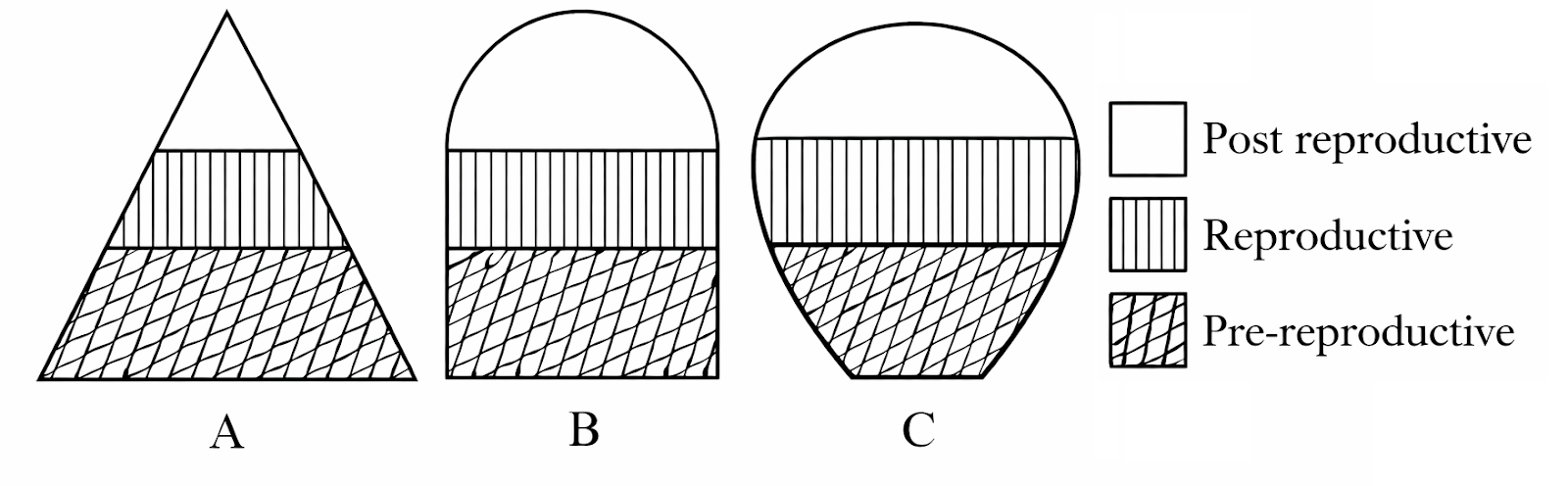
Ans. Following are the interpretations - Figure A - The base of the pyramid-shaped age pyramid is huge in comparison to the reproductive and post-reproductive phases of the population. It indicates that the population would increase quickly. Figure B - This inverted bell-shaped structure denotes that both the reproductive and pre-reproductive phases are the same, indicating stability in the population. Figure C - This urn-shaped structure denotes clearly that both the reproductive and the pre-productive phases are less than the post-productive phases of the particular population, it indicates that it has more of older people, denoting declination in the population.
8. List any three important characteristics of a population and explain.
Ans. The three important characteristics of a population are:
(a) Density: The number of individuals per unit area or volume. For example, the number of frogs per m3 of forest region.
(b) Natality or Birth rate: The birth rate is determined by the number of individuals bom to a given population during a given period of time.
(c) Mortality or Death rate: The death rate or mortality represents a decrease in a given population during a given period of time. Generally, the death of individuals in a population are expressed by specific mortality which is described as the mortality population are expressed by specific mortality which is described as the mortality for given age group.
9. With the help of suitable diagram describe the .; logistic population growth curve.
Ans. The S-shaped growth curve is also called a logistic growth curve. It describes a situation in which (in a new environmental condition) the population density of an organism increases slowly establishing itself then increasing rapidly, approaching an exponential growth rate. Many population of micro-organisms broadly follow this basic sigmoidal pattern. For example, when a fresh culture medium is inoculated with bacteria, sigmoidal or S-shaped growth curve is observed. The S-shaped curve is generated when a population approaches the environmental’s carrying capacity. Carrying capacity is the maximum number of individuals of a population that can be supported in a given time.
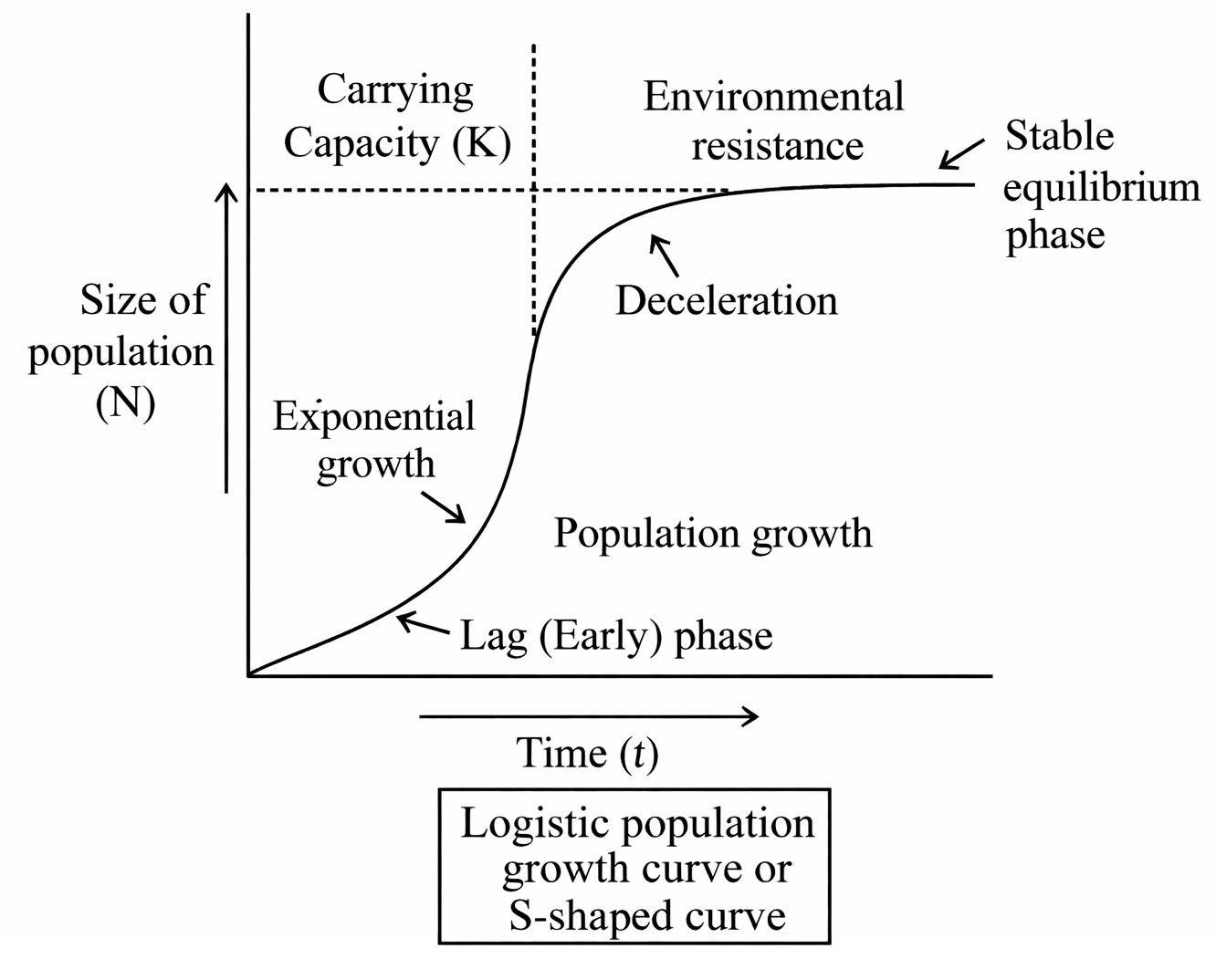
The S-shaped growth form is represented by the following equation- dNIdt = rN[K-NIK]
Where, r = intrinsic rate of natural increase N = population density at time t K = carrying capacity
10. Define the following terms and give one example for each:
(a) Commensalism
(b) Parasitism
Ans: (a) Commensalism is the association between organisms of different species in which one species benefits but does not apparent harm to the other. For example, in the large intestine of human being, bacteria Escherichia coli are present which helps in digestion.
(b) Parasitism is an association in which one organism lives on or in the body of another, from which it obtains its food. For example, the parasites of humans include fleas and lice, various bacteria, protozoans and fungi.
Exam Preparation Tips for Class 12 Biology Chapter 11
To excel in your important questions Class 12 Biology chapter 11 preparation, follow these tips:
-
Master the Graphs: Practice drawing the Logistic (S-shaped) and Exponential growth curves. Label the carrying capacity (K) clearly.
-
Memorize Interactions: Create a table for population interactions (+/-, +/0, +/+) to quickly recall them during the exam.
-
Understand Adaptations: Focus on how organisms like the kangaroo rat or desert plants adapt to water scarcity.
-
Solve Previous Papers: Look for Organisms and Populations class 12 biology Previous Year Papers from the last 5 years.
Important Questions Class 12 Biology Chapter 11 FAQs
Are the important questions in Class 12 Biology chapter 11 enough for board exams?
Which topics from Organisms and Populations are most important?
Are MCQs important for this chapter?
How many marks are usually asked from this chapter?


Have questions about your prep?
Our experts can answer all your questions