







Class 7 Maths Chapter 7: A Tale of Three Intersecting Lines Important Questions by PW
 Mishika Gupta23 Sept, 2026
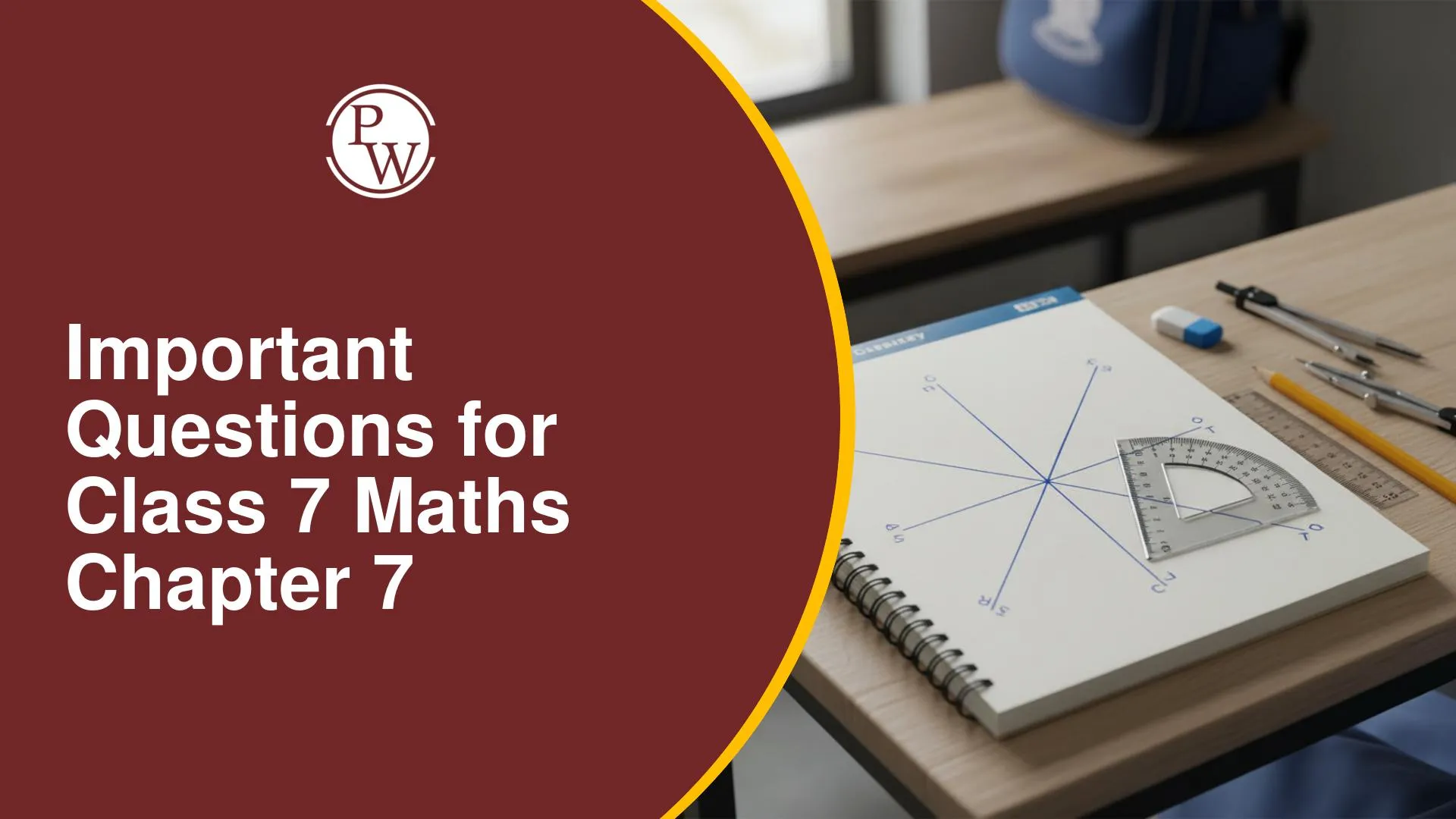
Triangles contain several lines, sides, and angles, making it important to identify the correct geometric property while solving questions. Medians, altitudes, perpendicular lines, orthocentres, and different types of triangles can become confusing when multiple concepts appear together. Diagram-based questions may also require careful observation to find unknown angles or apply the right relationship.
The Class 7 Maths Chapter 7 Important Questions offer focused practice on A Tale of Three Intersecting Lines through MCQs and diagram-based problems. You can use them to understand triangle properties, identify important line segments, practise constructions, calculate unknown angles, and apply geometric concepts in different situations.
Important Questions for Class 7 Maths Chapter 7 A Tale of Three Intersecting Lines
Explore these Class 7 Maths Chapter 7 Important Questions to strengthen your understanding of triangle properties, angle relationships, constructions, medians, and altitudes covered in A Tale of Three Intersecting Lines.
Q1. Types of Triangles
A triangle in which all three sides are equal is called:
(A) Isosceles triangle
(B) Scalene triangle
(C) Equilateral triangle
(D) Right-angled triangle
Answer: (C) Equilateral triangle
Q2. Medians of an Equilateral Triangle
In an equilateral triangle, all medians are:
(A) Equal in length
(B) Unequal in length
(C) Perpendicular to sides but unequal
(D) None of these
Answer: (A) Equal in length
Q3. Constructing an Altitude
To construct the altitude from vertex A to side BC (A not on BC) using compass and straightedge, the correct first step is to:
(A) Draw the circumcircle of triangle ABC.
(B) Draw the angle bisector of A.
(C) Draw the perpendicular bisector of BC.
(D) Draw an arc centred at A that intersects BC at two points.
Answer: (D) Draw an arc centred at A that intersects BC at two points.
Q4. Orthocentre of an Acute Triangle
In an acute-angled triangle, the orthocentre lies:
(A) Inside the triangle
(B) Outside the triangle
(C) On the triangle
(D) None of these
Answer: (A) Inside the triangle
Q5. Right-Angled Triangle
If one angle of a triangle is 90°, then the triangle is called:
(A) Right-angled triangle
(B) Acute triangle
(C) Obtuse triangle
(D) Equilateral triangle
Answer: (A) Right-angled triangle
Q6. Median of a Triangle
The line segment joining a vertex of a triangle to the midpoint of its opposite side is called:
(A) Altitude
(B) Median
(C) Perpendicular bisector
(D) Angle bisector
Answer: (B) Median
Q7. Altitude of a Triangle
In a triangle ABC, an altitude from vertex A is a line segment that:
(A) Joins A to the midpoint of BC
(B) Joins A to BC and is perpendicular to BC
(C) Joins A to BC and bisects A
(D) Joins A to the circumcentre of triangle ABC
Answer: (B) Joins A to BC and is perpendicular to BC
Q8. Scalene Triangle
The triangle having all three sides of different lengths is called:
(A) Scalene triangle
(B) Isosceles triangle
(C) Equilateral triangle
(D) Right triangle
Answer: (A) Scalene triangle
Q9. Angles of an Isosceles Triangle
In triangle ABC, AB = AC and B = 50°. What will be the measure of C?
(A) 40°
(B) 50°
(C) 80°
(D) 65°
Answer: (B) 50°
Q10. Constructing a Triangle
In constructing a triangle when two sides and an included angle are given, the first step is:
(A) Draw any side of the triangle
(B) Draw the included angle
(C) Draw a perpendicular bisector
(D) Measure the third side
Answer: (A) Draw any side of the triangle
Diagram-Based Questions
Q11. Find x
Given the angles of a triangle as (5x − 60)°, (2x + 40)°, and (3x − 80)°, find x.
(A) 28
(B) 30
(C) 25
(D) 45
Answer: (A) 28
Q12. Check for a Right Triangle
In triangle ABC, AB = 5 cm, BC = 12 cm, and AC = 13 cm. Is it a right triangle?
(A) Yes, right angle at A
(B) Yes, right angle at B
(C) Yes, right angle at C
(D) No
Answer: (B) Yes, right angle at B
Q13. Find the Third Angle
In triangle XYZ, if ∠X = 90° and ∠Y = 45°, what is the measure of ∠Z?
(A) 30°
(B) 45°
(C) 60°
(D) 90°
Answer: (B) 45°
Q14. Find x
In triangle ABC, AB = AC and BC and CD form a straight line. The exterior angle at C is 105°. Find x.
(A) 60°
(B) 65°
(C) 70°
(D) 75°
Answer: (D) 75°
Q15. Find the Unknown Angles
Find the unknown angles a and b, if l ∥ m.
Given:
-
l ∥ m
-
One angle is 40°.
-
One angle at line m is 110°.
(A) a = 70° and b = 120°
(B) a = 70° and b = 110°
(C) a = 120° and b = 70°
(D) a = 60° and b = 110°
Answer: (B) a = 70° and b = 110°
Class 7 Maths Chapter 7 Important Questions PDF
For further practice, the Class 7 Maths Chapter 7 Important Questions PDF covers key topics such as triangle properties, angle calculations, medians, altitudes, orthocentres, and geometric constructions. Solve the questions independently and then check the answers to assess your understanding and identify areas that need more practice.
Class 7 Maths Chapter 7 Important Questions PDF
Why Choose Class 7 Maths Chapter 7 Important Questions by PW?
Class 7 Maths Chapter 7 Important Questions by PW provide practice across triangle properties, geometric constructions, angle relationships, and diagram-based problems.
-
Recognise Triangle Types: Distinguish between equilateral, isosceles, scalene, acute, and right-angled triangles.
-
Work with Medians: Understand how a median joins a vertex to the midpoint of the opposite side.
-
Use Altitude Concepts: Identify perpendicular lines drawn from a vertex to the opposite side.
-
Understand Orthocentres: Learn how the position of the orthocentre varies across different triangles.
-
Find Missing Angles: Apply triangle angle properties to calculate unknown angles.
-
Use Isosceles Properties: Apply the relationship between equal sides and their opposite angles.
-
Practise Constructions: Strengthen understanding of triangle and altitude construction steps.
-
Interpret Geometric Figures: Examine diagrams carefully and apply the relevant property to solve problems.
A Tale of Three Intersecting Lines develops your understanding of triangles through their sides, angles, medians, altitudes, and other important lines. The Class 7 Maths Chapter 7 Important Questions provide practice with these concepts through objective and diagram-based problems, helping you revise properties and apply them while solving geometry questions.
Related Resources
-
CBSE Class 7 Maths Sample Papers
Important Questions for Class 7 Maths Chapter 7 FAQs
What topics are covered in Class 7 Maths Chapter 7?
What is the median of a triangle?
What is the altitude of a triangle?
Where does the orthocentre lie in an acute-angled triangle?






 Live & recorded classes available at easeDashboard for progress trackingMillions of practice questions at your fingertips

