







Important Questions for Class 8 Science Chapter 7: Particulate Nature of Matter

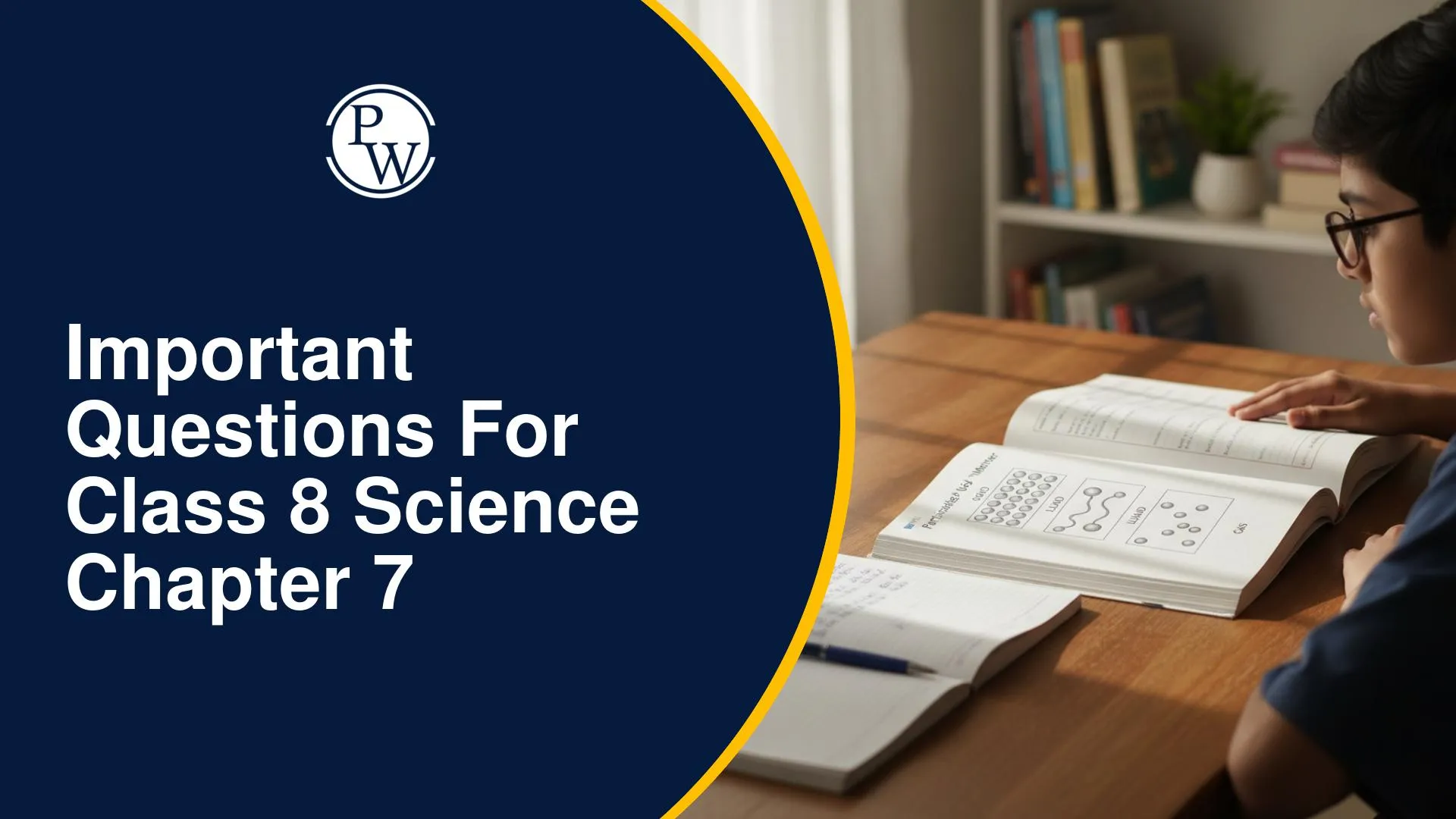
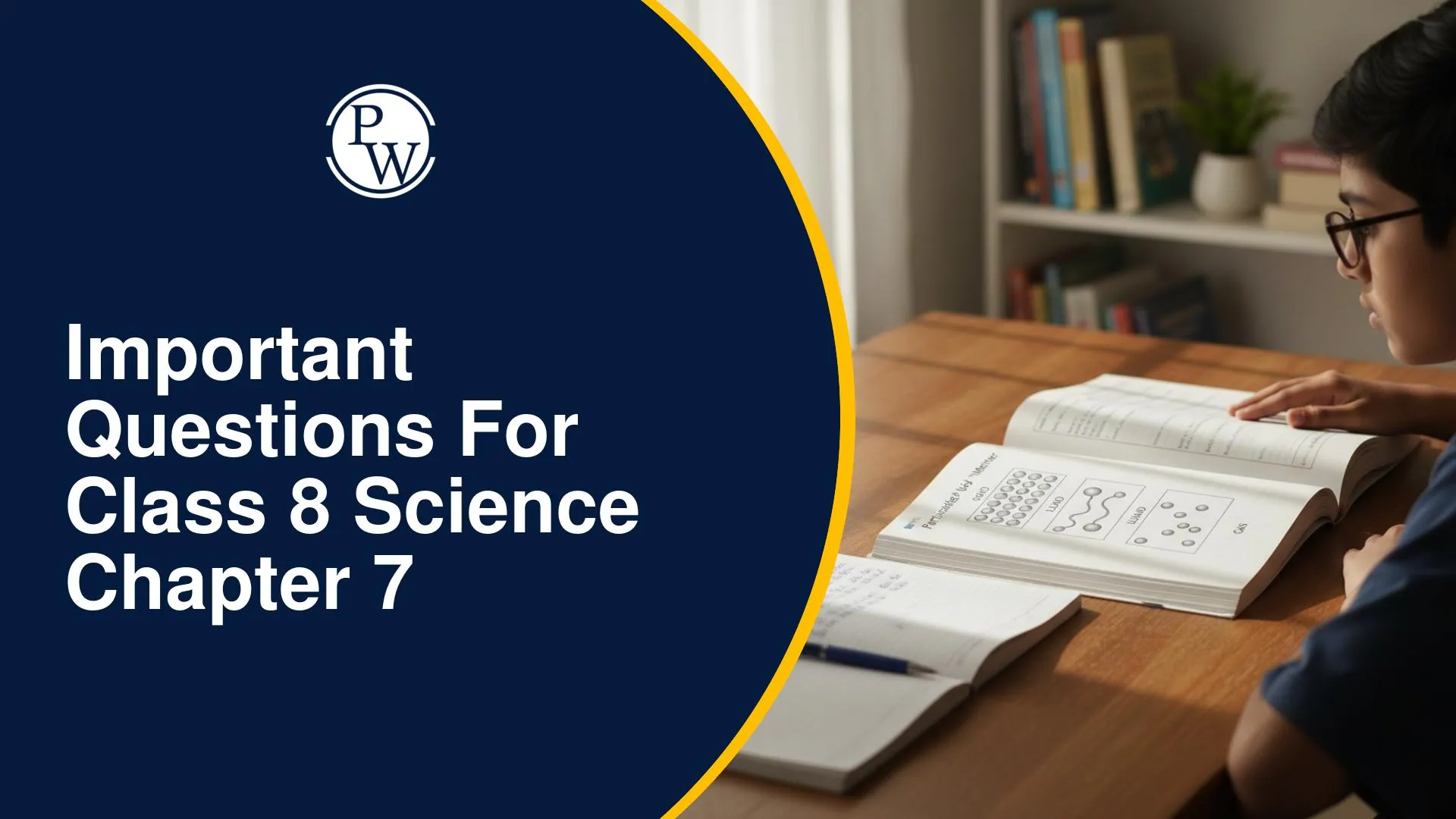
Chapter 7 of Class 8 Science teaches how matter is made of tiny particles. These particles are too small to see, but they explain many things around us, like why sugar dissolves in water or why we smell perfume across a room. This chapter builds the base for higher-level chemistry topics.
To help students prepare well, Physics Wallah has collected the Important Questions for Class 8 Science Chapter 7 in one place. These questions match the style used in class tests and board-pattern exams, so students can practice smartly and save time.
Important Questions for Class 8 Science Chapter 7 By PW
Here are important questions from Chapter 7. These are the same type of questions asked in school tests and practice papers, covering diffusion, sublimation, compressibility, and particle behaviour.
Q1. The water in the ocean tastes salty, even though the salt is not visible. Which of the following best explains this phenomenon?
(A) Ocean water looks blue, so the salt is hidden.
(B) Salt in ocean water dissolves completely to form a uniform mixture.
(C) Salt settles down at the bottom of the ocean and cannot be seen.
(D) The salt particles are too large to be seen with naked eyes.
Q2. A glass tumbler containing water is taken and a few grains of potassium permanganate are added to it. After some time, the water turns purple throughout the tumbler. Which of the following is the best explanation for this observation?
(A) Potassium permanganate particles are heavier and sink to the bottom, coloring the water.
(B) The purple color spreads only because of stirring with a spoon.
(C) The particles of potassium permanganate diffuse and spread into the spaces between water molecules, making the solution uniformly purple.
(D) The purple color appears due to a chemical reaction between water and potassium permanganate particles.
Q3. Which of the following is a correct example of sublimation?
(A) Water boiling
(B) Naphthalene changing to gas
(C) Melting of wax
(D) Steam condensing
Q4. Which of the following is NOT a characteristic of matter?
(A) Matter occupies space
(B) Matter has mass
(C) Matter can be divided infinitely without limit
(D) Matter is made up of particles
Q5. The transformation of a substance from the solid state to the liquid state on heating, at a fixed temperature, is called:
(A) Evaporation – a process in which a liquid changes into vapour at temperatures below its boiling point.
(B) Condensation – a process in which vapours change back into the liquid state on cooling.
(C) Melting (or Fusion) – a process in which a solid absorbs heat and changes into liquid at a fixed temperature known as the melting point.
(D) Sublimation – a process in which a solid changes directly into vapour without becoming a liquid in between.
Q6. Assertion: Solids have a fixed shape.
Reason: Inter-particle forces in solids are strong.
(A) Assertion and Reason both true, Reason explains Assertion.
(B) Assertion and Reason both true, Reason does not explain Assertion.
(C) Assertion true, Reason false.
(D) Assertion false, Reason true.
Q7. Three syringes are shown below, each filled with a different substance and their pistons are pressed with equal force:
Syringe A – filled with chalk powder
Syringe B – filled with water
Syringe C – filled with air
These ten questions give students a strong starting point. Practising them regularly builds confidence for both class tests and final exams.
Important Questions for Class 8 Science Chapter 7 PDF
Many students prefer a printable copy for daily revision. The Particulate Nature of Matter PDF version of this question set includes all the questions above along with extra practice questions on homogeneous and heterogeneous mixtures, diffusion, and states of matter.
Important Questions for Class 8 Science Chapter 7 PDF
Students can download this PDF and use it offline, which is useful during travel time or when internet access is limited before an exam.
Benefits of Practising Important Questions
Solving important questions regularly gives students a clear advantage. Some key benefits include:
-
Better understanding of core ideas like diffusion, sublimation, and compressibility
-
Quick revision before exams without reading the entire chapter again
-
Practice with different question types, including MCQs and assertion-reason
-
Improved speed and accuracy while answering in a timed test
-
More confidence to attempt tricky application-based questions
These Particulate Nature of Matter Class 8 Science important questions are designed to match the exact difficulty level expected in school exams, so students do not feel surprised on the test day.
The Particulate Nature of Matter chapter may look simple, but exam papers often test small details, such as why gases compress easily or why solids keep a fixed shape. Practising the Important Questions for Class 8 Science Chapter 7 given above, along with the downloadable PDF, helps students revise faster and score better.
Important Questions for Class 8 Science Chapter 7 FAQs
What is the Particulate Nature of Matter chapter about?
Where can I get the Important Questions for Class 8 Science Chapter 7 PDF?
Why do gases compress easily but solids do not?
What is diffusion, and why does it happen?
Are these important questions enough for exam preparation?






Get Free Counselling Today
and Clear up all your Doubts
 Live & recorded classes available at easeDashboard for progress trackingLakhs of practice questions

