Last Minute Revision Tips for CBSE Class 12 Chemistry Exam 2026: Important Topics, Formula Sheet & 1-Day Study Plan
 Aarti .27 Feb, 2026
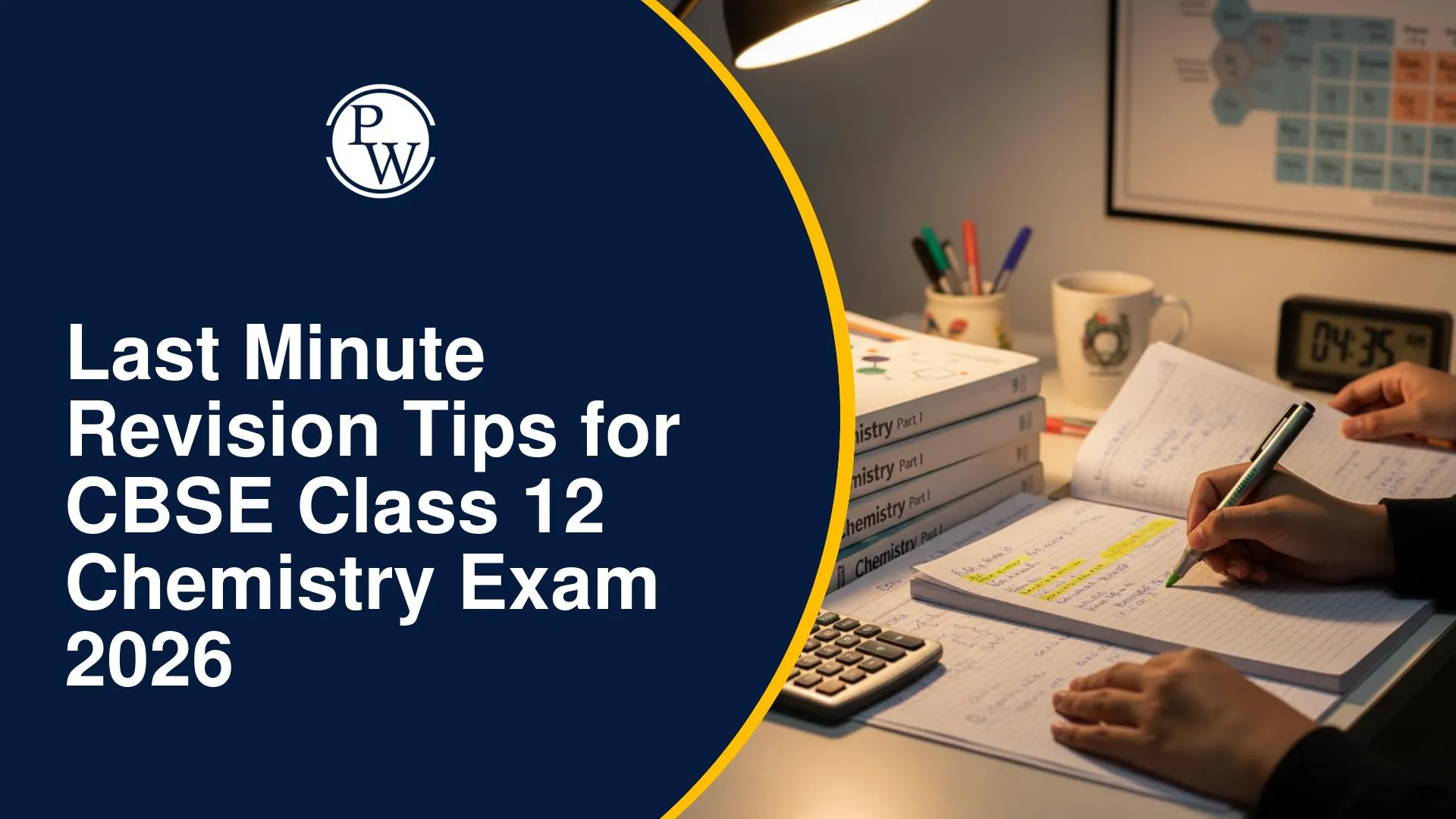
The CBSE Class 12 Chemistry Exam 2026 is scheduled for 28 February 2026. During this last time, students must focus on smart revision, not new learning at the last moment. Students must prioritize high-weightage chapters, revise important formulas and name reactions, and practice case-study based and competency-based questions. A focused 1-day strategy with time-blocked revision, mock practice, and formula recap to significantly improve accuracy and confidence.
The Chemistry theory paper usually carries 70 marks, with a balanced mix of MCQs, case-study questions, short answers, and long answers as per Central Board of Secondary Education guidelines.
Chemistry Class 12 Important Topics - Chapter Wise
The CBSE Class 12 Chemistry paper follows a balanced pattern, but not all chapters carry equal weightage. Understanding which topics are high, medium, and low priority helps students revise smartly and focus more on scoring areas. Based on recent CBSE trends for the 70-mark theory paper, the chapters below are arranged according to their expected importance so that students can plan their last-minute revision strategically and maximize marks.
High Priority Chapters
-
Electrochemistry (7–9 marks): Nernst Equation, Kohlrausch’s Law, Conductance & Molar Conductivity graphs, Galvanic & Electrolytic cells
-
Chemical Kinetics (7–8 marks): First order equation, Half life formula, Arrhenius equation, Units of rate constant
-
Coordination Compounds (7–9 marks): IUPAC naming, Isomerism, Crystal Field Theory, Magnetic moment
-
Aldehydes, Ketones & Carboxylic Acids (6–8 marks): Name reactions (Aldol, Cannizzaro, Clemmensen, Wolff-Kishner), Distinction test, Reaction mechanisms
-
d & f Block Elements (5–7 marks): Oxidation states, Color & magnetic properties, Lanthanide contraction
Medium Priority Chapters
-
Solutions (5–7 marks): Colligative properties, Abnormal molar mass
-
Haloalkanes & Haloarenes (5–6 marks): SN1 vs SN2, Finkelstein & Wurtz reaction
-
Amines (4–6 marks): Basic strength order, Diazotization, Carbylamine test
-
Solid State (3–5 marks): Packing efficiency, Defects, Density formula
Low Priority Chapters
-
Surface Chemistry (3–4 marks)
-
Biomolecules (3–5 marks)
-
Polymers (2–3 marks)
-
Chemistry in Everyday Life (2–3 marks)
These are scoring and theory-based. Revise definitions, examples, and important reactions only.
CBSE Class 12 Chemistry Complete Formula List
Major formulas come from Physical Chemistry. Organic & Inorganic are more conceptual and reaction-based. About 70–75% formulas are from 4 chapters: Solid State, Solutions, Electrochemistry, Chemical Kinetics.
1. Solid State
Density of unit cell
d = (Z × M) / (a^3 × N_A)
Where:
Z = number of atoms per unit cell
M = molar mass
a = edge length
N_A = Avogadro number
Relation between edge length (a) and radius (r):
Simple cubic (SC):
a = 2r
Body centred cubic (BCC):
a = 4r / √3
Face centred cubic (FCC):
a = 2√2 r
Packing efficiency:
SC = 52%
BCC = 68%
FCC = 74%
2. Solutions
Relative lowering of vapour pressure
(P° − P) / P° = n_B / n_A
Elevation in boiling point
ΔTb = i Kb m
Depression in freezing point
ΔTf = i Kf m
Osmotic pressure
π = C R T
Van’t Hoff factor
i = observed colligative property / calculated colligative property
Molarity
M = n / V (in litres)
Molality
m = moles of solute / kg of solvent
3. Electrochemistry
Nernst equation
E = E° − (0.0591 / n) log Q
Gibbs free energy relation
ΔG° = −n F E°
Relationship between ΔG° and equilibrium constant
ΔG° = −2.303 R T log K
Conductance
G = 1 / R
Molar conductivity
Λm = (κ × 1000) / C
Faraday constant
F = 96500 C mol⁻¹
4. Chemical Kinetics
Average rate
Rate = −Δ[R] / Δt
First order reaction
k = (2.303 / t) log ([R]0 / [R])
Half life (first order)
t1/2 = 0.693 / k
Second order half life
t1/2 = 1 / (k [R]0)
Arrhenius equation
k = A e^(−Ea / RT)
Log form
log k = log A − (Ea / 2.303RT)
5. Surface Chemistry
Freundlich adsorption isotherm
x / m = k P^(1/n)
Log form
log (x/m) = log k + (1/n) log P
6. d and f Block
Magnetic moment
μ = √(n(n + 2)) BM
Where n = number of unpaired electrons
CBSE Class 12 Chemistry 2026- Last One Day Revision Timetable
A well-structured timetable is the key to effective last-minute revision before the CBSE Class 12 Chemistry Exam 2026. Instead of studying randomly, students should divide the day into focused 2–3 hour slots covering high-weightage chapters, mock practice, and formula revision. A balanced plan that includes concept recall, numerical practice, reaction revision, and proper analysis of mistakes can significantly improve accuracy and confidence. This timetable is designed to help students maximize productivity while avoiding stress and burnout.
|
Time Slot |
Subject / Chapter |
Activity Type |
What to Do |
|
6:00 AM – 9:00 AM |
Physical Chemistry (Electrochemistry + Chemical Kinetics) |
Formula Revision + Numericals |
Revise Nernst equation, ΔG° relations, first order equation, Arrhenius equation. Solve 15–20 numericals. |
|
9:30 AM – 12:30 PM |
Organic Chemistry (High Weightage) |
Reaction + Conversion Practice |
Revise all name reactions (Aldol, Cannizzaro, Sandmeyer, Clemmensen, Wolff–Kishner). Practice 8–10 conversion questions + 10 MCQs/assertion-reason. |
|
1:30 PM – 3:30 PM |
Coordination Compounds + d & f Block |
Concept + Trend Revision |
Practice IUPAC naming, revise CFT basics, magnetic moment formula, oxidation states, color trends, lanthanide contraction. |
|
4:00 PM – 7:00 PM |
Full Syllabus |
Full-Length Mock Test (70 Marks) |
Attempt one previous year question paper within exact 3-hour board pattern timing. |
|
7:00 PM – 8:00 PM |
Weak Areas |
Paper Analysis |
Check mistakes, note weak reactions/formulas, correct presentation errors. |
|
8:00 PM – 9:00 PM |
Low Weightage Chapters |
Light Revision |
Revise Biomolecules, Polymers, Surface Chemistry, Chemistry in Everyday Life (definitions & examples). |
|
9:00 PM – 10:00 PM |
Complete Syllabus |
Final Formula & Reaction Recall |
Revise full formula sheet once. Quickly go through organic name reaction table. Sleep by 10:30 PM. |
CBSE Class 12 Chemistry Last-Minute Preparation Tips
The last day before the exam is not for new learning but for smart revision. Students must focus on these last-minute tips before the CBSE Class 12 Chemistry exam day:
- Revise formulas at least 3 times
- Solve 5 numericals from each Physical chapter
- Revise all Organic name reactions with reagents & conditions
- Practice at least 3 full conversion questions
- Solve 1 previous year paper or mock test
- Practice 2–3 case-study-based questions
- Revise trends & exceptions from Inorganic and graphs and units