
Exercise 7.2 is one of the most important parts of Chapter 7 Triangles in Class 9 Maths. This exercise focuses on applying triangle congruence rules such as SAS, ASA, and AAS to prove two triangles congruent and derive useful geometric results.
The NCERT Solution Class 9 Maths Chapter 7 Ex 7.2 provide clear, step-by-step explanations that help you understand not just how to prove congruence but why each step is valid. These solutions strengthen your foundation in geometry and build accurate mathematical reasoning.
What Does Class 9 Maths Chapter 7 Triangles Exercise 7.2 Cover?
Class 9 triangles exercise 7.2 focuses on identifying and proving triangle congruence using the main rules:
-
SAS (Side–Angle–Side)
-
ASA (Angle–Side–Angle)
-
AAS (Angle–Angle–Side)
This exercise strengthens logical thinking by asking you to justify each step of a geometric proof.
The NCERT Solutions for Class 9 Maths Triangles Exercise 7.2 make these concepts easy by breaking the proofs into understandable steps.
Class 9 Maths Chapter 7 Triangles Exercise 7.2 Questions and NCERT Solutions
All Class 9 Maths Chapter 7 Triangles Exercise 7.2 questions focus on proving congruence with proper reasoning.
Below are the NCERT Solutions Class 9 Maths Chapter 7 Ex 7.2 for exam preparation:
Question 1. In an isosceles triangle ABC, with AB = AC, the bisectors of ∠B and ∠C intersect each other at 0. Join A to 0. Show that (i) OB = OC (ii) AO bisects ∠A
Solution:
i) in ∆ABC, we have AB = AC [Given] ∴∠ABC = ∠ACB [Angles opposite to equal sides of a A are equal]
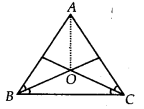
⇒ ∠ABC =∠ACB or ∠OBC = ∠OCB
⇒OC = OB [Sides opposite to equal angles of a ∆ are equal]
(ii) In ∆ABO and ∆ACO, we have AB = AC [Given] ∠OBA = ∠OCA [ ∵∠B =∠C] OB = OC [Proved above]
∆ABO ≅∆ACO [By SAS congruency]
⇒∠OAB = ∠OAC [By C.P.C.T.]
⇒AO bisects ∠A.
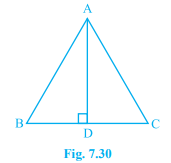
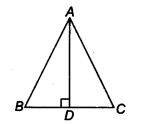
Question 2. In ∆ABC, AD is the perpendicular bisector of BC (see figure). Show that ∆ ABC is an isosceles triangle in which AB = AC.
Solution:
Since AD is bisector of BC. ∴BD = CD Now, in ∆ABD and ∆ACD, we have AD = DA [Common] ∠ADB = ∠ADC [Each 90°] BD = CD [Proved above]
∴∆ABD ≅∆ACD [By SAS congruency]
⇒AB = AC [By C.P.C.T.]
Thus, ∆ABC is an isosceles triangle.
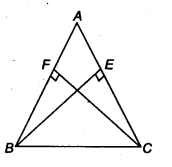
Question 3. ABC is an isosceles triangle in which altitudes BE and CF are drawn to equal sides AC and AB respectively (see figure). Show that these altitudes are equal.
Solution:
∆ABC is an isosceles triangle. ∴AB = AC ⇒∠ACB = ∠ABC [Angles opposite to equal sides of a A are equal] ⇒∠BCE = ∠CBF Now, in ∆BEC and ∆CFB ∠BCE = ∠CBF [Proved above] ∠BEC = ∠CFB [Each 90°] BC = CB [Common] ∴∆BEC ≅∆CFB [By AAS congruency] So, BE = CF [By C.P.C.T.]
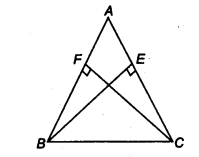
Question 4. ABC is a triangle in which altitudes BE and CF to sides AC and AB are equal (see figure).Show that (i) ∆ABE ≅∆ACF (ii) AB = AC i.e., ABC is an isosceles triangle.
Solution:
(i) In ∆ABE and ∆ACE, we have ∠AEB = ∠AFC [Each 90° as BE ⊥AC and CF ⊥AB] ∠A = ∠A [Common] BE = CF [Given]
∴∆ABE ≅∆ACF [By AAS congruency]
(ii) Since, ∆ABE ≅∆ACF ∴AB = AC [By C.P.C.T.]
⇒ABC is an isosceles triangle.
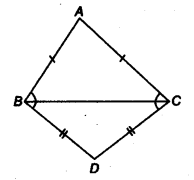
Question 5. ABC and DBC are isosceles triangles on the same base BC (see figure). Show that ∠ABD = ∠ACD.
Solution:
In ∆ABC, we have AB = AC [ABC is an isosceles triangle] ∴∠ABC = ∠ACB …(1) [Angles opposite to equal sides of a ∆ are equal] Again, in ∆BDC, we have BD = CD [BDC is an isosceles triangle] ∴∠CBD = ∠BCD …(2) [Angles opposite to equal sides of a A are equal] Adding (1) and (2), we have ∠ABC + ∠CBD = ∠ACB + ∠BCD ⇒∠ABD = ∠ACD.
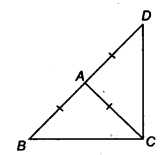
Question 6. ∆ABC is an isosceles triangle in which AB = AC. Side BA is produced to D such that AD = AB (see figure). Show that ∠BCD is a right angle.
Solution:
AB = AC [Given] …(1) AB = AD [Given] …(2) From (1) and (2), we have AC = AD Now, in ∆ABC, we have ∠ABC + ∠ACB + ∠BAC = 180° [Angle sum property of a A] ⇒2∠ACB + ∠BAC = 180° …(3) [∠ABC = ∠ACB (Angles opposite to equal sides of a A are equal)] Similarly, in ∆ACD, ∠ADC + ∠ACD + ∠CAD = 180° ⇒2∠ACD + ∠CAD = 180° …(4) [∠ADC = ∠ACD (Angles opposite to equal sides of a A are equal)] Adding (3) and (4), we have 2∠ACB + ∠BAC + 2 ∠ACD + ∠CAD = 180° +180° ⇒2[∠ACB + ∠ACD] + [∠BAC + ∠CAD] = 360° ⇒2∠BCD +180° = 360° [∠BAC and ∠CAD form a linear pair] ⇒2∠BCD = 360° – 180° = 180° ⇒∠BCD = = 90° Thus, ∠BCD = 90°
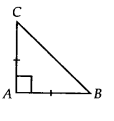
Question 7. ABC is a right angled triangle in which ∠A = 90° and AB = AC, find ∠B and ∠C.
Solution:
In ∆ABC, we have AB = AC [Given] ∴Their opposite angles are equal.⇒∠ACB = ∠ABC Now, ∠A + ∠B + ∠C = 180° [Angle sum property of a ∆] ⇒90° + ∠B + ∠C = 180° [∠A = 90°(Given)] ⇒∠B + ∠C= 180°- 90° = 90° But ∠B = ∠C ∠B = ∠C = = 45° Thus, ∠B = 45° and ∠C = 45°
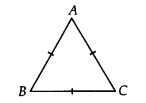
Question 8. Show that the angles of an equilateral triangle are 60° each.
Solution:
In ∆ABC, we have AB = BC = CA [ABC is an equilateral triangle] AB = BC ⇒∠A = ∠C …(1) [Angles opposite to equal sides of a A are equal] Similarly, AC = BC ⇒∠A = ∠B …(2) From (1) and (2), we have ∠A = ∠B = ∠C = x (say) Since, ∠A + ∠B + ∠C = 180° [Angle sum property of a A] ∴x + x + x = 180o ⇒3x = 180° ⇒x = 60° ∴∠A = ∠B = ∠C = 60° Thus, the angles of an equilateral triangle are 60° each.
How to Prepare Using NCERT Solutions Class 9 Maths Chapter 7 Ex 7.2?
To understand Triangles Class 9 Exercise 7.2 deeply, follow this systematic approach:
-
Before solving questions, read the triangle congruence rules (SSS, SAS, ASA, RHS). This will make every proof easier.
-
Most mistakes happen due to unclear diagrams. Draw both triangles properly and mark equal angles/sides.
-
"Corresponding Parts of Congruent Triangles are Congruent" is essential after proving triangles congruent.
-
Keep your statements and reasons aligned. This improves accuracy and presentation.
-
Using the NCERT Solutions for Class 9 Maths Triangles Exercise 7.2 helps you identify shorter and more precise ways to write proofs.
NCERT Solutions Class 9 Maths Chapter 7 Exercise 7.2 FAQs
What is the main topic of NCERT Solutions Class 9 Maths Chapter 7 Ex 7.2?
Is class 9 triangles exercise 7.2 difficult?
How can NCERT solutions help in triangles class 9 exercise 7.2?
Does Class 9 Triangles Exercise 7.2 help in higher classes?
Should diagrams be drawn for every question?


Have questions about your prep?
Our experts can answer all your questions